By Robert Balgac, Founder, Black Swan Insurance Group | October 9, 2026
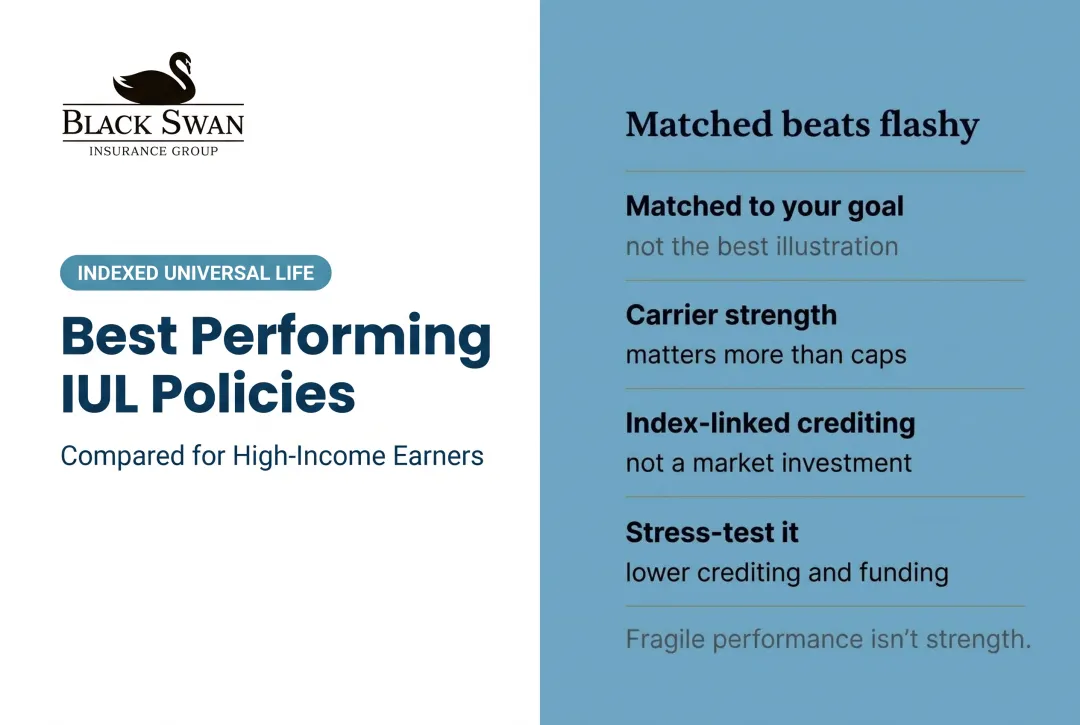
Search "best-performing IUL plans" and you will find lists ranking policies by illustrated return. That is the problem in one sentence: an illustration is not a performance history.
Caps change. Participation rates get adjusted. Carriers revise fee schedules and loan provisions. What looked unbeatable on a hypothetical ledger three years ago may bear no resemblance to what is being credited today.
LIMRA reported $17.5 billion in total U.S. individual life new premium for 2025, with IUL new premium reaching $4.5 billion, up 17% — a sales record, not evidence about which carrier performs best.
The short answer: Future performance cannot be ranked, because the variables that determine it — caps, participation rates, cost of insurance — are mostly non-guaranteed and set by the carrier after you buy. What you can assess beforehand is the guarantee structure, the cost base, the loan mechanics, and how a carrier has treated existing policyholders when it previously cut rates.
Key Takeaways
- Fit hinges on funding capacity, health, horizon, liquidity and comfort with complexity
- Current caps, bonuses and illustrated values are assumptions, not predictions
- Compare guaranteed values, charges, crediting methods and loan terms — not the top-line projection
- Evaluate against term, the 401(k), Roth accounts, brokerage assets and whole life
- A legitimate permanent-insurance need has to come first
What Actually Determines Results
Permanent life insurance with a death benefit, flexible premiums and a cash-value account credited partly by reference to an index — without the policy being invested in it.
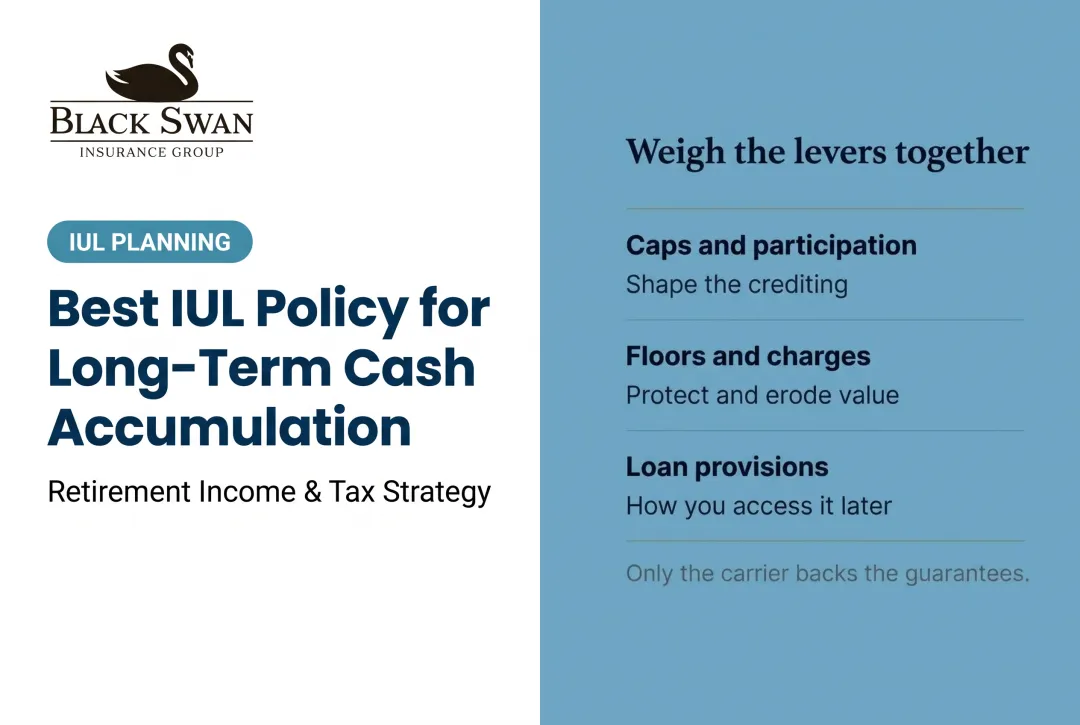
Several mechanisms control the credit: the floor (usually 0%), the cap, the participation rate, the spread under spread-based methods, and the indexing method (annual point-to-point against monthly averaging). Then the fixed-account option, cost of insurance, administrative charges, surrender charges and any bonuses shape the net.
A 0% floor protects against negative index crediting. It does not protect against declining cash value. Insurance costs, fees, loan interest and withdrawals still reduce the account, including in a year the index performs well.
Zero is your hero in a down year — but the floor applies to the credit, not to the charges.

Two policies with identical premiums and death benefits can produce very different outcomes through design, underwriting class, funding allocation and loan treatment.
The carrier issues the contract and pays claims. An independent brokerage compares options and explains trade-offs — it does not control the product.
The Ultimate IUL Blueprint
Before judging any plan on performance, the Blueprint covers what the design has to survive: funding levels, caps and charges, the MEC line, loan timing, and what to demand from an illustration.
Carriers, By Use Case
Research candidates tied to specific uses, not universal recommendations. Confirm current state availability, product version and rates before applying.
Penn Mutual. Two distinct lines, and conflating them is a common error. Protection IUL offers six S&P 500-linked accounts with floors of 0% or 1%, a fixed account at a 1% guaranteed minimum, and an automatic no-lapse rider that applies only while funding requirements are met. Accumulation IUL carries a no-lapse guarantee that is nullified by outstanding loans, with reinstatement possible once repaid. Request guaranteed and non-guaranteed projections under reduced funding before comparing against anyone else — loans affect the two versions differently.
Nationwide. Three products with separate rider schedules; features do not transfer between them. Indexed UL Accumulator III pairs a 0% floor with S&P 500, multi-index, Nasdaq-100, uncapped/spread and BNPP Global H-Factor strategies, plus LTC II, Chronic Illness and Overloan Lapse Protection II riders. New Heights IUL II links to the American Funds Growth Fund of America and an S&P 500 Distance Stabilizer Index. YourLife Indexed UL Protector targets protection buyers — confirm current new-issue availability. The trade-off across the range is complexity: more allocation options means more decisions to manage for decades.
Pacific Life. Pacific Horizon IUL 2 launched April 2024 with eight indexed accounts and three design options — early cash-surrender value, longer-term accumulation, or a balance. It carries a fixed-charge indexed loan with a guaranteed 4.5% loan-interest charge rate, which is a loan cost, not a guaranteed arbitrage advantage. Horizon Survivorship IUL 2 pays after the second death with an automatic no-lapse guarantee extending through the survivor's lifetime under policy conditions.
Lincoln Financial. WealthProtector IUL, WealthAccelerate IUL, WealthBuilder IUL, WealthBuilder ECV IUL and WealthPreserve 2 SIUL. WealthProtector (February 2026) offers an optional Extended No-Lapse Rider II customisable to age 100, a guaranteed policy-value bonus, and enhanced chronic- and terminal-illness riders. WealthBuilder (March 2025) allows allocation across multiple indexed accounts at a 0% floor, with an optional Performance Multiplier Rider at additional cost. Survivorship and estate designs require coordination with a qualified attorney and tax adviser — this article is not a substitute for that.
Protective. Indexed Choice UL closed to new sales effective 9 March 2026, with no replacement identified in the closure notice. That makes it unusable for a current comparison regardless of what any marketing page still displays — worth knowing, because outdated roundups still list it.
John Hancock. Four active versions: Protection IUL, Accumulation IUL, and Protection and Accumulation Survivorship. A stated 0% crediting floor across indexed options, plus Vitality — GO at no cost, PLUS at $2/month single-life or $4/month survivorship. Its own consumer guide carries explicit cautions about cost of insurance, surrender charges and loan-driven lapse risk, which is more candour than most. Availability does not equal lowest cost; verify current charges.

What the Critics Get Right
The entire premise of a "best-performing" ranking deserves the scepticism it attracts.
Performance cannot be ranked in advance. The Protective closure above makes the point better than any argument: a product that appeared on performance lists through 2025 is simply gone, and anyone still recommending it is working from stale material. Caps move, products are withdrawn, and carriers change how they treat in-force policyholders — none of which appears in an illustrated return.
What a comparison can honestly surface are the clauses that decide outcomes: Penn Mutual's guarantee being nullified by a loan, Pacific Life's 4.5% figure being a cost rather than a benefit, Nationwide's riders not transferring between products. Those are knowable now.
How These Were Grouped
Editorial research on verified current information — not a promise any plan outperforms others.
| Carrier | Agency | Rating | Date |
|---|---|---|---|
| Penn Mutual | AM Best | A+ | April 2026 |
| Nationwide Life | S&P | A+ | April 2025 |
| Pacific Life | Moody's | Aa3 | August 2026 |
| Lincoln National Life | AM Best | A | March 2026 |
| Protective Life | AM Best | A+ | September 2025 |
| John Hancock (U.S.A.) | AM Best | A+ | December 2025 |
Complaint data needs caution. A 2024 Kansas Department of Insurance index showed relatively low complaint ratios across most of these carriers, but Nationwide was not listed — and that covers one state, not a national or IUL-specific result. Pull current NAIC data for the exact legal entity issuing your policy.
Policy economics: cost of insurance and premium loads, administrative expenses and surrender charges, rider costs and guaranteed cash values, and how much of each premium dollar actually reaches accumulation.
Crediting beyond the headline cap: participation rates and spreads, floor provisions and indexing method, and whether projections lean on non-guaranteed bonuses.
Stress tests: lower crediting over extended periods, reduced or interrupted premiums, extended loans and withdrawals, rising cost of insurance, and distributions beginning on schedule. Each changes lapse risk and the death benefit differently.
An illustration is a model, not a guarantee.

Stronger Fit
- Earning $150K+ with available funding surplus after reserves, debt and maxed retirement contributions
- A genuine permanent protection, business or legacy need
- Insurable with sufficient time to retirement
- Willing to review the policy annually
Weaker Fit
For late-start high earners and business owners the runway to course-correct is shorter, so weigh insurability, emergency reserves, liquidity and existing 401(k) or Roth contributions against term insurance, whole life and brokerage alternatives first. Step back entirely if funding is unstable, liquidity is needed soon, or the need is temporary — term is cheaper and does that job properly.
Risks to Understand Before You Apply
- Products can be withdrawn, as Protective's closure shows — check current availability, not last year's list.
- Caps, participation rates and bonuses can be lowered after issue, within contract limits.
- A loan can nullify a no-lapse guarantee on some contracts until repaid.
- Cost of insurance rises with age, and underfunding is the leading cause of failure.
- MEC status is generally permanent and changes loan and withdrawal taxation.
- Lapsing with a loan outstanding can create taxable income with no cash received.
Find Out Where You Actually Stand
This starts with the Tax-Free Wealth Blueprint Fit Review. If you earn $150K+ and are comparing plans, we pull current illustrations with both columns, request the full fee and charge report, examine loan provisions and their effect on cash value, verify current carrier ratings, and set the design against at least one alternative strategy. No brokerage can guarantee future crediting, and we will not pretend otherwise. If IUL does not fit, we will tell you that too.
Frequently Asked Questions
What is the best-performing plan?
None, for everyone. Fit depends on funding capacity, health, horizon and goals — and sustainable performance looks very different from an attractive, unguaranteed illustration.
How should I compare plans?
Same death benefit and funding schedule across carriers, then compare guarantees, fees, caps, participation rates, loan provisions and riders using stress-tested values rather than current projections.
Can an IUL lose money?
The floor can prevent negative index crediting in a period. Insurance costs, fees, loans, withdrawals and insufficient premiums can still reduce cash value and cause a lapse.
Are illustrations guaranteed?
No. Current or non-guaranteed values are projections. Review the guaranteed column separately, alongside a lower-performance scenario.
Is it suitable for retirement income?
Some policyholders use properly structured and funded contracts for supplemental income. Suitability depends on coverage need, funding capacity, horizon and coordination with other retirement assets.
How much should I contribute?
It depends on the death benefit, age, health, budget and MEC limits — and on whether you can sustain the premium without crowding out higher priorities.
Sources
- LIMRA — U.S. individual life insurance new premium tops $17.5 billion in 2025
- Protective — Indexed Choice UL closure notice
- NAIC — Life Insurance Illustrations
Disclosure: This article is educational and is not personal tax, legal or investment advice. Indexed universal life is life insurance first. Carrier products, riders, loan terms, ratings and state availability change frequently — products may be withdrawn from sale — and must be confirmed against current carrier materials before applying; ratings reflect an insurer's claims-paying ability, not the suitability of any contract. Illustrated values are not guarantees; actual results depend on policy terms, crediting, costs and funding. Actual results depend on policy design, carrier, crediting options, caps, participation rates, expenses, funding and ongoing management. This strategy is not appropriate for everyone. Policy loans and withdrawals reduce cash value and the death benefit, and can create tax consequences if the policy lapses or becomes a modified endowment contract. Consult your own tax, legal and financial professionals for advice specific to your situation.
And remember, it's not what you earn, it's what you keep… enjoy the ride.