By Robert Balgac, Founder, Black Swan Insurance Group | October 9, 2026
Indexed universal life and variable universal life are both permanent life insurance policies built on the same three features: a death benefit, flexible premiums, and a cash-value component. If you earn $150K+ and someone has put both in front of you, the brochures will look almost identical. The difference that matters is a single mechanism, and it decides how each one fails.
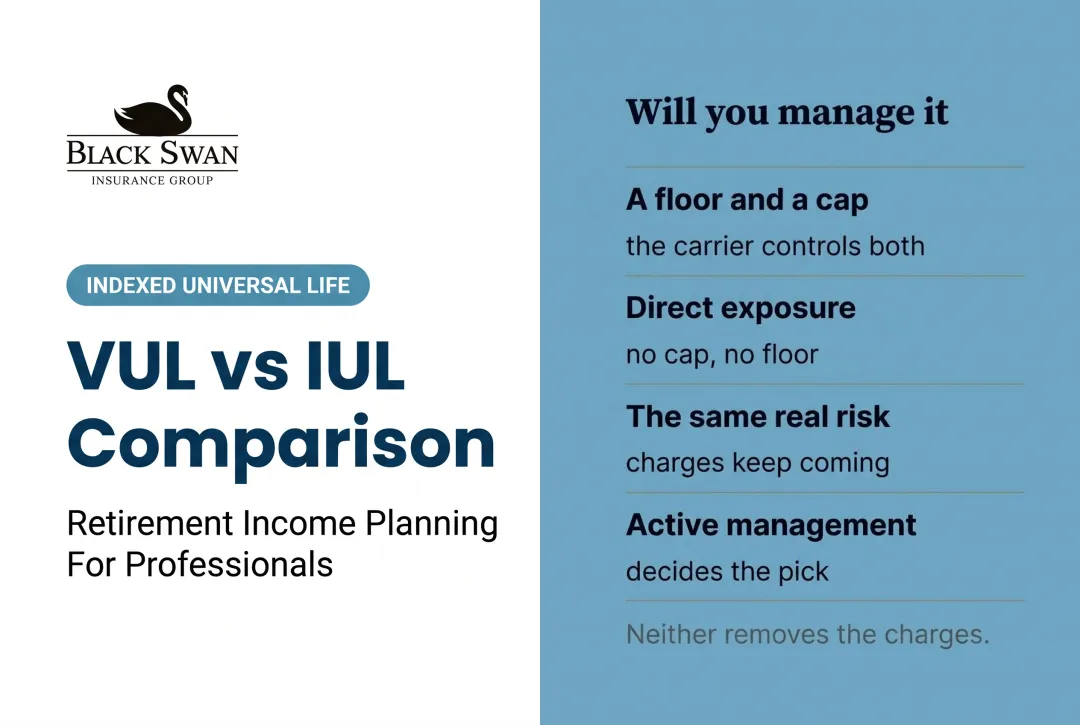
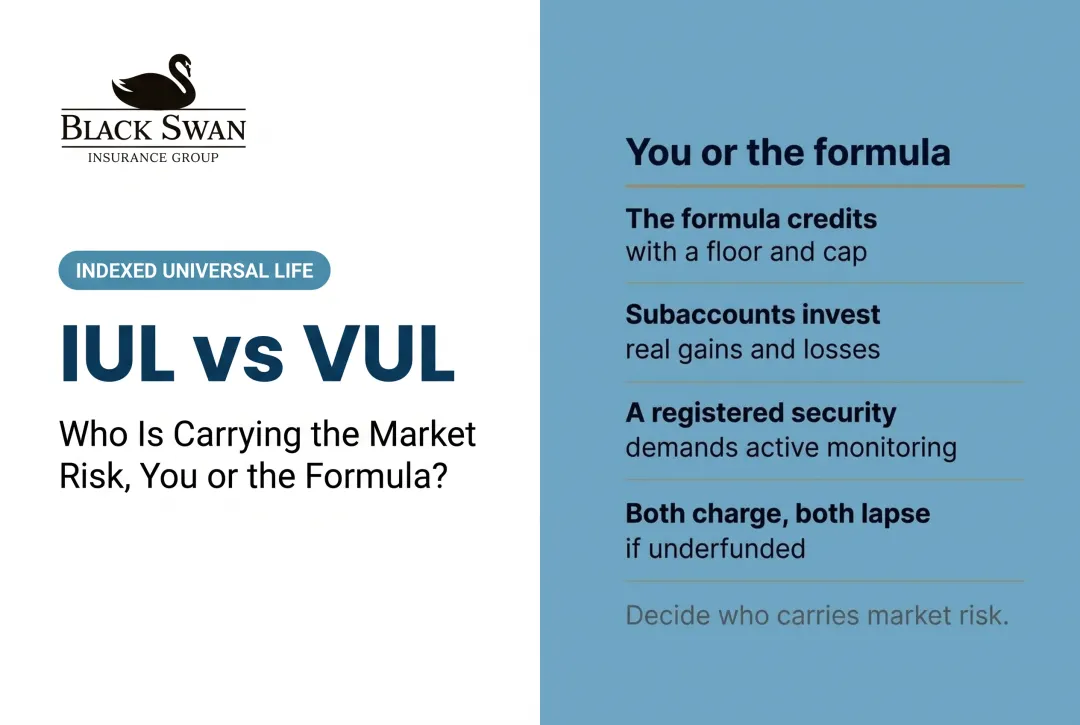
IUL credits interest based on the performance of a market index, using a formula with caps and floors that limit both the upside and the downside. VUL invests your cash value directly into subaccounts resembling mutual funds, so it rises and falls with the market itself.
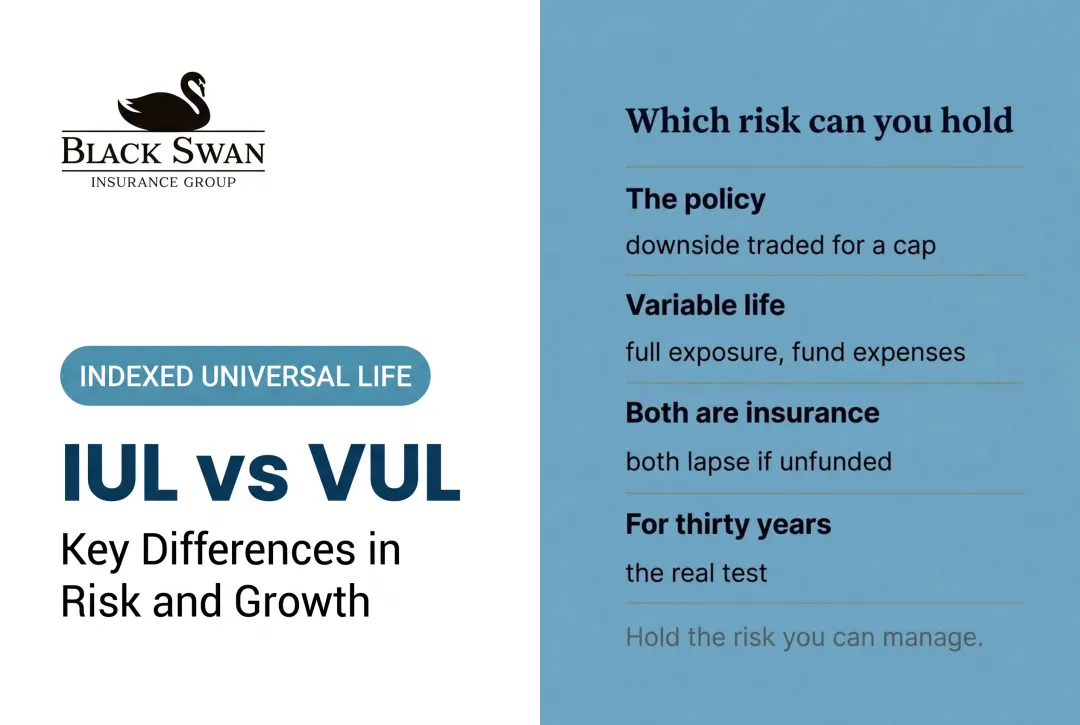
The short answer: IUL hands the crediting decision to the insurer and buys you a floor, paying for it with a cap. VUL hands you the investment decisions and the full downside with them. Neither is safer in the abstract — IUL's risk is that charges and underfunding erode a capped contract; VUL's risk is that a bad decade forces you to pour money in to keep the policy alive. Pick the failure mode you can actually manage.
This is life insurance first, for both. Treating either as an investment account with a death benefit attached is the mistake that precedes most of the bad outcomes below.
Key Takeaways
- Both are permanent life insurance with flexible premiums and cash value — not standalone investment accounts
- IUL suits buyers wanting index-linked growth with a floor on negative index crediting
- VUL suits experienced investors wanting direct subaccount control, accepting that cash value can decline
- The floor protects the credit, not the policy: charges, loans and underfunding still erode cash value
- Fit hinges on death benefit need, time horizon, risk tolerance and reliable long-term funding
The Comparison That Matters
| Factor | IUL | VUL |
|---|---|---|
| Risk exposure | Cash value tracks an index through a crediting formula; a floor limits negative index results | Cash value is invested directly in subaccounts and can lose money |
| Growth potential | Capped by participation rates, caps, or spreads set by the insurer | No cap on subaccount returns, but full exposure to market losses |
| Investment control | Insurer manages the crediting strategy | Policyholder selects and reallocates among stock, bond, or balanced subaccounts |
| Premium/lapse risk | Underfunding, charges, loans, or withdrawals can still cause a lapse | Market downturns can shrink cash value and require added funding |
| Costs & complexity | Cost of insurance, admin fees, surrender charges, plus cap/participation rules to track | Insurance charges, separate-account expenses, admin and surrender costs, plus fund selection |
What the Floor Does and Does Not Do
An IUL floor, often 0%, protects against negative index crediting. It does not protect the policy. Cost-of-insurance charges, administrative fees and policy loans can still erode cash value in a year the floor applies.
Zero is your hero in a down year — but the floor applies to the credit, not to the charges.
VUL has no floor at all. If the subaccounts lose 15% in a bad year, cash value typically reflects that loss directly, on top of ongoing policy charges. That is not a flaw hidden in the fine print — it is the stated design, and buyers who understand it are not the ones who get hurt.
Both products attract serious money. According to LIMRA's 2025 annual sales report, each grew 17% that year, though VUL remains the smaller category at $2.6 billion against IUL's $4.5 billion.

How an IUL Works
IUL is permanent life insurance where credited interest is tied to an external index, such as the S&P 500, without your money being invested in it. The insurer measures index performance over a set period and applies a formula involving:
- Participation rate — the share of index gains credited
- Cap — the maximum rate credited in a period
- Floor — the minimum credited rate, often 0%
- Spread — a deduction some insurers apply instead of, or alongside, a cap
The floor addresses negative index-crediting results specifically. It does not offset insurance costs, administrative charges, loan interest or the effects of underfunding, all of which still reduce policy value over time.
Because IUL is generally not classified as a security, it is typically sold under a state insurance licence rather than broker-dealer registration — a distinction FINRA explains in its consumer guidance. VUL, by contrast, is registered with the SEC, which is why it arrives with a prospectus.
That regulatory asymmetry is worth pausing on. The product with fewer disclosure requirements is the one more aggressively marketed to retail buyers. Draw your own conclusion about what that means for the quality of the sales material you are reading.
IUL typically fits when you need genuine permanent death-benefit protection rather than temporary coverage, your cash flow sustains premiums for the long haul, your horizon runs 15 years or more, you want tax diversification after maxing qualified accounts, and moderate volatility suits your overall profile.
A business owner or high-income professional should still stack IUL against term coverage, 401(k)s, Roth strategies and brokerage accounts. It is one tool in the plan, not a replacement for the others.
How a VUL Works
VUL is permanent life insurance where cash value is allocated among separate investment subaccounts, usually a menu resembling mutual funds. You choose the allocation and performance follows directly from it.
Policy charges apply on top of investment performance: cost of insurance, administrative fees, mortality-and-expense charges and transaction costs. A 2025 SEC-filed VUL prospectus from a major insurer lists all of these charge categories explicitly, along with underlying portfolio expenses tied to each subaccount.

VUL generally appeals if you want control over asset allocation rather than relying on an insurer's crediting formula, accept that cash value can swing hard or decline, and are comfortable monitoring and rebalancing for decades.
It fits when you have a real permanent insurance need, a long horizon, high risk tolerance, genuine investment knowledge, and enough liquidity to keep funding through a downturn — which is precisely when you will least want to.
It is a poor fit if you want predictable cash value, need near-term access to funds, lack emergency reserves outside the policy, or are counting on the contract to replace a diversified retirement strategy.
The Ultimate IUL Blueprint
If you are comparing these two, the Blueprint covers what an IUL design has to survive: funding levels, caps and charges, the MEC line, loan timing, and what to demand from an illustration.
What the Critics Get Right
The strongest criticism of this comparison is that both products are frequently sold to people who should own neither.
Critics point out, correctly, that the layered charges in a VUL — insurance costs plus mortality-and-expense plus subaccount expense ratios — make it an expensive wrapper for market exposure you could buy far more cheaply in a brokerage account. They point out, equally correctly, that an IUL's cap transfers most of a strong market year to the insurer while the policyholder keeps all the charges. And they note that both are sold on projections that regulators have repeatedly had to rein in.
All of that is fair, and it is why the first question below is whether you need permanent coverage at all.
What the criticism skips is the buyer who has already exhausted the cheap options and has a protection need that does not expire. For that person the question is not "insurance or investing" — it is which permanent structure they can keep funded and monitored for forty years. That is a narrower question, and it has a real answer.
A great IUL is engineered. A bad IUL is sold.
Which One Fits
Neither wins by default. Start with whether you need permanent life insurance at all, and how much belongs in the plan. Only then does the cash-value comparison matter.
Match the Product to Risk Tolerance and Horizon
- IUL if you value less direct market downside and accept capped upside for a steadier crediting profile
- VUL if you want direct investment control, accept volatility for uncapped upside, and will hold through down years without flinching
Stress-Test Funding Capacity
Before committing to either, assess income stability and surplus cash flow, emergency reserves outside the policy, existing 401(k)/IRA/Roth contributions, business liquidity needs, and your ability to keep funding through a downturn or a career change.
A policy that looks excellent on paper falls apart quickly when funding stops in a rough year — and rough years are not optional.
Read the Illustration Like a Sceptic
Illustrations show non-guaranteed, projected values, not promises. Regulators have tightened this: the NAIC's Actuarial Guideline 49-A, updated as recently as 2023 and 2026, narrowed how aggressive illustrated IUL rates can be. Even so:
- Separate guaranteed from illustrated values
- Check current caps, participation rates and spreads against historical ranges
- Model a lower-crediting or higher-cost scenario, not the best case
- Review surrender schedules and loan provisions
- Confirm the death-benefit option fits your goals
An illustration is a model, not a guarantee.

Stronger Fit
- IUL — permanent protection needed, less direct market exposure preferred, capped upside acceptable, $150K+ income with dependable surplus
- VUL — permanent protection needed, high risk tolerance and real investment experience, prepared to manage market exposure and variable funding
Weaker Fit
Not everyone should buy either one. Consider neither if you mainly need cheap temporary coverage — term is the right product and costs a fraction — or if cash flow is tight, reserves are thin, or either policy would crowd out more urgent retirement and protection priorities.
One more thing that applies to both: cash value generally grows tax-deferred, and loans may receive favourable tax treatment, but only while the policy stays in force and is not classified as a Modified Endowment Contract. A lapse or surrender with an outstanding loan can create taxable income. Rules are contract-specific, so confirm design and tax treatment with a licensed tax advisor.
Two Scenarios Worth Recognising
The high-income professional prioritising protection. A 42-year-old physician with stable six-figure income, a mortgage, two children and a maxed 401(k). She wants permanent protection plus tax diversification, and does not want this particular bucket swinging with the market. Strong funding capacity, long horizon, moderate risk tolerance for this money. That profile warrants a closer look at IUL alongside the Roth strategies and brokerage investing she already uses.
The business owner comfortable with market exposure. A 48-year-old agency owner who already manages a diversified brokerage account and has lived through market cycles. He wants permanent coverage but would rather control subaccount allocation directly and accept the volatility. He has liquidity outside the business and the discipline to keep funding in a down year. That points toward a VUL conversation — with the same scrutiny on charges, subaccount expenses and funding sustainability.

Neither scenario predicts performance. They illustrate fit, not results.
Before applying for either, confirm the permanent death-benefit need is real and sized correctly, that you have compared guaranteed against current illustrated values, stress-tested a lower-return and higher-cost scenario, understood fees, surrender charges and loan terms, and had a licensed insurance, investment and tax professional review the plan.
This is not set-it-and-forget-it. It is design-it, fund-it, review-it.
Risks to Understand Before You Choose
- VUL cash value can fall directly with the market, and a sustained drawdown can require extra premium to keep the contract alive.
- IUL upside is capped, and caps and participation rates can be lowered after issue, subject to contract minimums.
- Cost of insurance rises with age in both, which is the mechanism behind most late-life lapses.
- Layered charges compound. VUL adds subaccount expenses and mortality-and-expense charges on top of insurance costs.
- Surrender charges run for years; an early exit from either returns less than you paid in.
- The loan is not the problem. The unmanaged loan is the problem.
- MEC status is generally permanent and removes the tax-advantaged living access either policy was bought for.
Find Out Where You Actually Stand
This starts with the Tax-Free Wealth Blueprint Fit Review. If you earn $150K+ and are weighing IUL against VUL, we settle the permanent-coverage question first, then compare designs side by side, read guaranteed against illustrated values, price the full charge stack on each, and stress-test both through lower-return and reduced-income years. If term solves your problem, we will say so. If IUL does not fit, we will tell you that too.
Frequently Asked Questions
What's the difference between an IUL and a VUL?
An IUL credits cash value based on an external index using caps, participation rates and a floor. A VUL invests cash value directly in separate accounts that rise and fall with the market, with no floor against losses.
Why do wealthy people use IULs?
Some high-income individuals use them for permanent death-benefit protection, tax-deferred cash-value growth and tax diversification after maxing other accounts. Wealth alone does not make an IUL the right fit — funding capacity and a genuine permanent need still decide it.
Is IUL safer than VUL?
IUL generally carries less direct market-loss exposure because of its floor. Fees, cost of insurance, loans, withdrawals and underfunding can still weaken the policy badly, so it is not free of risk.
Can you lose money in an IUL?
Yes. Negative index performance typically will not push credited interest below the floor, but total policy value can still decline through charges, loans, withdrawals or insufficient premiums — and that decline can end in a lapse.
What are the disadvantages of VUL?
Direct market-loss exposure, layered investment and insurance expenses, and ongoing management demands. Poor performance can require additional funding simply to keep the policy active.
How do I choose between an IUL and a VUL?
Compare your permanent insurance need, risk tolerance, time horizon, funding capacity, policy charges and preference for investment control. Have a qualified insurance and tax professional review the specific contract before deciding.
Sources
- LIMRA — 2025 U.S. individual life insurance new premium report
- FINRA — Insurance products
- SEC EDGAR — variable universal life prospectus (2025)
- NAIC — Life Insurance Illustrations
Disclosure: This article is educational and is not personal tax, legal or investment advice. Indexed universal life is life insurance first. Variable universal life is a registered security sold by prospectus; read it before investing. Product features, charges and availability vary by carrier and state, and all guarantees are subject to the issuing insurer's claims-paying ability. Illustrated values are not guarantees; actual results depend on policy design, carrier, crediting options, caps, participation rates, expenses, funding and ongoing management. This strategy is not appropriate for everyone. Policy loans and withdrawals reduce cash value and the death benefit, and can create tax consequences if the policy lapses or becomes a modified endowment contract. Consult your own tax, legal and financial professionals for advice specific to your situation. Any potential tax-advantaged access depends on the policy being properly structured, funded and managed.
And remember, it's not what you earn, it's what you keep… enjoy the ride.