By Robert Balgac, Founder, Black Swan Insurance Group | October 9, 2026
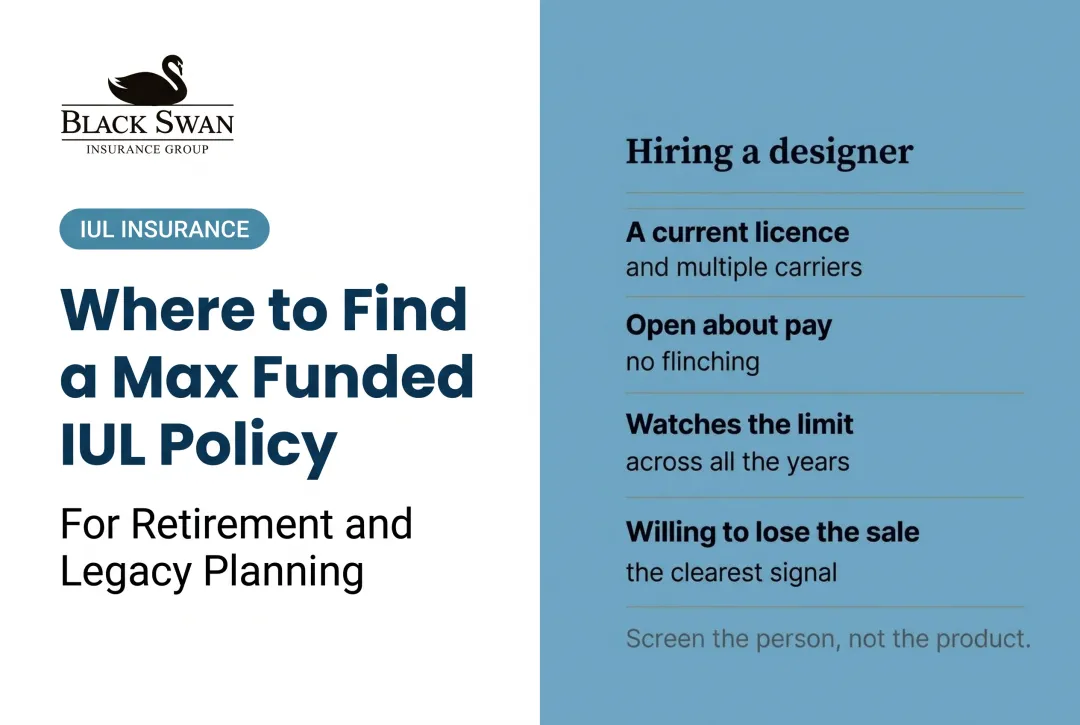
"Max-funded IUL" is marketed as though it were a product with a shelf, a brand and a price tag. It is not. It is a funding strategy applied to an indexed universal life contract, and dozens of U.S. life insurers issue policies that can be structured this way. Nobody sells a "max-funded IUL". Carriers sell IUL; the funding design is something your agent builds — well or badly.
That matters if you earn $150K+, have captured the employer match, maxed the 401(k) and run into the Roth phase-outs. You are the profile this gets pitched to hardest, and the profile most likely to be shown a cap rate instead of a cost structure.
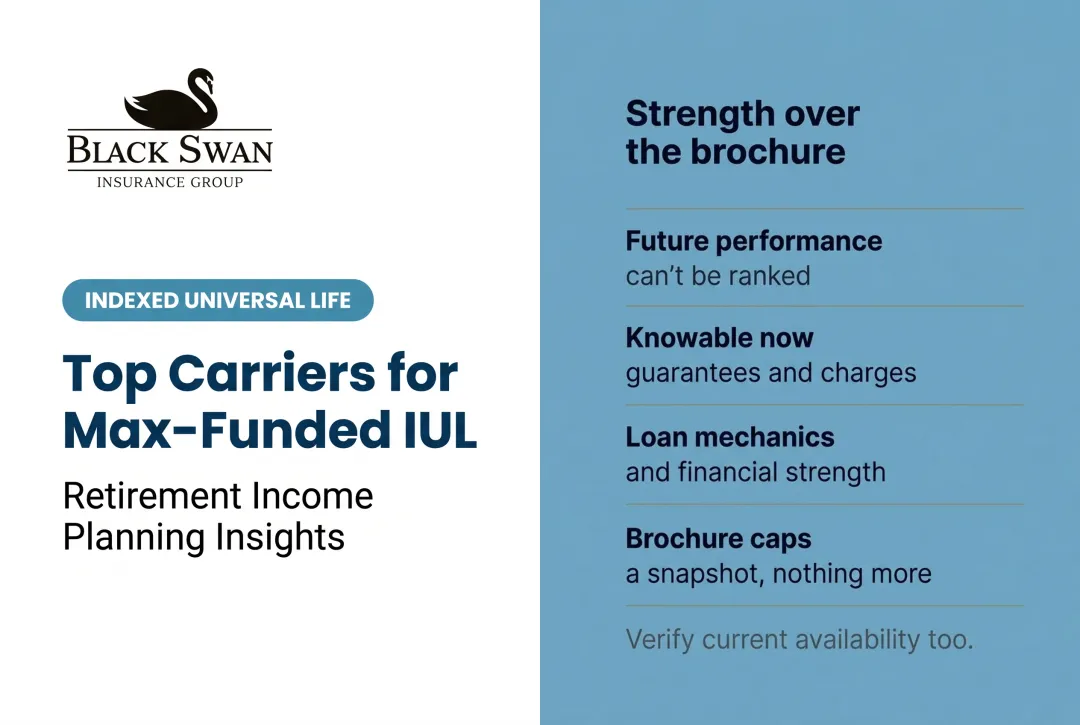
The short answer: The carrier question is the second question. First decide whether you need permanent life insurance and whether you can sustain high premiums for decades. Only then does it matter that Nationwide, Pacific Life, Lincoln, Allianz and Mutual of Omaha all issue IUL contracts that accept high-premium funding. The right answer is the carrier whose guarantees, charge schedule and loan provisions survive a pessimistic illustration — not the one with the highest advertised cap.
Key Takeaways
- Max funding pushes premium toward cash value while staying under Modified Endowment Contract limits — it is a design choice, not a product category
- Many established U.S. insurers issue suitable contracts; availability, index menus and underwriting rules vary by state and change over time
- Weigh guarantees, the full charge schedule and loan terms, not current illustrated performance
- Compare carriers on identical premium, death benefit, underwriting class and conservative assumptions, or you are not comparing anything
- Use this beside a 401(k), Roth and emergency reserves, never as a replacement for them
What "Max-Funded" Actually Describes
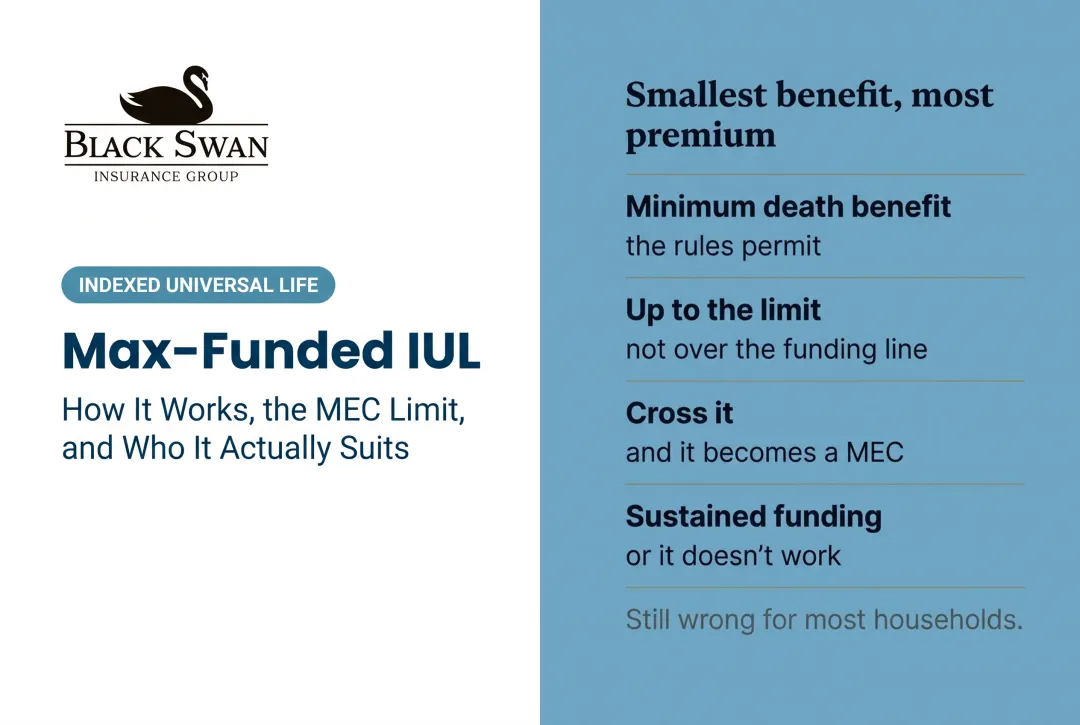
A max-funded IUL is a permanent life insurance policy written with a relatively high premium and a death benefit deliberately sized down, so more of each dollar reaches cash value while the contract stays inside IRS and policy-specific limits.
Where Each Premium Dollar Goes
Carriers split every premium across several buckets:
- Cost of insurance — the mortality charge for the death benefit
- Administrative and premium loads — carrier fees for issuing and servicing the contract
- Rider charges — costs for optional benefits such as chronic-illness riders
- Cash value allocation — what remains after charges, credited based on index performance
A smaller death benefit, within MEC limits, usually means lower insurance costs and more premium available for accumulation. Design decisions made at issue affect early cash value for years afterwards, and most of them cannot be undone cheaply.
The Seven-Pay Test
Under IRC Section 7702A, a policy becomes a Modified Endowment Contract if cumulative premiums exceed the statutory seven-pay limit within the first seven contract years. Once that happens, loans and withdrawals are generally taxed income-first, with a possible 10% penalty before age 59½, per IRS Revenue Ruling 2007-38.

There is no single dollar figure that applies to everyone. The threshold moves with the insured's age, health class, death benefit and the carrier's own policy design. This is precisely why "how much should I put in?" has no answer until a specific contract exists.
Caps, Participation Rates and Floors
Even inside the premium limits, growth depends on the carrier's crediting rules: the cap rate limits credited interest, the participation rate sets what share of index gain applies, the floor — often 0% — sets the minimum credit, and a spread is deducted before interest is credited.
None of these stops net cash value from declining once charges, loans or withdrawals come out. Overfunding beyond what you can actually sustain raises lapse, liquidity and tax risk rather than lowering it.
Zero is your hero in a down year — but the floor applies to the credit, not to the charges.
How to Evaluate the Carriers
Choosing on the strength of an illustration is how people end up disappointed a decade later. Here is what separates carriers in practice.
Guaranteed Against Non-Guaranteed
Every NAIC-compliant illustration carries two columns. The NAIC Life Insurance Buyer's Guide warns specifically that some cash-value policies carry low values in the early years — which is why you demand the illustration before signing, not after.
Compare, at identical durations: guaranteed cash value against projected cash value; guaranteed death benefit against current assumptions; current caps and participation rates against historical averages; and any bonus or multiplier, noting whether it is contractual or discretionary.
An illustration is a model, not a guarantee.
Internal Costs and Loan Design
Request the full charge schedule — cost of insurance, premium loads, administrative fees, rider costs, surrender charges. These compound, and they decide how much cash value survives the early years.
Loan provisions deserve their own interrogation. Is the loan rate fixed or variable? Does collateral stay in an indexed strategy or move to a declared rate? Can the credited rate on loaned value ever exceed the rate charged? What happens to the death benefit if the loan balance compounds faster than cash value?
FINRA has flagged that policy loans can require additional premium simply to keep coverage from lapsing, and that an outstanding loan at surrender can trigger a tax bill nobody planned for (FINRA — Should You Exchange Your Life Insurance Policy?).
The loan is not the problem. The unmanaged loan is the problem.
Stress-test every proposal under lower crediting, skipped premiums and extended retirement withdrawals before trusting it.

Financial Strength and In-Force Behaviour
Check the issuing insurer's financial-strength rating. An A+ from AM Best reflects claims-paying ability. It says nothing about future index crediting, and nothing about how that carrier has historically treated existing policyholders when caps were renewed downward.
The Ultimate IUL Blueprint
Before you shortlist a carrier, the Blueprint covers what the design has to survive: funding levels, caps and charges, the MEC line, loan timing, and exactly what to demand from an illustration.
Carriers Worth Researching
Many established U.S. insurers issue IUL products suited to high-cash-value funding. Availability, index menus and underwriting rules vary by state and change over time, so treat this as a starting point for research, never a fixed list.
| Carrier | Product | Design focus | Notes |
|---|---|---|---|
| Nationwide Life and Annuity | Indexed UL Accumulator III | Cash growth, target ages 30–55 | Riders vary by state |
| Pacific Life | Pacific Horizon IUL 2 | Choice of early cash value or long-term accumulation | Not available in New York |
| Lincoln National Life | WealthBuilder ECV IUL | Built-in early cash value features | Excludes New York |
| Allianz Life | Life Accumulator IUL | Accumulation with chronic-illness rider option | State approval varies |
| Mutual of Omaha (United of Omaha) | Income Advantage IUL | Retirement supplementation, optional living benefits | Features vary by state |
Independent brokerages typically hold appointments with several carriers rather than one. Black Swan Insurance Group works with carriers including F&G Annuities and Life, Corebridge, Gerber Life Insurance, American and Transamerica, which is what makes side-by-side design comparison possible instead of a single house brand.
Organise by Objective, Not Ranking
Rather than asking who is best, ask which carrier fits the job: early cash-value-focused designs for accumulation; stronger guaranteed death-benefit riders for protection; loan provisions built for the distribution phase if the point is retirement income; accelerated or living-benefit riders for chronic-illness planning; joint-life or second-to-die structures for survivorship needs.
Current caps, participation rates, bonuses and loan rates can all change after issue. The guaranteed minimum interest rate and the guaranteed cost-of-insurance cap cannot. Know which number you are looking at before you compare anything.
What the Critics Get Right
The strongest criticism of carrier round-ups like this one is that they answer a question most readers should not be asking yet.
Someone searching for who offers max-funded IUL has usually already been told the strategy is right for them, and is now shopping venues. The harder question — whether a permanent death-benefit need exists at all, and whether the cheaper buckets are full — gets skipped. Critics are also right that illustrations have historically been used to flatter products, that cost of insurance rises with age, and that the person presenting the design is often paid on the premium.
The answer is not to avoid the product. It is to compare carriers on identical conservative assumptions and to insist on being told when the answer is no.
Who This Fits
Stronger Fit
- High-income professionals, executives and practice owners with a genuine permanent protection need
- Stable surplus cash flow after reserves, debt and maxed retirement contributions
- Affluent families balancing protection, liquidity and legacy goals
- A long enough runway to absorb early charges, plus willingness to review annually
Weaker Fit
Not everyone should buy this. Wait or choose something else if you have income that fluctuates year to year, near-term liquidity needs such as a home purchase or tuition within two to three years, no real permanent death-benefit need, thin emergency reserves, or a preference for uncapped market exposure without a floor.
A term policy, a 401(k) with a match, a Roth IRA and a taxable brokerage account each do a job an IUL does not. None of them replaces the others, and an IUL does not replace them either.
Late-Start High Earners
Starting at 50 is not starting at 35. The compressed funding period has to still produce a meaningful death benefit; underwriting at that age has to still support affordable insurance costs; and a Roth conversion or taxable brokerage account may simply be more practical with a shorter runway.

Risks to Understand Before You Choose a Carrier
- Caps and participation rates can be lowered after issue, subject only to contract minimums — a carrier's current cap is a renewal decision, not a promise.
- Cost of insurance rises with age, so a design that works at 45 can strain at 70 if funding never changed.
- Crossing the MEC line is generally permanent and changes the tax treatment of every loan and withdrawal that follows.
- Underfunding is the leading cause of failure. Flexible premiums are flexible until the policy needs them.
- Lapsing with a loan outstanding can create taxable income with no cash received.
- State availability and product forms change, so any carrier list, including this one, ages quickly.
Find Out Where You Actually Stand
This starts with the Tax-Free Wealth Blueprint Fit Review. If you earn $150K+ and you are comparing carriers, we work through the protection need first, then model your funding against the MEC limit, stress-test it under lower crediting and zero-credit years, and put competing carrier designs side by side on the same premium, death benefit and underwriting class — with the charges and loan assumptions in plain numbers. If the answer is a term policy and a brokerage account, we will say so. If IUL does not fit, we will tell you that too.
Frequently Asked Questions
Which insurance companies offer max-funded IUL policies?
Multiple U.S. carriers, including Nationwide, Pacific Life, Lincoln, Allianz and Mutual of Omaha, issue IUL products suited to high-premium funding. Availability and features vary by state, so compare current policy forms rather than a static list.
How do I actually get one?
Confirm you have a genuine permanent insurance need, complete underwriting, then compare illustrations from multiple carriers. The design should fund as much as you can sustain without crossing into MEC status.
Is a max-funded IUL better than a 401(k)?
They do different jobs. A 401(k) offers employer matching and tax-deferred growth with contribution limits; an IUL offers permanent protection plus potential tax-advantaged access when properly structured, funded and managed. Do not redirect matched 401(k) dollars into an insurance premium.
Is a max-funded IUL a good idea?
It depends on your permanent coverage need, income stability, time horizon, health and willingness to manage the policy for decades. A stress-tested comparison across carriers usually makes the answer obvious either way.
What should I compare before choosing a carrier?
Guaranteed against current assumptions, the full cost structure, crediting methods, loan provisions, MEC margin, financial strength, and how the design performs under reduced funding.
Sources
- IRS — Revenue Ruling 2007-38
- NAIC — Life Insurance Buyer's Guide
- FINRA — Should You Exchange Your Life Insurance Policy?
Disclosure: This article is educational and is not personal tax, legal or investment advice. Indexed universal life is life insurance first. Carrier names, product names and availability are illustrative and change by state and over time; nothing here is a recommendation of any specific contract. Illustrated values are not guarantees; actual results depend on policy design, carrier, crediting options, caps, participation rates, expenses, funding and ongoing management. This strategy is not appropriate for everyone. Policy loans and withdrawals reduce cash value and the death benefit, and can create tax consequences if the policy lapses or becomes a modified endowment contract. Consult your own tax, legal and financial professionals for advice specific to your situation.
And remember, it's not what you earn, it's what you keep… enjoy the ride.