By Robert Balgac, Founder, Black Swan Insurance Group | October 9, 2026
If you earn $150K+ and you have been handed an illustration with the words "fully funded" on it, the first thing worth knowing is that the phrase has no fixed meaning. It is not a regulatory term. It is not defined in the contract. Two advisers can use it in the same week to describe two materially different funding strategies, and only one of them will match what you thought you were buying.
That matters because the adjacent terms — max funded, overfunded, MEC — are also used loosely, and one of them is an actual tax classification with permanent consequences. Getting the vocabulary straight is not pedantry. It is the difference between a policy that does what you planned and a 1099 you did not expect.
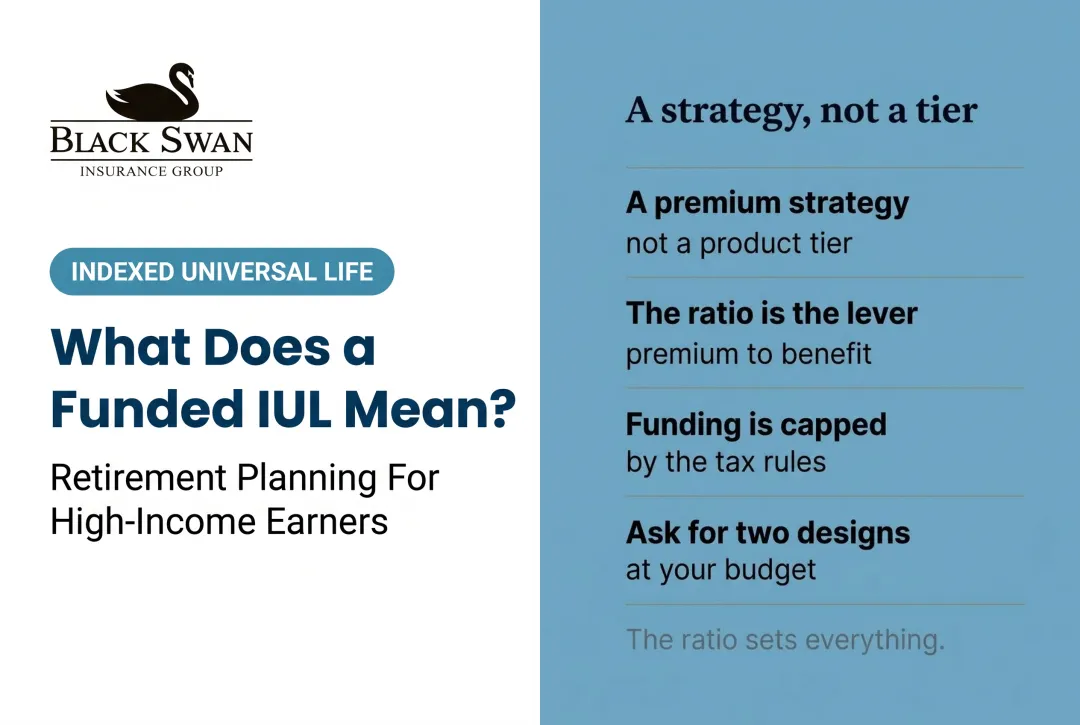
The short answer: "Fully funded" usually means you are paying the premium the policy illustration was built around — nothing more. It is not the same as max funding toward the legal non-MEC ceiling, and it is not a promise of growth. Ask whichever adviser used the phrase which definition they mean, in writing, before you agree to a schedule.
This is life insurance first. The cash value is second, and potential tax-advantaged access when properly structured, funded and managed is third.
Key Takeaways
- Fully funded generally means meeting the planned premium schedule — not funding to the legal maximum
- Premiums cover cost of insurance and charges before cash value accumulates
- Crediting is shaped by caps, participation rates, spreads and floors, and most of those are non-guaranteed
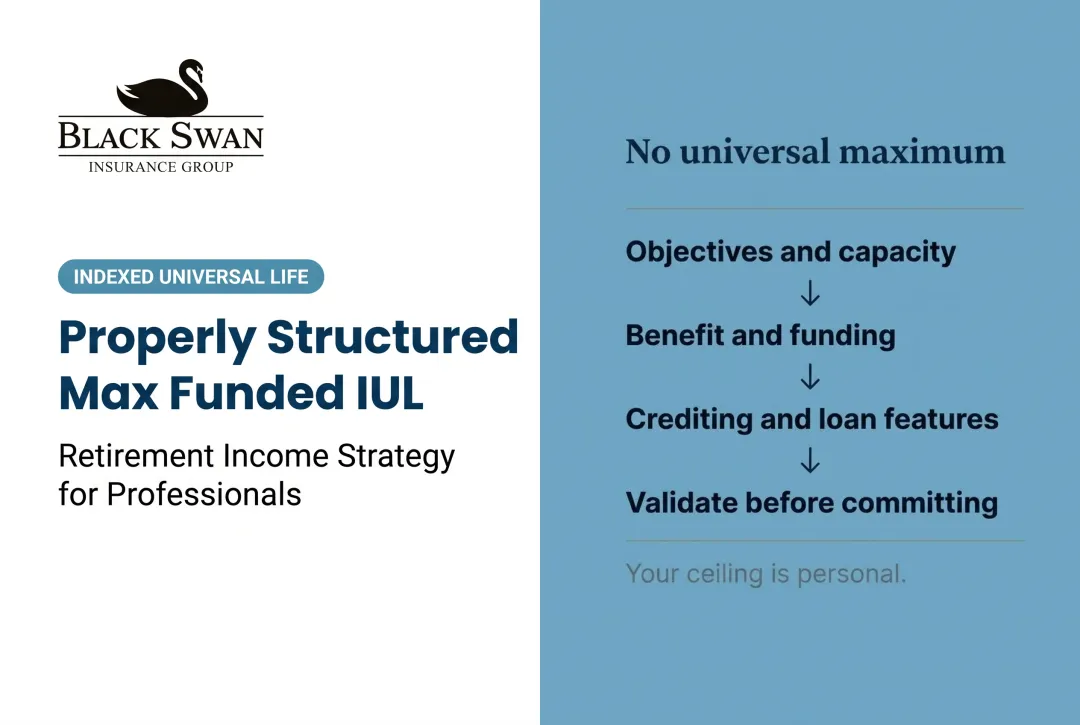
- Contribution room depends on your death benefit, age, health and carrier rules — there is no universal dollar figure
- Loans and withdrawals reduce available value and can create tax consequences if mismanaged
- This should complement your 401(k), IRA, emergency fund and existing coverage, never replace them
Four Words, Four Different Meanings
Indexed universal life is permanent life insurance with flexible premiums, a lifelong death benefit and a cash value account whose growth is linked to an index such as the S&P 500. The insurer calculates a credit based on index performance. Your money is never invested in the index.
In this article, "fully funded" means meeting the planned premium schedule the policy was designed around. Some agents use the phrase to describe pushing premiums close to the legal non-MEC ceiling. That is a meaningfully different strategy with a different risk profile.

Here is how the terms actually differ:
- Fully funded — paying the premium the illustration was built around
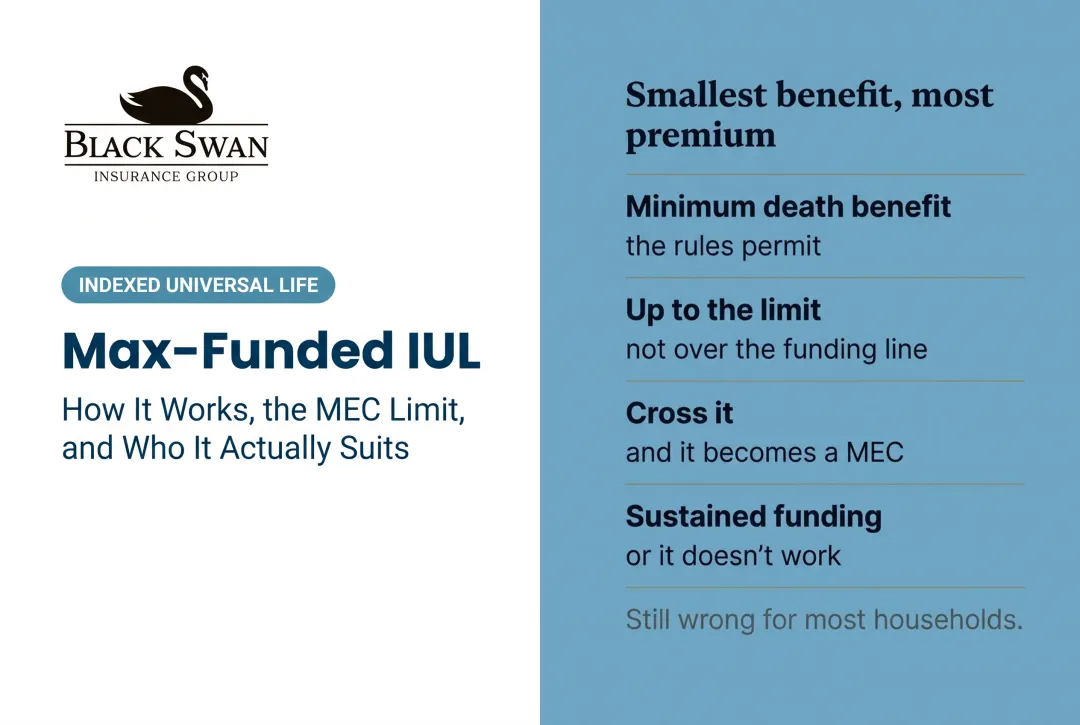
- Max funded — paying as much as the tax rules allow while preserving life insurance tax treatment
- Overfunded — ambiguous. It can mean paying more than planned, or it can mean crossing into MEC territory. Context decides.
- MEC — a tax classification triggered when cumulative premiums exceed the IRS seven-pay limit, regardless of what anyone calls the funding strategy
A fully funded IUL is not a brokerage account, not direct index ownership and not a guaranteed-return investment. It is also not an automatic substitute for a 401(k), a Roth IRA or a term policy. People consider it for permanent protection, potential tax-deferred cash value growth, flexible access to that value, and diversification of future income sources. None of it is automatic. All of it depends on consistent funding, insurance costs, crediting terms and the policy staying in force.
Separate the guaranteed column from the non-guaranteed assumptions before anything else. They tell very different stories.
How the Money Actually Moves
Design and underwriting, premium payment, deductions, cash value allocation, index crediting, monitoring, and eventually access or death benefit. Each step changes what you can contribute and what you will actually see.

Design Sets the Room
Age, health, desired death benefit, planned premium and funding period together determine how much contribution room exists. A policy built primarily to accumulate cash value uses a different death benefit structure from one built primarily for family protection.
A hypothetical 45-year-old choosing a lower initial death benefit relative to premium may create more funding room than the same person choosing a higher death benefit — though this varies by carrier and underwriting class. Illustrated numbers are a model built on current assumptions, not expected results.
Charges Come Out First
Premiums do not flow entirely into cash value. Before anything accumulates, the policy deducts cost of insurance based on age, health and death benefit; administrative charges; rider costs if elected; and surrender charges, particularly in early policy years.
A design built for a larger death benefit carries different insurance costs from one built to prioritise cash value growth — and charges are not identical across carriers or products. Read the illustration's premium allocation, guaranteed charges and current non-guaranteed charges side by side.
Crediting, and the Floor Everyone Misreads
Four mechanics set your credit: the cap (the maximum rate credited), the participation rate (the percentage of index growth applied), the spread (a deduction taken before crediting) and the floor (the minimum crediting rate, often 0%).
Here is the part that gets missed: a 0% floor protects against a negative index credit, not against declining cash value. Charges, loans and withdrawals can still reduce your account in a year the floor applies. Caps and participation rates are non-guaranteed, and carriers can adjust them within contract limits.
Zero is your hero in a down year — but the floor applies to the credit, not to the charges.
The NAIC requires illustrations to separate guaranteed from non-guaranteed elements under its Life Insurance Illustrations Model Regulation, and AG 49-A guidance, with revisions effective through 2026, further constrains how optimistic an IUL illustration may look. That regulation governs what can be shown. It says nothing about what the policy will earn.
Where the Ceiling Comes From
There is no universal dollar limit for IUL premiums. Room depends on your death benefit, age, health classification, funding pattern and carrier rules, layered on federal tax tests under Sections 7702 and 7702A.
The seven-pay test compares cumulative premiums in the first seven policy years against a limit specific to that contract. Exceed it and the policy becomes a MEC, changing how loans and withdrawals are taxed from then on.
Before increasing premium on an existing policy:
- Request an updated in-force illustration showing current values
- Confirm remaining non-MEC funding room with the carrier, in writing
- Ask when the seven-pay testing period resets — material changes can restart it
- Involve a tax professional before committing to a larger premium
Accessing the Money
Withdrawals and loans are not the same thing. A withdrawal reduces cash value and death benefit directly. A loan creates debt against the policy, accrues interest and reduces what is available, even though you retain ownership of the underlying value.
Tax treatment depends on whether the policy stays in force, its MEC status and your basis. The IRS illustrated the stakes in Revenue Ruling 2009-13: a policyholder who surrendered a contract for $78,000 against $64,000 of basis owed ordinary income tax on the $14,000 gain.
That is a surrender example rather than a loan example, and it still shows how quickly a casual "it's tax-free" assumption unravels once a policy lapses or is surrendered with gain above basis.
Lapse risk is real, especially with loans outstanding. If charges and loan interest outpace crediting, a heavily loaned policy can collapse and the forgiven balance can become taxable income. Ask whether your carrier offers an overloan protection rider and what conditions apply.
The loan is not the problem. The unmanaged loan is the problem.
The Part Nobody Sells You
An annual review should test current premium capacity against your actual cash flow, actual charges versus those originally illustrated, crediting assumptions against recent performance, outstanding loan balances and interest accrual, and whether your protection needs or income goals have changed.
Keep the original illustration, the contract, annual statements, premium history and loan statements. You need them to see drift between the plan and reality, and drift is cheap to fix early and expensive to fix late.
The Ultimate IUL Blueprint
If you are deciding how hard to fund, the Blueprint walks through what a design has to survive: funding levels, caps and charges, the MEC line, loan timing, and what to demand from an illustration before you sign it.
What the Critics Get Right
The fair criticism is that vague language serves the seller. "Fully funded" sounds like completion. It sounds like the policy is finished, safe, done. In practice it means only that you are currently paying what someone modelled, under assumptions that are mostly non-guaranteed, in a contract whose charges rise with age.
The second fair point: the person recommending a higher funding level earns more when you fund more. That is a real conflict and pretending it does not exist insults your intelligence.
What the criticism misses is that every number involved is knowable. The guaranteed column exists. The seven-pay limit is calculable. The current charge schedule is printed. The failures in this product are almost always failures to ask, not failures of the product to disclose.
Where This Fits, and Where It Does Not
LIMRA reported a record $4.5 billion in new IUL premium in 2025, up 17% year over year with policy counts up 8%, and is forecasting continued double-digit growth into 2026. Strong sales prove the product is popular. They prove nothing about whether it suits your household.
| Tool | Primary purpose | Key trade-off |
|---|---|---|
| Fully funded IUL | Permanent protection + potential tax-advantaged cash value | Crediting is capped; charges apply regardless of market performance |
| Term life | Low-cost protection for a set period | No cash value to access later |
| Whole life | Permanent protection with fixed premiums | Less funding flexibility than IUL |
| 401(k) | Tax-advantaged retirement savings | Contribution limits and distribution rules |
| Roth IRA | Tax-free qualified retirement withdrawals | Annual limits and income phase-outs |
| Taxable brokerage | Direct investment exposure, full liquidity | Capital gains tax on sales; no protection |
| Cash reserves | Immediate liquidity | No growth potential, no protection |

Stronger Fit
- Earning $150K+ with a genuine permanent insurance need, not just an accumulation goal
- Stable surplus cash flow above maxed retirement contributions
- Solid emergency reserves held outside the policy
- A long horizon and the willingness to review the policy annually
- Business and practice owners building assets outside the company
Weaker Fit
This strategy is not appropriate for everyone. Walk away, for now or for good, if:
- You only need low-cost protection for a defined period — buy term
- You may need the money within a few years
- Cash flow is inconsistent enough that a multi-year schedule is a guess
- High-interest debt or emergency savings still need attention first
- You cannot qualify on reasonable underwriting terms
- You want uncapped, direct market exposure — this product does not provide it
Risks to Understand Before You Commit to a Funding Level
- Charges continue in flat years. The floor limits the credit, not the cost of insurance, administrative charges or surrender charges.
- Caps and participation rates can change. What is illustrated today is not contractually fixed for life.
- MEC status is generally permanent. Crossing the seven-pay line changes loan and withdrawal taxation for good.
- Underfunding is its own failure. Backing off premium to stay clear of the line can leave the policy too thin to survive rising insurance costs later.
- Lapse with a loan outstanding can create taxable income with no cash arriving to pay it.
- The illustration is a model. An illustration is a model, not a guarantee.
Find Out Where You Actually Stand
This starts with the Tax-Free Wealth Blueprint Fit Review. If you earn $150K+ and someone has told you a policy is "fully funded," we establish which definition they used, confirm the remaining non-MEC room with the carrier, stress-test the schedule against a weak income year rather than a strong one, and read the guaranteed column alongside the illustrated one. Then we tell you whether the funding level you are considering is the right one. If IUL does not fit, we will tell you that too.
Frequently Asked Questions
How much money can I put in an IUL?
It depends on your age, health, death benefit, carrier rules and the applicable MEC limit. There is no universal maximum. Get a current carrier illustration and talk to a tax professional before increasing premium.
What does "fully funded" actually mean?
Meeting the planned premium schedule the policy was designed around — distinct from max funding toward the legal non-MEC limit. Ask how the term is being used in your specific illustration.
Is a fully funded IUL the same as a max-funded IUL?
Not necessarily. Max funding targets the highest premium permitted without triggering MEC status. Fully funded usually just means hitting the planned target. The terms overlap in casual use and are not identical.
Can a fully funded IUL still become a MEC?
Yes, if cumulative premiums exceed the seven-pay limit for that contract. Confirm your current seven-pay status with the carrier before adding premium.
Are IUL loans and withdrawals tax-free?
It depends on basis, MEC status and whether the policy stays in force. Lapsing or surrendering with a loan outstanding can turn deferred gain into taxable income.
Does this replace a 401(k) or Roth IRA?
No. It is permanent life insurance with a cash value feature, not a qualified retirement account. It belongs alongside those accounts, not instead of them.
Sources
- NAIC — Life Insurance Illustrations
- IRS Revenue Ruling 2009-13
- LIMRA — individual life insurance new premium sets record in 2025
- IRS — 401(k) limit increases to $24,500 for 2026
Disclosure: This article is educational and is not personal tax, legal or investment advice. Indexed universal life is life insurance first. Illustrated values are not guarantees; actual results depend on policy terms, crediting, costs and funding. Actual results depend on policy design, carrier, crediting options, caps, participation rates, expenses, funding and ongoing management. This strategy is not appropriate for everyone. Policy loans and withdrawals reduce cash value and the death benefit, and can create tax consequences if the policy lapses or becomes a modified endowment contract. Consult your own tax, legal and financial professionals for advice specific to your situation.
And remember, it's not what you earn, it's what you keep… enjoy the ride.