By Robert Balgac, Founder, Black Swan Insurance Group | October 5, 2026
People search for this because someone presented an indexed universal life policy to them the way a portfolio would be presented: here is the growth, here is the protection against loss, here is the tax treatment. The framing is the problem, and it produces bad decisions in both directions — people buy the wrong thing, and other people dismiss a legitimate tool because it fails a test it was never built to pass.
An IUL is life insurance with cash value features. Judge it on that, and the analysis becomes tractable.
The short answer: An IUL is not a security and is not directly invested in the market. Cash value is credited by a formula referencing an index, subject to caps, participation rates and spreads, and reduced monthly by insurance and administrative charges. Compared on return alone against a low-cost index fund, it will generally lose. Compared as permanent life insurance that also builds accessible cash value, it can make sense for a narrow group of high earners with a genuine protection need.
Key Takeaways
- Your premium is not invested in the index; the index is a measuring stick for a crediting formula
- The death benefit is what you are buying, and paying insurance costs for a feature you do not need is the core mistake
- Capped, formula-based crediting with a floor is a different risk profile from direct market participation, not a better one
- On pure return against a diversified index fund, expect the policy to underperform
- The honest comparison is not IUL versus the market; it is IUL versus term insurance plus investing the difference
Why the Framing Misleads
It Is Insurance, Structurally and Legally
An IUL is life insurance first — a life insurance contract, not a security. The carrier holds the assets in its general account, you have no ownership of index shares and receive no dividends, and any potential tax-advantaged access to cash value depends on the policy being properly structured, funded and managed. What you have is a contractual promise to credit interest according to a stated formula.
That distinction is not pedantry. It determines the fee structure, the regulator, the disclosure regime, the tax treatment and what happens if you stop paying.
The Charges Have No Investment Analogue
A brokerage account charges an expense ratio. A policy deducts a premium load, cost of insurance that rises with age, administrative fees and rider charges — every month, whether or not interest is credited. In a zero-credit year, an index fund holder is flat and a policyholder is down.

The Floor Is Not Downside Protection on Your Money
Your indexed crediting may have a floor, but policy charges still apply. A 0% floor means the index-linked credit will not be negative. It does not mean the account value cannot fall.
The product is not the strategy. The design is the strategy. And neither one is a portfolio.
What an Honest Comparison Looks Like
Against a Taxable Brokerage Account
The brokerage account wins on cost, liquidity, transparency and full participation including dividends. The policy offers a death benefit, a crediting floor, and different tax treatment on access. If you do not need the death benefit, the brokerage account is the better vehicle and it is not close.
Against a 401(k)
The 401(k) generally wins on cost and carries an employer match, which is the highest-certainty money in your financial life. The 401(k) is not the villain. A one-bucket retirement plan is the villain. For 2026 the elective deferral limit is $24,500, and for many high earners the constraint arrives after that limit is reached.
Against a Roth IRA
Cheaper and simpler where you qualify. The Roth phase-out begins at $153,000 single and $242,000 married filing jointly for 2026, which is precisely why this conversation tends to start above those thresholds.
Against Term Insurance Plus Investing the Difference
This is the comparison that matters most and the one most often skipped. Term is not the enemy. Cheap coverage solves a real problem. It just does not solve every problem — and for most households it solves the one they actually have.

What the Critics Get Right
Critics comparing IUL to an index fund and concluding it underperforms are arithmetically correct. They are right that illustrations are frequently presented as forecasts, that caps can be reduced after sale, and that a minimum-funded policy with an oversized death benefit is close to the worst configuration available to a cash-value buyer.
Where the criticism overreaches is in assuming the buyer's only goal is return. Someone with a lifelong protection need, an estate liquidity problem or a business continuity obligation is solving a different problem, and for them the comparison against an index fund is not the relevant one.
The Comparison Done Properly
If you want to test the framing yourself, run it as a like-for-like exercise rather than as a return contest.
Match the death benefit. Price term insurance for the same coverage and the same period you would realistically need it. Subtract that premium from what the IUL would cost. The difference is what would be invested in the alternative scenario.
Invest the difference honestly. Use a realistic after-tax return in a taxable brokerage account, not an optimistic one, and account for the fact that most people do not actually invest the difference with discipline. That behavioural gap is a real argument in the policy's favour, and it is the one advocates rarely make because it sounds like an insult.
Then compare outcomes at three points: year ten, year twenty and year thirty. The policy is usually behind at ten, closer at twenty, and the answer at thirty depends almost entirely on crediting and charges.
Finally, ask what happens if you die in year six. That is the scenario the insurance is for, and it is the one the return comparison ignores entirely.
If the policy loses that exercise on your numbers, you have your answer and it cost you nothing to find out. If it wins, you understand why, which is worth more than being told.
Run your numbers before you buy anything.
The Ultimate IUL Blueprint
A plain-English walkthrough of crediting mechanics, charges, funding and how to tell a design from a sales illustration.
Who It May Fit, and Who Should Walk Away
Stronger Fit
- $150K+ stable income, already capturing the full employer match and funding available retirement accounts
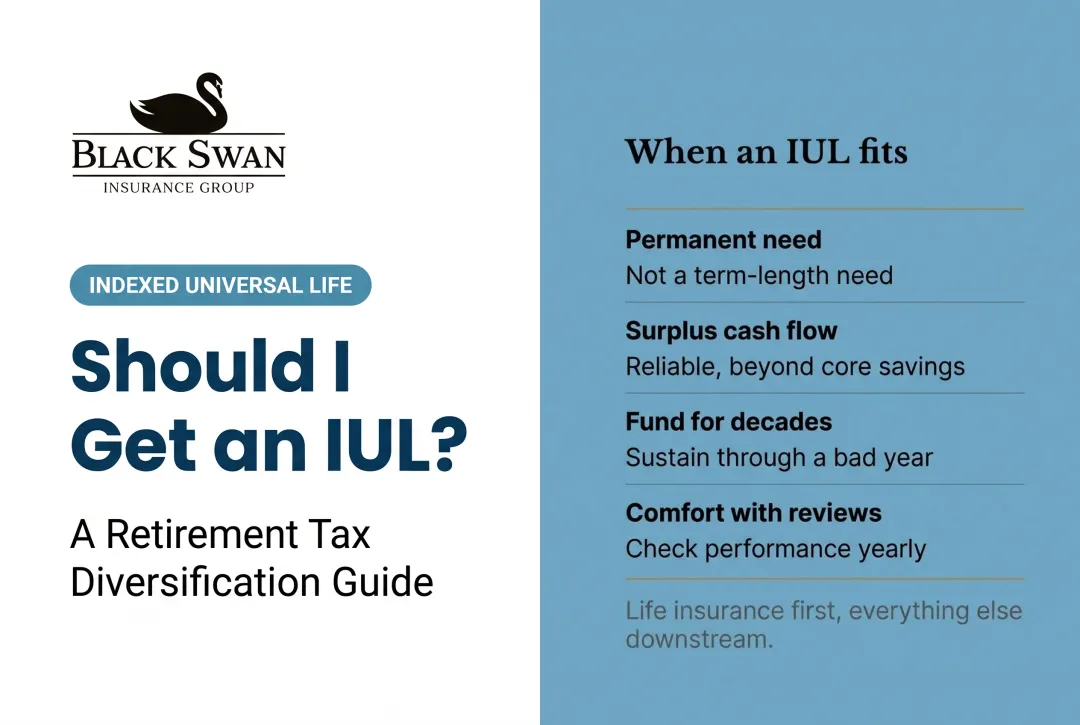
- A genuine permanent protection, legacy or business-continuity need that exists independently of the cash value
- $500–$2,500 a month of sustainable funding capacity without touching reserves
- Above the Roth phase-out and looking for tax diversification rather than maximum return
- A twenty-year-plus horizon and willingness to review the policy annually
Weaker Fit
Not everyone should buy an IUL, and anyone evaluating it purely on return has already found their answer. This is not a market substitute and was never built to be one.
- Return is the primary objective
- No permanent protection need
- Unstable income or no emergency reserve
- High-interest debt outstanding
- Liquidity needed inside the surrender period

Risks to Understand Before You Decide
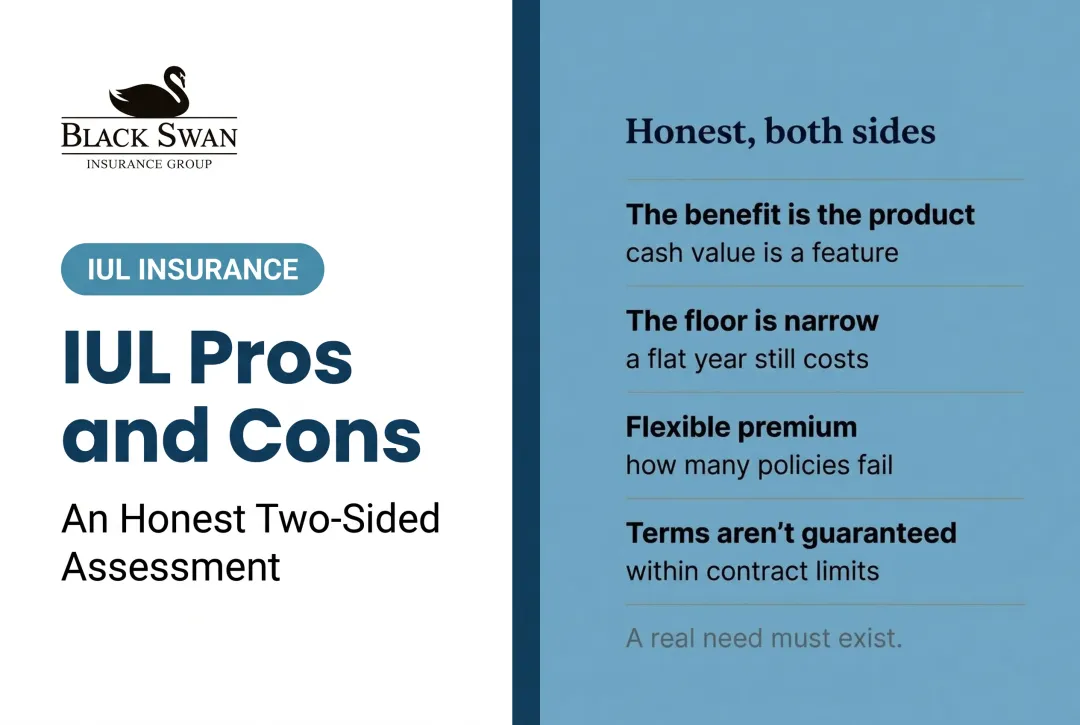
- Charges run whether or not interest is credited, so a flat year is a losing year for cash value.
- Caps, participation rates and current charges are generally non-guaranteed within contract limits.
- Price-return indices exclude dividends, a structural drag relative to total-return comparisons.
- Underfunding is the dominant failure mode and often surfaces fifteen or more years in.
- Surrender charges make early exit expensive.
- Policy loans and withdrawals reduce cash value and the death benefit, and a lapse with gain and an outstanding loan can create taxable income with no cash received to pay it.
Find Out Where You Actually Stand
If you earn $150K+ and want the comparison run properly — the policy against term insurance plus investing the difference, against your 401(k), against a brokerage account, on your own numbers — start with the Tax-Free Wealth Blueprint Fit Review. If IUL does not fit, we will tell you that too.
Frequently Asked Questions
Is an IUL a good investment?
It is not an investment. It is life insurance with cash value features. Evaluated against a diversified index fund on return alone, it will generally underperform.
Is my money in an IUL in the stock market?
No. The carrier credits interest using a formula that references an index. You do not own index shares and do not receive dividends.
Why do financial advisors often recommend index funds instead?
Because for a return objective they are cheaper, more transparent and more liquid. That advice is sound when return is the goal and there is no permanent protection need.
Can an IUL beat inflation?
Credited rates net of charges vary widely by design, funding and crediting environment, and no honest projection exists without your numbers. Treat any specific claim with suspicion.
When does an IUL actually make sense?
When a permanent protection need exists, funding is sustainable, the horizon is long, and tax diversification matters — usually after the qualified accounts are already being used fully.
What should I compare it against?
Term insurance plus investing the difference, your 401(k), a Roth if you qualify, and a taxable brokerage account. If the policy cannot justify itself against those four, it is not the right tool.
Does the floor make an IUL safer than the market?
It makes the credited rate safer, not the account. A market investor in a flat year is roughly flat; a policyholder in a flat year is down by the charges. Different risk, not less risk.
What return should I assume when comparing?
Use the guaranteed minimum for the pessimistic case and something well below the illustrated rate for the base case. If the policy only works at the illustrated assumption, it is not a plan.
Sources
- NAIC — Life Insurance — indexed universal life definitions and crediting
- FINRA — Investor guidance — comparing insurance products with investments
- IRS — Retirement plans — 2026 contribution limits and Roth phase-out ranges
- NAIC, Life Insurance Illustrations Model Regulation (Model #582) — non-guaranteed element disclosure
- I.R.C. § 7702A — Modified Endowment Contract and the seven-pay test
- I.R.C. § 72 — additional tax on early distributions
Disclosure: The information on this page is educational in nature and does not constitute personalized financial, tax, or legal advice. Actual results depend on policy design, carrier, crediting options, caps, participation rates, expenses, funding, loans, and ongoing management. Policy loans and withdrawals reduce cash value and the death benefit, and can create tax consequences if the policy lapses or becomes a modified endowment contract. Consult a licensed insurance professional and, where appropriate, a tax or financial advisor before making any insurance or financial decision. Indexed universal life is life insurance first. Illustrated values are not guarantees; actual results depend on policy terms, crediting, costs and funding. This strategy is not appropriate for everyone.
And remember, it's not what you earn, it's what you keep… enjoy the ride.