By Robert Balgac, Founder, Black Swan Insurance Group | October 5, 2026
The phrase makes it sound like a savings account with a death benefit attached. It is not, and the gap between that impression and the contract is where most of the disappointment in this category comes from.
Cash value life insurance is permanent coverage with an accumulation component. Every premium dollar passes through the cost of insurance, the administrative charges and any rider costs before anything reaches the cash account. In the early years that ordering matters enormously — which is why two people holding the same $500,000 death benefit can have wildly different cash values, and why the face amount tells you almost nothing.
If you earn $150K+, have maxed the obvious accounts and are being shown a projected value in year twenty, the number worth asking about is what reaches the account in year one.
The short answer: Cash value life insurance pairs permanent coverage with an accumulating account; term insurance generally builds none, by design. Premiums cover the mortality charge, administrative fees and riders first, with the remainder credited to cash value. Growth is generally tax-deferred inside the policy, and any potential tax-advantaged access later through withdrawals or loans is conditional on the contract being properly structured, funded and managed. You can reach the money through withdrawals, loans, surrender or premium offsets — each with a tax or coverage consequence attached.
Key Takeaways
- Cash value policies pair permanent coverage with an accumulating account; term life usually builds none
- Premiums cover insurance costs, fees and riders before cash value — not all of it becomes savings
- Access comes through withdrawals, loans, surrender or premium offsets, each with a trade-off
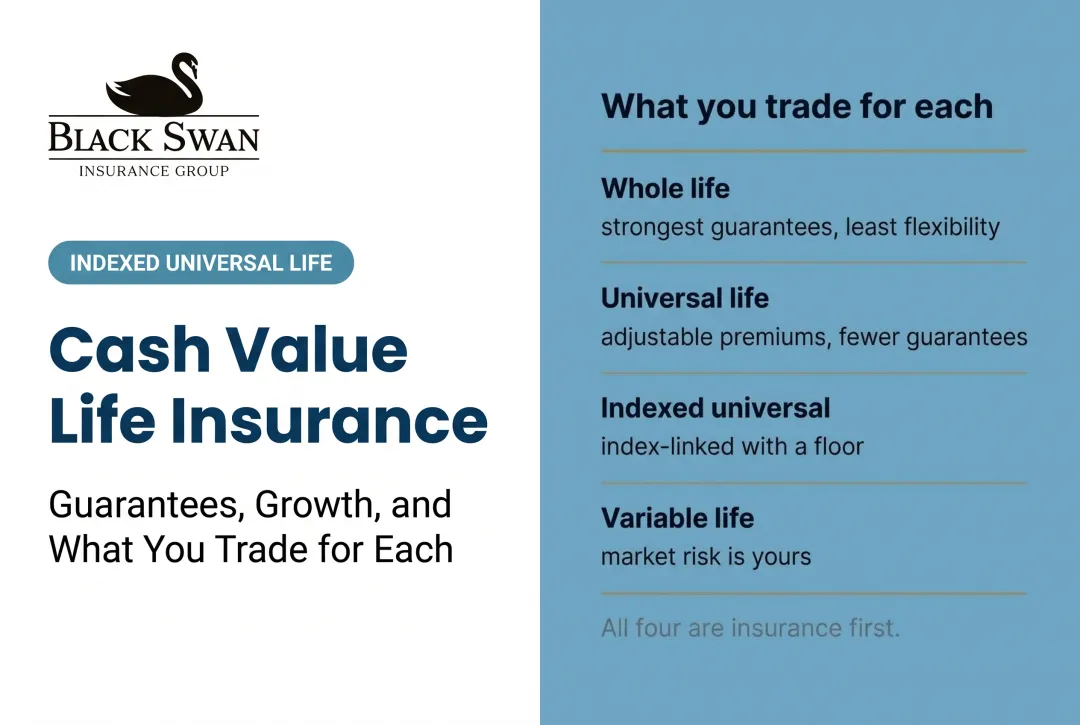
- Whole, universal, indexed universal and variable designs differ substantially in guarantees, growth and risk
- Cash surrender value, not cash value, is what you would actually walk away with
Where the Premium Goes
Every cash value policy has two moving parts: a death benefit for beneficiaries, and a cash value you may reach while living. They are connected, and they do not move in lockstep.
Your premium typically covers:
- Cost of insurance — the mortality charge for your coverage, which rises with age
- Administrative expenses — policy fees and overhead
- Riders — optional additions such as waiver of premium or accelerated death benefit
- Cash value contribution — whatever remains
The split varies by insurer and design. A universal life policy generally applies the planned premium to insurance costs first, crediting the remainder to the cash account, per guidance from the Maryland Insurance Administration.
Growth Depends Entirely on the Design
- A guaranteed interest rate — whole life
- Non-guaranteed dividends declared annually — participating whole life
- Declared or index-linked crediting — universal life and indexed universal life
- Investment subaccount performance — variable life
Accumulation is generally tax-deferred, so growth inside the policy is not taxed annually. The treatment gets considerably more complicated once you access the money, or if the contract is classified as a modified endowment contract under IRS rules.
Cash Value Is Not Cash Surrender Value
These get used interchangeably, and that is a costly mistake. Cash surrender value is what you would actually walk away with today, after surrender charges, outstanding loans and accrued interest.
Take two people each holding a $500,000 death benefit. One has funded a whole life policy consistently for 15 years. The other bought an indexed universal life policy two years ago at minimum premium. Their cash values will look nothing alike. Funding history, policy age and design drive the number — the face amount does not.
Early years commonly produce limited accessible value. Insurance costs, fees and surrender charges consume contributions before meaningful cash value builds. The NAIC's Life Insurance Buyer's Guide notes some policies stay low early and build later while others accumulate more gradually. There is no universal timeline.

Premium is the fuel. Cash value is the tank. The charges are the engine burn. Underfund it and you are not driving anywhere, regardless of what the brochure showed.
The Four Designs
Whole Life
Fixed premiums, a guaranteed death benefit subject to policy terms, and cash value growing according to the contract. On nonparticipating whole life, the carrier sets premium, death benefit and cash surrender value at issue and those figures stay put.
Participating policies may pay dividends, which are not guaranteed. Guardian Life notes that dividends are typically declared annually and vary with insurer performance.
Universal Life
Flexible premiums and a cash account earning interest, with premium and death benefit adjustable within contract limits. The catch is structural: coverage stays active only while cash value covers the ongoing insurance costs.
Indexed Universal Life
Interest credited on a formula referencing an external index such as the S&P 500, without investing in the market.
- Cap — the maximum credited interest for that strategy period
- Participation rate — how much of the index-linked gain the policy can credit
- Spread — an amount subtracted before crediting
- Floor — a minimum credit, often 0%, protecting against a negative index year
As Nationwide's product materials state, IUL policies do not directly participate in stock market gains or dividends; the index is a reference point in a crediting formula, not an investment.
Variable and Variable Universal Life
Cash value allocated to investment subaccounts, so value rises and falls with market performance. FINRA classifies variable life as a security requiring registration, and anyone selling it needs a securities licence alongside an insurance licence. A prospectus detailing fees, investment options and death benefit structures must be provided before purchase.

Cash value is what separates these from term insurance, which covers a set period with no accumulation at all. That is a design choice, not a defect — term is built for temporary protection at a much lower cost, and when the need is temporary it is usually the better answer.
| Feature | Whole life | Universal life | IUL | Variable/VUL |
|---|---|---|---|---|
| Premium flexibility | Fixed | Flexible | Flexible | Flexible |
| Growth guarantee | Yes | Limited | Floor only | None |
| Market exposure | None | None | Indirect, via index crediting | Direct, via subaccounts |
| Complexity | Low | Moderate | Moderate to high | High |
What the Critics Get Right
The buy-term-and-invest-the-difference argument is the strongest objection in this category, and it deserves a straight answer.
Critics are right that a permanent policy sold to someone with a purely temporary need is an expensive solution to a cheap problem. They are right that early-year charges mean the accumulation story takes a decade to become true, and that anyone surrendering before then will lose money. And they are right that "cash value" sounds like a savings account and is marketed accordingly, when the mechanics are nothing of the sort.
Where the argument depends on an assumption is the investing half. It works when the difference genuinely gets invested every year, through a bad market, without being redirected. Plenty of households do exactly that, and for them the criticism is decisive. For someone with a real permanent protection need, the comparison was never term versus permanent — it is which permanent design survives their actual cash flow.
Reaching the Money, and What It Costs
Withdrawals
Usually available up to contract limits. They reduce cash value and can reduce the death benefit. Amounts above your cost basis — generally premiums paid, less prior withdrawals or dividends — may be taxable.
Policy Loans
Borrowing leaves the funds in the policy as collateral, and you owe interest. An unpaid balance compounds and can lapse the policy if it outpaces remaining cash value.
Surrender
You receive the cash surrender value: cash value less surrender charges and any outstanding loan. Permanent coverage ends.
Per the IRS, surrender proceeds above cost basis count as taxable income. In one IRS example, a policyholder with a $78,000 surrender value and $64,000 of premiums paid owed ordinary income tax on the $14,000 difference.
Paying Premiums From Cash Value
Some contracts allow it, which helps in a tight year. Exhausting the value or underfunding the policy invites lapse — and a lapse with an outstanding loan and gain in the contract can create a taxable event with no cash received to pay it.
At Death
Beneficiaries generally receive the contractual death benefit. Cash value is not automatically added unless the contract says so. Outstanding loans and accrued interest are subtracted first, which can meaningfully reduce what the family receives.

Eight Questions Before You Touch It
- What is my current cash surrender value?
- What is my cost basis in the policy?
- Are surrender charges still active?
- What is the loan interest rate, and how does it accrue?
- How does this affect my projected death benefit?
- Does this increase lapse risk?
- What are the tax consequences?
- How does this change what my beneficiaries receive?
The Ultimate IUL Blueprint
If the indexed design is the one in front of you, the Blueprint covers the decisions that determine whether the accumulation story becomes real: funding levels, minimum death benefit, the MEC line and loan timing.
Who This Actually Fits
Stronger Fit
- A lasting insurance need rather than a temporary gap
- Household income of $150K+ with consistent capacity to fund premiums through a downturn
- A long time horizon that lets cash value get past the early-year charges
- Already funding retirement accounts, with emergency reserves in place
- Genuine interest in accessing policy value alongside the protection
- Willingness to monitor funding and performance year to year
Weaker Fit
Not everyone should buy an IUL. If you want the maximum amount reaching the account, this is the wrong structure to be looking at.
- The cheapest possible coverage is the objective — term insurance answers that directly
- Highly liquid savings are the priority right now
- Surplus cash flow is unstable, or reserves are thin
- High-interest debt needs clearing first
- No appetite for monitoring funding and performance over decades
The Alternatives Worth Pricing
Term insurance for lower-cost protection, employer group coverage, qualified retirement plans, Roth strategies, brokerage accounts for flexible investing, annuities for guaranteed income, and plain emergency savings for short-term liquidity. None is universally better. The right mix follows from income, obligations and horizon.
For physicians, business owners and executives, cash value coverage — indexed universal life in particular — usually gets evaluated for a specific job: permanent protection, tax diversification, business succession liquidity or legacy planning. It works alongside reserves, diversified investments and retirement contributions, never instead of them.
A 401(k) can start feeling like a shot glass trying to hold a fire hose. That is an argument for a second bucket, not an argument against the first one.
Risks to Understand Before You Buy
- Early cash value is low by design, and surrendering in the first several years is how people lose money in this category
- Cost of insurance rises with age and is charged regardless of crediting
- Surrender charges run for years and are frequently unread until it is too late
- Dividends on participating whole life are not guaranteed
- Caps and participation rates on indexed designs are not fixed and may be adjusted within contract limits
- Variable subaccount value can fall, and a bad sequence at minimum funding accelerates lapse risk
- Withdrawals above cost basis may be taxable, and they reduce the death benefit
- Loan interest compounds, and a lapse or surrender with a loan outstanding and gain in the contract can create taxable income
- Crossing the seven-pay limit makes the contract a MEC under I.R.C. § 7702A and changes distribution taxation
- Guarantees depend on the issuing insurer's claims-paying ability
Find Out Where You Actually Stand
This starts with the Tax-Free Wealth Blueprint Fit Review. If you earn $150K+ and are weighing permanent coverage, we read the guaranteed column, model what actually reaches the cash account in the early years, stress-test the funding against a bad stretch, and price term alongside it. If it does not fit, we will tell you that too.
Frequently Asked Questions
Can I withdraw cash value from my policy?
Many permanent policies allow withdrawals subject to contract terms and available value. They reduce the death benefit and may be taxable above your cost basis.
What is cash value, exactly?
The accumulated policy value in certain permanent contracts, after applicable costs and charges. The New York State Department of Financial Services notes it is typically well below the face amount, particularly in the early years.
What is the cash value of a $500,000 policy?
The death benefit does not determine it. Premiums paid, policy type, age at issue, funding level, duration and charges all do.
Is this a good investment?
It is life insurance with an accumulation feature, and treating it as though it were an investment vehicle is where people get into trouble. It can play a role in a long-term protection plan, compared honestly against alternatives on cost, liquidity, guarantees and risk.
Which policy type has the best cash value?
There is no universal answer. Whole, universal, indexed and variable designs carry different guarantees, assumptions and risks. The right one depends on funding capacity and objective.
Should I just buy term?
If the need is temporary and the goal is the most death benefit for the lowest premium, yes — and that is worth saying plainly before anyone designs a permanent policy for you.
Sources
- NAIC — Life Insurance Buyer's Guide
- IRS Publication 525 — Taxable and Nontaxable Income
- Maryland Insurance Administration — Universal life insurance
- Guardian Life — Whole life dividends and returns explained
- Nationwide — Indexed universal life product materials
- NY Department of Financial Services — Cash value versus face amount
Disclosure: This article is educational and is not personal tax, legal or investment advice. Indexed universal life is life insurance first. Actual results depend on policy design, carrier, crediting options, caps, participation rates, expenses, funding and ongoing management. Policy loans and withdrawals may reduce cash value and death benefit and can create tax consequences if the policy lapses or becomes a modified endowment contract. Guarantees are subject to the claims-paying ability of the issuing insurer. This strategy is not appropriate for everyone. Illustrated values are not guarantees; actual results depend on policy terms, crediting, costs and funding. Consult your own tax, legal and financial professionals for advice specific to your situation.
And remember, it's not what you earn, it's what you keep… enjoy the ride.