By Robert Balgac, Founder, Black Swan Insurance Group | October 9, 2026
"Creating an IUL account" is a misnomer, and the misnomer causes real damage. You are not opening a bank account or a brokerage account. You are applying for an indexed universal life insurance policy issued by a licensed carrier that underwrites you, issues a contract, and credits interest to a cash-value component based partly on a market index.
That distinction is not pedantry. People who think they are opening an account treat the premium like a deposit, assume they can stop and restart at will, and are surprised twenty years later when the contract is in trouble. People who understand they are buying a life insurance policy ask the right question from day one: what does it cost to keep this in force for the rest of my life?
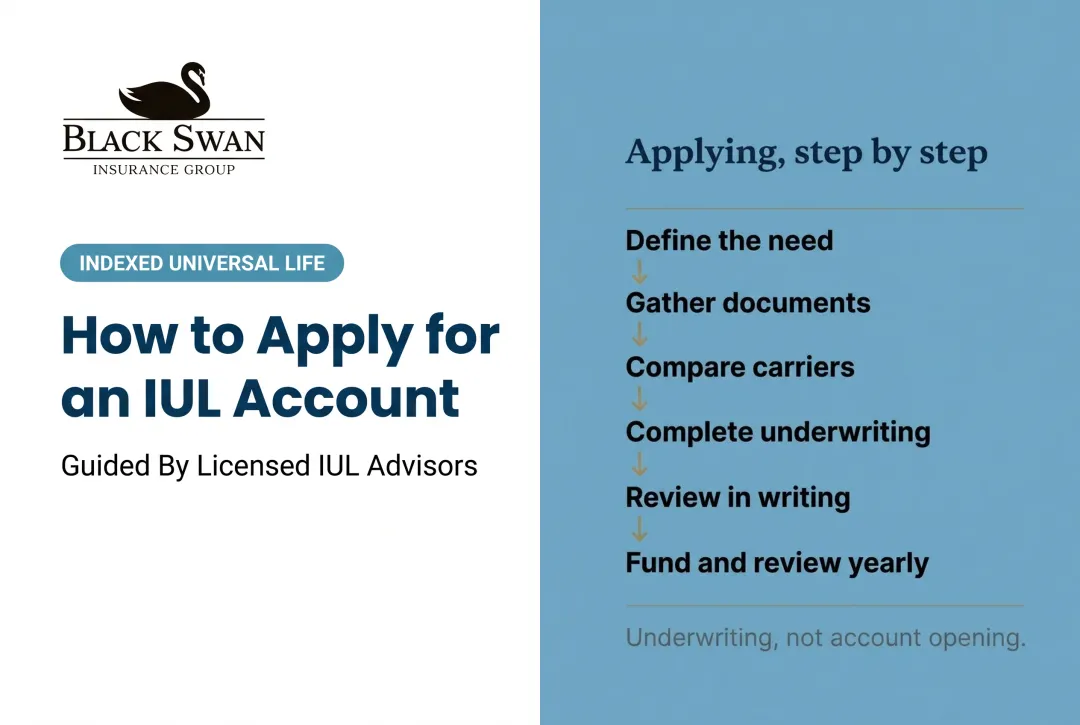
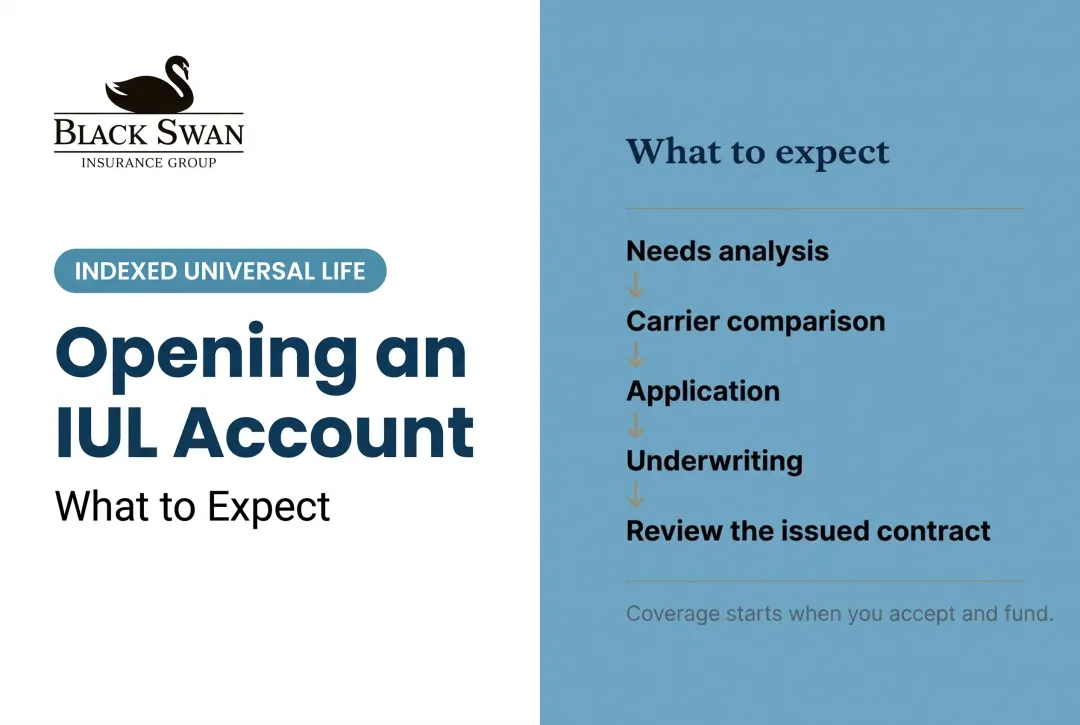
The short answer: There is no account to open. There is a policy to design, underwrite, fund and monitor — in that order. The application takes weeks; the funding discipline takes decades, and that second part is where nearly every failure happens.
According to the National Association of Insurance Commissioners, IUL interest is tied to an external index, but the cash value is never directly invested in the market itself. This is life insurance first.
Key Takeaways
- IUL pairs permanent life insurance with index-linked cash value — it is not a direct market investment
- Suitability depends on protection need, cash flow, liquidity and tolerance for complexity
- Gather identification, beneficiary details, income data and a full health history before applying
- Review illustrations by separating guaranteed values from non-guaranteed projections
- Monitor funding and loans so underfunding and lapse risk stay in check
- If you might need the money back in three to five years, this is the wrong vehicle
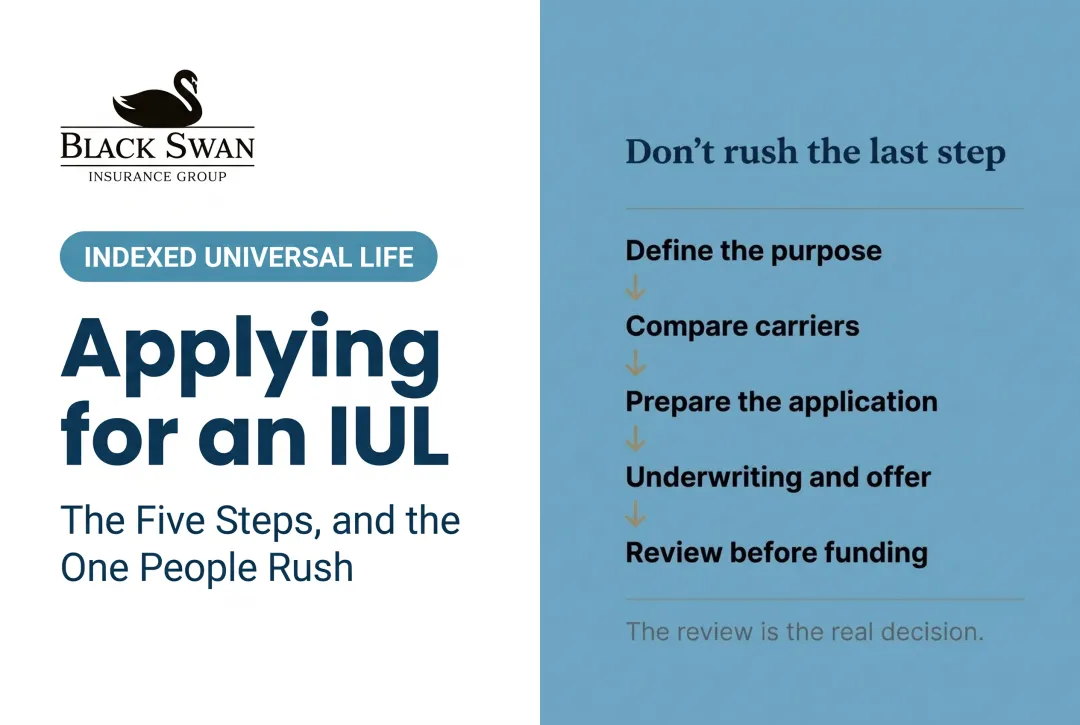
Step 1: Define the Purpose Before You Compare Anything
Before you look at a single carrier, get clear on why you want permanent coverage:
- Permanent death-benefit protection for a spouse, children or business partner
- Supplemental retirement income alongside a 401(k), IRA or Roth account
- Estate or legacy planning to leave a tax-efficient inheritance
- Business protection tied to a partnership or key employee
Estimate coverage by weighing dependents, income replacement, outstanding debts, mortgage balances, education costs and legacy goals.
Then check the order of operations. Before allocating surplus cash to an IUL, confirm you have addressed emergency reserves, employer retirement-plan contributions, available matching funds and essential term coverage. Those are cheaper and more liquid. An IUL competes for the dollars left over, not the first ones.
Surrender charges and early-year costs work hard against anyone who needs the money back quickly. This is a decades-long commitment priced as one.
Step 2: Work With a Licensed Professional and Compare Carriers
One illustration from one carrier is not a decision. You need someone who can place multiple designs side by side. At Black Swan that comparison typically includes carriers such as F&G Annuities and Life, Corebridge and Transamerica, each with different crediting structures and underwriting niches.
Ask your advisor to walk through:
- The insurer's financial-strength ratings and contract terms
- Available riders, cost-of-insurance structure and surrender schedule
- How caps, participation rates, spreads, floors and bonuses are set — and whether they can change after issue
- Whether they will coordinate with your CPA or estate attorney on tax and trust questions
A good advisor explains limitations as readily as benefits. If someone shows you only an attractive projected number, that is a red flag, not a selling point.
A great IUL is engineered. A bad IUL is sold.
Step 3: Application and Underwriting
Gather accurate personal, financial, beneficiary, health, lifestyle, occupation and existing-insurance information before you submit anything.
Underwriting may include a health questionnaire, prescription-history check, medical records request, paramedical exam or lab work. The mix depends on the carrier and the coverage amount.
Timelines vary by path. LIMRA's research found average final decisions took 9 days for accelerated underwriting against 27 days for traditional underwriting. That is not a universal IUL timeline, but it is a useful benchmark for planning around a loan closing or an estate deadline.
Disclose everything truthfully. Inconsistencies between your application and your medical records can delay underwriting, change your offered rating, and create problems during a future claim review — the one moment your family cannot afford friction.
Before submission, ask your agent to review the application for omissions and confirm what documentation the carrier still needs.

Step 4: Review, Approve and Fund
When the offer arrives, compare it line by line against what you requested: health classification, coverage amount, death-benefit option, premium schedule, riders, exclusions and charges. Carriers issue at a different rating than applied for more often than buyers expect, and accepting delivery without checking is how people end up paying for a policy they did not price.
Review the final illustration, not the original sales projection:
- Guaranteed values and current non-guaranteed assumptions
- Cash surrender values and break-even timing
- Loan scenarios and sustainable premium funding
Confirm the design will not accidentally trigger modified endowment contract status under IRS rules, even in a lean income year.
An illustration is a model, not a guarantee.
Only pay the initial premium once you understand the free-look period, payment instructions and frequency, ownership and beneficiary designations, and the carrier's delivery requirements.
The Ultimate IUL Blueprint
Before you fund anything, the Blueprint walks through what the design has to survive: funding levels, caps and charges, the MEC line, loan timing, and what to demand from an illustration.
Step 5: Monitor and Manage the Active Policy
Review annual statements for cash value, surrender value, charges, credited interest, index allocations and any outstanding loans. Reassess after major life events — marriage, divorce, a business sale, retirement, a significant income change.
Loans and withdrawals reduce cash value and death benefit, add interest costs, and can create lapse or tax consequences if left unmanaged.
This is not set-it-and-forget-it. It is design-it, fund-it, review-it.
Black Swan builds that discipline into the relationship with a yearly policy check-in to adjust funding or strategy as goals shift. A design that fit in year one often needs recalibration by year ten, and the cost of catching drift early is a conversation. The cost of catching it late is the policy.
What the Critics Get Right
The sceptics make a fair point about this entire process, and it deserves stating before someone else does.
The buyer is being asked to evaluate a forty-year contract using a document — the illustration — produced by the party selling it, under assumptions that party selected, with the key variables explicitly non-guaranteed. The person guiding the review earns on the premium. Most buyers cannot independently verify a cost-of-insurance schedule, and almost nobody re-reads the contract at year twelve.
That is a structurally uncomfortable arrangement and pretending otherwise insults your intelligence.
What the criticism usually misses is that the defence is available and cheap. Ask for the guaranteed column. Ask for a reduced-crediting scenario at years 10, 20 and 30. Ask what premium keeps the contract in force to age 100 under guaranteed assumptions. Those three requests cost nothing and filter out most bad designs before any money moves.
Is an IUL Right for You?
Suitability hinges on four things: a genuine permanent coverage need, long-term funding capacity, insurability, and how the policy fits alongside — not instead of — the rest of your plan.
Higher-Income and Late-Start Earners
High-income professionals, executives and practice owners typically evaluate IUL for permanent protection, tax diversification, or building assets outside a concentrated business interest. Compare it against qualified plans, Roth strategies, brokerage accounts, term insurance and whole life first.
For 2026, the IRS raised the 401(k) elective-deferral limit to $24,500, with an additional $8,000 catch-up at 50+ (or $11,250 for ages 60–63). The IRA limit is $7,500, or $8,600 at 50+. Roth contributions phase out starting at $153,000 single and $242,000 joint. Those figures matter for comparison — they are not a funding ceiling for an IUL.

Once those ceilings are in view, a shorter retirement runway raises the stakes on underwriting speed, funding capacity and realistic assumptions. It still does not automatically make IUL the right fit.
Documents to Prepare
- Government-issued ID, Social Security number, address and occupation
- Income, net worth and existing life insurance details
- Beneficiary names, contact details and proposed allocation percentages
- Full health and lifestyle history — medications, diagnoses, surgeries, family history, tobacco use, hazardous hobbies
- Cash-flow obligations, debt, emergency reserves, and the premium you can sustain without compromising other priorities
Professional and Compliance Readiness
Confirm your agent is licensed in your state and provides the required disclosures, illustrations and replacement forms. Bring in a tax professional or estate attorney for ownership structures, trusts or business use. The illustration is not the contract — the contract controls.
The Parameters That Actually Drive Results
Results come from several interacting variables, not one advertised rate.
Coverage amount and death-benefit option. The death benefit supports the policy's core purpose while driving premiums, cost of insurance and MEC testing. Compare increasing and level options; each affects long-term cash value and protection differently.
Premium amount, timing and sustainability. There is a real difference between the minimum premium that keeps a policy in force and the premium needed to pursue an accumulation goal. Flexible premiums sound convenient; skipping payments while charges continue erodes the policy quietly.
Crediting method. Your cash value is not invested in the index. The insurer credits interest using a formula and contractual limits:
- Floor — the minimum credited rate, often 0%
- Cap — the maximum rate used in the credit calculation
- Participation rate — the portion of index gains applied
- Spread — an amount subtracted before the credit is calculated
Zero is your hero in a down year — but the floor applies to the credit, not to the charges.

Charges, surrender values and loan risk. Review cost of insurance, premium loads, administrative charges, rider costs and surrender charges. Surrender value is typically lower than total premiums paid in early years. A policy loan is not free money — it accrues interest and reduces both cash value and death benefit.
Ownership, beneficiaries and tax treatment. Ownership structure, beneficiary designations and trust arrangements affect control, estate planning and taxation. Tax-advantaged access is not automatic; it depends on the policy avoiding MEC status and staying in force.
Stronger Fit
- You earn $150K+, have maxed the 401(k) and hit Roth phase-out, with dependable surplus afterwards
- You have a genuine lifelong protection, estate or business need
- You are insurable at a reasonable rate with a long funding horizon
- You will read an annual statement and request an in-force illustration when something changes
Weaker Fit
Not everyone should buy this. Step back if you need inexpensive temporary coverage — term is cheaper and simpler — or if you have uneven cash flow, thin emergency reserves, higher-priority debt, a need for liquidity inside five years, or no appetite for monitoring a contract for decades.
Common Mistakes and Alternatives
Mistakes that recur: buying on a projected return or a "no downside" claim; underfunding by confusing minimum premiums with planned premiums; comparing illustrated cash value while ignoring guaranteed values and charges; taking loans without understanding interest costs and lapse risk.
Troubleshooting: if underwriting stalls, check for incomplete health disclosures or missing records. If the issued policy does not match expectations, compare the approved rating, premium and riders before accepting delivery. If cash value looks low, review actual credited interest, caps and outstanding loans rather than assuming an indexing error. If lapse risk appears, request an updated in-force illustration immediately.
| Option | Best suited for |
|---|---|
| Term life | Affordable, time-limited income replacement |
| Whole life | Permanent coverage with predictable guarantees |
| 401(k)/Roth/brokerage | Retirement or accumulation goals with contribution capacity |
| Annuities | Guaranteed income with less protection emphasis |
The right answer often involves a combination, determined through a full plan rather than a single projected number.
Risks to Understand Before You Fund a Policy
- Early surrender returns less than you paid in, often for a decade or more.
- Cost of insurance rises with age, which is the mechanism behind most late-life lapses.
- Caps and participation rates can be lowered after issue, subject to contract minimums.
- Underfunding compounds quietly and surfaces decades after the decision that caused it.
- MEC status is generally permanent and removes the tax-advantaged living access you may be buying for.
- The loan is not the problem. The unmanaged loan is the problem.
- Misstatements on the application can surface at claim time, when nobody can fix them.
Find Out Where You Actually Stand
This starts with the Tax-Free Wealth Blueprint Fit Review. If you earn $150K+ and are weighing whether to open a policy, we confirm the job the coverage has to do, compare designs across carriers including F&G Annuities and Life, Corebridge and Transamerica, read guaranteed against illustrated values, model the funding schedule against the MEC limit, and stress-test the contract through lower-crediting and reduced-income years. If term solves your problem, we will say so. If IUL does not fit, we will tell you that too.
Frequently Asked Questions
What is the minimum amount required to open an IUL account?
There is no universal minimum. It depends on the carrier, your age and health, the coverage amount and the design. The minimum to issue coverage usually differs sharply from the funding level needed to reach a cash-value goal.
Is an IUL account the same as a bank or brokerage account?
No. It is a life insurance contract with a death benefit and cash value, issued by an insurer. It is neither a deposit account nor a direct investment in an index.
How long does it take to create an IUL policy?
It varies with application completeness, medical underwriting and carrier processing. LIMRA data shows underwriting decisions averaging 9 to 27 days depending on path, though full issuance can take longer.
Do I need a medical exam to open an IUL?
It depends on the carrier and coverage amount. Some applicants need a paramedical exam and labs; others qualify for accelerated underwriting without one.
What should I look for in an IUL illustration?
Guaranteed and non-guaranteed values, charges, surrender values, caps, participation rates, loan assumptions and break-even timing. Treat non-guaranteed numbers as projections, not promises.
Can an IUL replace my 401(k), IRA or other retirement accounts?
Generally no. Evaluate it as one piece of a broader plan, never as a replacement for employer matching, emergency reserves or diversified investment accounts.
Sources
- NAIC — Life Insurance
- LIMRA — Life insurers look to make the underwriting process easier for customers
- IRS — 401(k) limit increases to $24,500 for 2026
Disclosure: This article is educational and is not personal tax, legal or investment advice. Indexed universal life is life insurance first. Carrier names are listed for research purposes and are not recommendations; product features, underwriting rules and availability vary by carrier and state, and all guarantees are subject to the issuing insurer's claims-paying ability. Illustrated values are not guarantees; actual results depend on policy design, carrier, crediting options, caps, participation rates, expenses, funding and ongoing management. This strategy is not appropriate for everyone. Policy loans and withdrawals reduce cash value and the death benefit, and can create tax consequences if the policy lapses or becomes a modified endowment contract. Consult your own tax, legal and financial professionals for advice specific to your situation. Any potential tax-advantaged access depends on the policy being properly structured, funded and managed.
And remember, it's not what you earn, it's what you keep… enjoy the ride.