By Robert Balgac, Founder, Black Swan Insurance Group | October 9, 2026
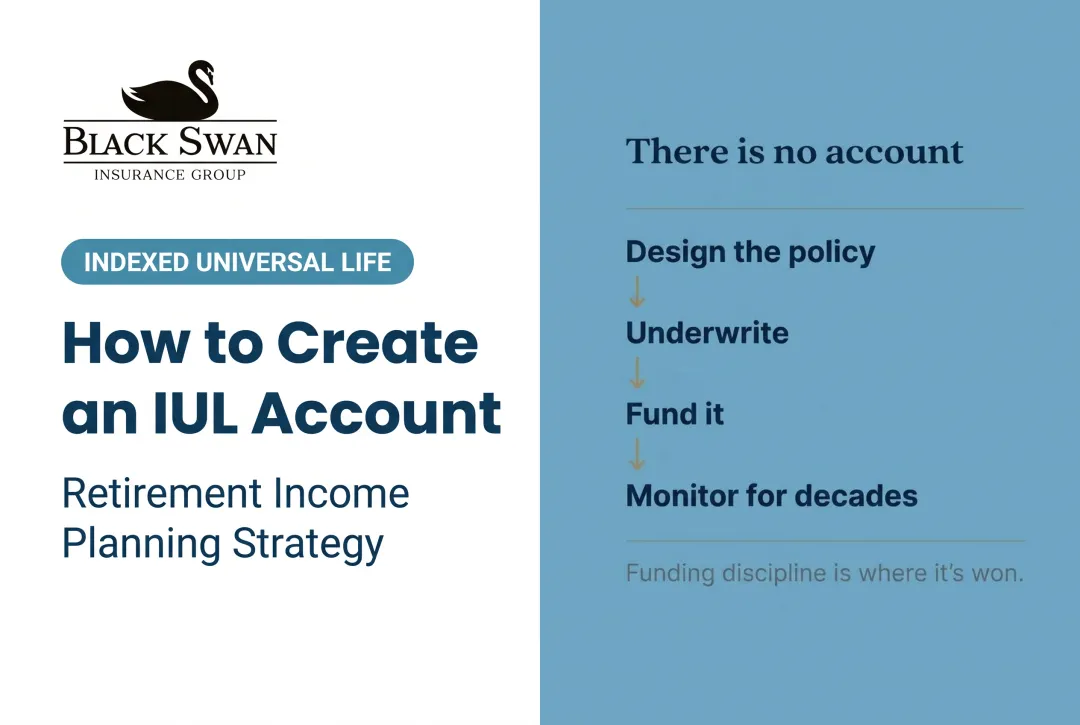
Search for how to "open an IUL account" and the phrasing itself tells you the problem. There is no account to open. An IUL is permanent life insurance with an index-linked cash value component — Allianz Life describes it as permanent coverage where indexed interest is linked to an external index, and the policyholder never buys a share of that index.
You do not fund it the way you fund a brokerage account. You apply, and a carrier decides whether to insure you, at what price, and on what terms. Age, health, coverage amount, funding pattern and the carrier's own rules all move that answer.
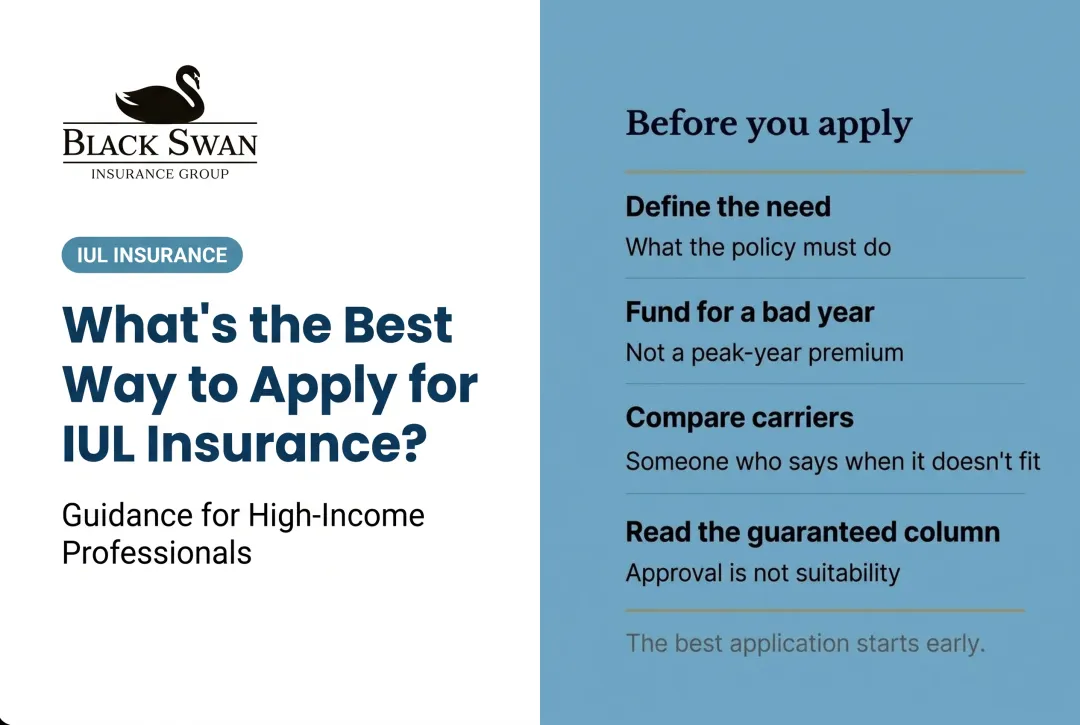
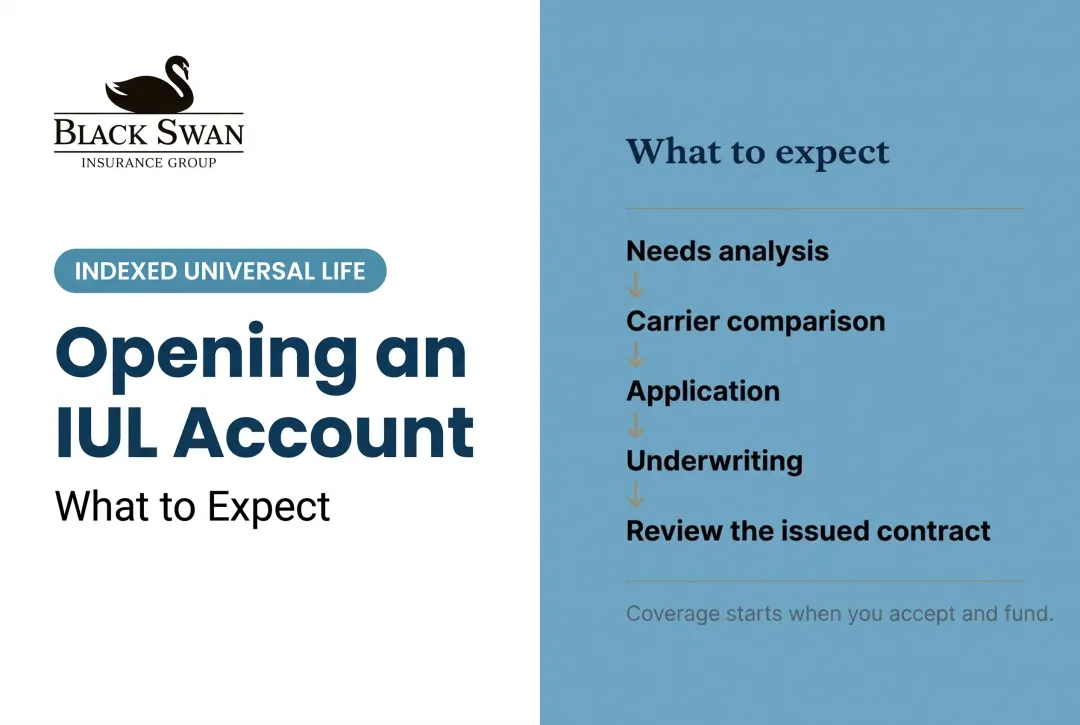
The short answer: Applying for an IUL is an underwriting process, not an account opening. The sequence is define the need, gather documents, compare carriers, complete underwriting, review the illustration and contract in writing, then fund it sustainably and review it annually. The step most people skip is the first one — deciding whether they need permanent insurance at all.
This matters most if you earn $150K+, have captured the match, maxed the 401(k) and run into the Roth phase-outs. That profile gets shown IUL constantly. It is also the profile most likely to fund a policy properly — and most likely to be sold one it did not need.
Key Takeaways
- A licensed professional submits the application after financial and health disclosures, often with a medical exam
- Weigh IUL against term, the 401(k), IRAs, brokerage and whole life — not as an automatic replacement for any of them
- The illustration is a projection; read the guaranteed and non-guaranteed columns as separate documents
- Sustainable funding and accurate underwriting answers are what keep coverage in force decades later
- Minimum funding varies by carrier, age, health and coverage amount — verify current figures directly
Step 1: Decide Whether You Need This At All
Before anyone touches an application, get specific about the job. Permanent death-benefit protection for a family or business? Estate or legacy planning? Supplemental retirement flexibility? Business continuity? Some combination?
Separate the protection need from the cash value goal. They are related. They are not the same thing, and conflating them is how people end up with a policy that does neither job well.
Then be honest about cash flow. IUL premiums are a long commitment. Can you sustain them without raiding emergency savings or deferring debt repayment? If you have not captured an employer match or funded an IRA, handle those first — there is no version of this where an insurance premium outranks free money.
For business owners and late-start high earners the picture shifts: wealth concentrated in the business, a shorter runway to fund adequately, and genuine liquidity needs. All of that belongs in the decision before the application, not after.
Step 2: Gather the File
Carriers need a complete financial and health picture before they will underwrite anything.
The NAIC's Life Insurance Buyer's Guide notes that applicants typically provide name, address, employer, job title and birth date, plus beneficiary Social Security or tax ID numbers, and may answer health questions or complete an exam.
Expect to prepare government ID and Social Security information; employment, income and existing insurance records; a complete health history covering medications, diagnoses, surgeries, hospitalisations, tobacco or nicotine use and family history; and beneficiary names, dates of birth, relationships and allocations.
Larger coverage amounts and business-related applications usually require more — tax returns, business income documentation, asset statements explaining the financial purpose. If a trust or entity will own the policy, involve an attorney or tax professional on ownership and beneficiary structure before submission. Restructuring afterwards is expensive and sometimes impossible.
Step 3: Compare Carriers, Not Just Products
A captive representative sells one carrier's products. An independent professional can compare designs, underwriting appetites and policy features across carriers. That distinction matters more here than in most insurance decisions, because IUL pricing and crediting terms vary sharply between companies.
Ask how any recommendation accounts for your age, health classification, coverage need, premium capacity and intended use of cash value. Request carrier-specific illustrations and a direct comparison of guaranteed values against current assumptions, death-benefit options, premium requirements and surrender values, and policy loan provisions.
A great IUL is engineered. A bad IUL is sold.
This is where Black Swan Insurance Group gets involved — not by defaulting to IUL for everyone who asks, but with a fit-or-no-fit review first, comparing designs across carriers such as F&G Annuities and Life, Corebridge, Transamerica and John Hancock before narrowing to anything.
The Ultimate IUL Blueprint
Before you apply, the Blueprint covers what the design has to survive: funding levels, caps and charges, the MEC line, loan timing, and exactly what to demand from an illustration.
Step 4: Underwriting
Complete the personal, financial, beneficiary, coverage, premium and health sections carefully. Omissions and inconsistencies delay underwriting at best, and create complications at claim time at worst — which is a problem your family inherits, not you.
Underwriting may involve prescription-history checks and medical-records review, lab work and a paramedical exam, financial justification for the requested coverage, and additional requirements based on age, health or carrier rules.
Some carriers offer accelerated or non-medical paths using electronic health data. LIMRA found accelerated underwriting averaged 9 days from application to decision, against 27 days for traditional underwriting. Industry averages, not a promise about your file.
Underwriting sets your health classification and final premium. Two carriers can read identical records and reach different offers, which is the entire argument for comparing more than one.

Step 5: Read the Illustration Properly
Once approved you receive a formal illustration. Go through it line by line: planned premiums and death benefit, cash surrender value over time, policy charges and assumed crediting rates, index strategies and loan assumptions.
Treat the guaranteed and non-guaranteed columns as two different documents. Caps, participation rates, spreads and current crediting assumptions can change under the carrier's rules and the contract, so the attractive column is not locked in.
An illustration is a model, not a guarantee. The rate on the cover is the least binding number in the document.
Confirm whether the proposed premium is designed for minimum protection, for accumulation, or both — and whether planned funding approaches the Modified Endowment Contract limit. Crossing that line permanently changes the tax treatment of loans and withdrawals.
Read the contract, not the illustration summary. Check the free-look period, the surrender schedule and the premium-flexibility rules before any money moves.
Step 6: Fund It, Then Keep Watching It
Confirm when the first premium is due, which payment methods the carrier accepts, and what must be satisfied before the policy is actually in force.
Set up payment that matches reliable income, and think through what happens if that income drops. Review the fixed and indexed account options — caps, participation rates, spreads — without assuming any indexed option tracks actual market returns.
Then schedule the review. Black Swan builds this into the final stage of its five-step process: needs assessment, coverage exploration, policy tailoring, transparent sign-up, and continued guidance with annual reviews of cash value, charges and funding adequacy.
This is not set-it-and-forget-it. It is design-it, fund-it, review-it.
What the Critics Get Right
The sceptics are right that this product is sold more often than it is designed, and that the application process itself is where the damage usually starts.
An applicant who has not separated the protection need from the accumulation goal will accept whatever design is put in front of them. An applicant chasing an illustrated number will pick the prettiest column. And the person guiding them is frequently compensated on the premium. Those incentives are real, and the correct response is not to avoid the product — it is to arrive with your own questions and to compare carriers.
Who This Fits
Stronger Fit
Applying makes sense if you:
- Earn $150K+ with surplus cash flow after reserves, debt and maxed retirement contributions
- Have a genuine permanent protection, estate or business need
- Are insurable at a reasonable rate with a long funding horizon
- Can tolerate the complexity and will review the policy annually
Weaker Fit
Wait, or choose something else, if you:
- Have unstable or unpredictable income
- Hold limited emergency reserves
- Need inexpensive, short-term protection only — buy term, it solves that properly
- Expect the policy to behave like a guaranteed investment account
That last one catches more applicants than any other. The floor protects against negative index crediting. It does not eliminate policy charges and it does not guarantee cash value will grow.

Mistakes That Cost People Money
Chasing a projected number — selecting on an attractive illustrated cash value without comparing charges, guarantees and alternatives.
Treating premiums as optional — flexible does not mean discretionary. Underfunding reduces cash value and raises lapse risk, and the consequence lands decades later.
Submitting an incomplete file — missing health details, delayed exams and unanswered carrier requests all stall underwriting, sometimes past a rate lock.
Before locking a design, stress-test it: guaranteed values, lower-crediting scenarios, and reduced-premium assumptions. A single illustrated rate is a model, not a forecast.

If the application stalls, check for missing signatures, outstanding medical records, labs or financial documentation. If the offer is worse than expected, compare other carriers and review the health classification before changing coverage or premium. If cash value is falling after issue, request an in-force illustration and review charges and loan balances before surrendering anything.
The Alternatives, Honestly
| Option | Best fit when | Key trade-off |
|---|---|---|
| Term life | You need affordable income replacement for a set period | No cash value; coverage ends |
| Whole life | You want fixed premiums and predictable guarantees | Generally less funding flexibility |
| 401(k) / IRA / Roth | You have not maximised tax-advantaged retirement saving | Contribution limits apply |
| Taxable brokerage | You want full liquidity and market exposure | No protection; fully taxable |
| IUL | Permanent need plus long-term funding capacity | Charges, caps and MEC limits apply |
If you already own coverage and are weighing a switch, do not cancel first. A replacement can trigger new underwriting, surrender charges and a fresh contestability period. Complete a documented side-by-side comparison before changing anything.

Risks to Understand Before You Apply
- Underwriting can come back worse than quoted. The illustration you were shown assumed a health class you may not receive.
- Replacing existing coverage restarts contestability and can cost you surrender charges on the old contract.
- Caps and participation rates can be lowered going forward, subject to contract minimums.
- Cost of insurance rises with age, so a design that works at 45 can strain at 70 if funding never changed.
- Crossing the MEC line is generally permanent and removes the living-access advantage.
- Underfunding is the leading cause of failure, and lapsing with a loan outstanding can create taxable income with no cash received.
Find Out Where You Actually Stand
This starts with the Tax-Free Wealth Blueprint Fit Review. If you earn $150K+ and you are thinking about applying, we work through the protection need first, then model the funding against the MEC limit, stress-test it through lower-crediting and zero-credit years, compare designs across carriers, and show the charges and loan assumptions in plain numbers. If term and a brokerage account serve you better, we will say so. If IUL does not fit, we will tell you that too.
Frequently Asked Questions
How much money do you need to open an IUL?
There is no universal minimum, and the amount needed to issue a policy is different from the amount needed to make it work. It depends on carrier, age, health, coverage amount and premium schedule.
What documents do I need?
Identification and Social Security information, health and medication history, income and financial details, existing insurance records, and beneficiary information. Larger policies require additional financial documentation.
Do I need a medical exam?
Often yes, though some carriers offer accelerated or non-medical paths if you qualify. Requirements vary by carrier, health profile, age and coverage amount.
How long does approval take?
It depends on file completeness, whether records or labs are needed, and carrier workload. LIMRA's figures — 9 days accelerated against 27 traditional — are averages, not commitments.
Can I get an IUL with health problems?
Frequently yes, though approval, pricing and coverage depend on the condition, treatment history and each carrier's guidelines. Different carriers reach different conclusions on identical files, which is why comparison matters.
Should I apply before maxing my 401(k) or IRA?
No. Evaluate IUL within the broader plan, after the employer match and core tax-advantaged saving. An insurance premium does not outrank free matching money.
Sources
- NAIC — Life Insurance Buyer's Guide
- LIMRA — Life insurers look to make the underwriting process easier
- Allianz Life — Life insurance overview
- NAIC — Life Insurance Illustrations
Disclosure: This article is educational and is not personal tax, legal or investment advice. Indexed universal life is life insurance first. Underwriting outcomes, product availability and policy terms vary by carrier and state, and all guarantees are subject to the issuing insurer's claims-paying ability. Illustrated values are not guarantees; actual results depend on policy terms, crediting, costs and funding. Any potential tax-advantaged access depends on the policy being properly structured, funded and managed. Actual results depend on policy design, carrier, crediting options, caps, participation rates, expenses, funding and ongoing management. This strategy is not appropriate for everyone. Policy loans and withdrawals reduce cash value and the death benefit, and can create tax consequences if the policy lapses or becomes a modified endowment contract. Consult your own tax, legal and financial professionals for advice specific to your situation.
And remember, it's not what you earn, it's what you keep… enjoy the ride.