By Robert Balgac, Founder, Black Swan Insurance Group | October 9, 2026
Both get pitched as "tax-free retirement" tools, which is where the trouble starts. A Roth IRA is an individual retirement account funded with after-tax dollars. An indexed universal life policy is permanent life insurance with a death benefit, whose cash value is a secondary feature. They sit on completely different foundations, and the shared marketing vocabulary hides that.
This comparison is written for a specific reader: the $150K+ earner who has maxed the 401(k), discovered that direct Roth contributions are phased out or nearly so, and is now being told that a policy is "the Roth for people who earn too much". That claim deserves a proper examination rather than a dismissal — and the examination has an order to it.
For 2026 the IRS set the IRA contribution limit at $7,500, plus a $1,100 catch-up for savers 50 and older — a hard ceiling that does not exist in the same form for policy funding.
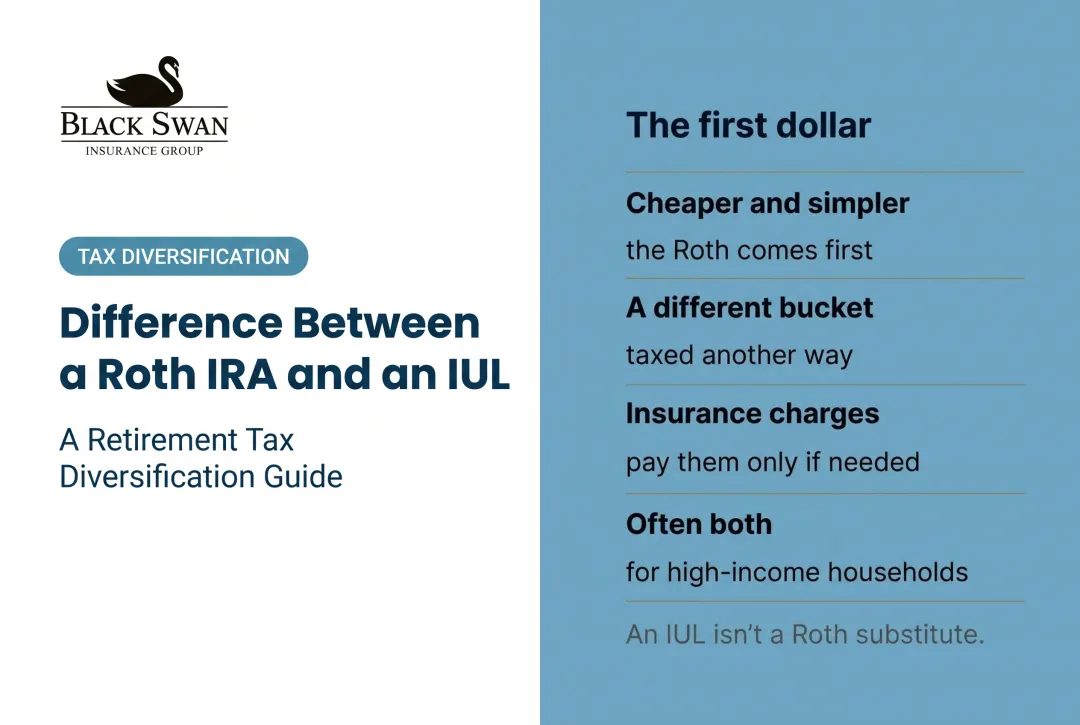
The short answer: A Roth IRA is simpler, cheaper and better at its job, and if you are eligible you should fund it. If you are phased out, the next step is a backdoor Roth conversion, not an insurance premium. A policy only enters the conversation when a genuine permanent protection need exists alongside surplus cash flow — and then it is an addition to your Roth strategy, not a replacement for it.
A great IUL is engineered. A bad IUL is sold.
Key Takeaways
- Roth IRAs offer simpler ownership, uncapped market exposure and typically far lower costs
- An IUL pairs cash value with a permanent death benefit — it is life insurance first
- Contribution rules differ structurally: IRS limits for Roths versus insurer and MEC rules for policies
- Policy loans and potential tax-advantaged access only work if the contract stays in force
- Fund core retirement accounts first, then evaluate a policy on insurance need and funding capacity
Eligibility and Funding Rules
Roth IRAs come with firm IRS boundaries. Policies have no equivalent annual dollar cap, but they are far from unlimited.
| Filing Status | 2026 Direct Roth Contribution MAGI Phase-Out |
|---|---|
| Single or head of household | $153,000–$168,000 |
| Married filing jointly | $242,000–$252,000 |
| Married filing separately | $0–$10,000 |

If you are a single filer earning $150K+, you are standing on the edge of that first row — which is precisely the moment the "Rich Man's Roth" pitch tends to arrive.
For policies, funding is bound by the seven-pay test under IRC Section 7702A. Overfund and the contract becomes a modified endowment contract, which generally taxes loans and withdrawals income-first, with a possible 10% additional tax under IRS Revenue Ruling 2007-38. Underwriting and the carrier's maximum premium bind the top end. The ceiling exists; it is just shaped differently.
Growth, Costs and Access
Crediting versus ownership
Policy crediting runs through a formula, not a stock purchase:
- Floor — the minimum credited interest, often 0%
- Cap — the maximum credited interest, regardless of index gains
- Participation rate — the percentage of index movement counted
- Spread — an amount subtracted from index gains before crediting
A Roth IRA has none of this. You own what you buy, with uncapped upside and undiluted downside.
Costs
Policy charges typically include cost-of-insurance fees, administrative charges and premium loads, plus surrender charges during an early policy period. Review both the guaranteed and non-guaranteed illustration columns before assuming any projected result.
Roth IRA costs are simpler: fund expense ratios and any advisory fee. A total market index fund can run as low as 0.015% annually — a fraction of typical insurance charges. That gap is the single most important number in this comparison, and nothing in the policy column erases it. What a policy offers in exchange is a death benefit and a different tax character, which is a real thing to buy, but only if you need it.
Access and legacy
Roth withdrawals follow a defined order: contributions first, then conversions, then earnings. Qualified distributions after 59½, with the five-year rule satisfied, come out tax-free, and there is no required minimum distribution during the owner's lifetime.
Policy access works through loans or withdrawals. Both reduce cash value and the death benefit, and unpaid loans at lapse or surrender can trigger an unexpected tax bill. The permanent death benefit is the protection and legacy side: under current rules it can pass to beneficiaries income-tax-free, which a Roth IRA does not provide in the same way.
The Two Instruments
The policy
Life insurance first. Cash-value accumulation is secondary and only works as intended when the contract is properly designed and funded. A portion of each premium covers cost of insurance and policy charges; the remainder builds cash value, credited with interest tied to an index. The policy does not own shares of anything.
That crediting depends on floors, caps, participation rates and spreads, all of which an insurer can adjust over time within contract limits. Illustrations model possible outcomes; they are not promises.

Zero is your hero in a down year — but the floor applies to the credit, not to the charges.
Three realities worth sitting with: a floor stops a negative index credit while insurance charges keep deducting regardless; policy loans, withdrawals and underfunding can all erode cash value even in a good index year; and a policy fits someone with a genuine permanent insurance need, stable cash flow, a long horizon and insurability — not someone shopping purely for returns.
The Roth IRA
An after-tax retirement account. Meet the IRS conditions — generally age 59½ and the five-tax-year rule — and qualified withdrawals come out entirely tax-free. It also offers a broad investment menu across stocks, bonds, mutual funds and ETFs; contribution withdrawals, though not earnings, available penalty-free at any time; and no lifetime required minimum distributions for the original owner.
It suits younger savers, cost-conscious investors and anyone who does not need a life insurance component layered into retirement savings. It does not include a contractual death benefit or a crediting floor, though beneficiary designations still carry estate-planning value.
One caveat that matters here most of all: earning too much for a direct Roth contribution does not close the door. Backdoor Roth conversions and employer-plan Roth options exist, and both are cheaper than a premium. Confirm the mechanics with a tax professional first — the pro-rata rule counts all traditional IRA balances, which can produce an unwelcome bill.
The Ultimate IUL Blueprint
If you have exhausted the Roth routes and a permanent protection need genuinely exists, the Blueprint covers what the design has to survive: funding levels, charges, the MEC line, loan timing and what to demand from an illustration.
What the Critics Get Right
The criticism here is blunt and largely correct: a Roth IRA costs a few basis points, has no underwriting, cannot lapse, and gives you genuinely tax-free qualified withdrawals under current law. A policy costs orders of magnitude more, requires good health to obtain, can lapse if you stop funding it, and delivers its tax advantage only through loans against your own money on a contract that must stay in force for decades. Presenting the second as a version of the first is a sales technique, not an analysis.
What the criticism does not cover is the reader who is already above the phase-out, has completed the backdoor conversion, has maxed the plan, and still has surplus. For that person the comparison is no longer Roth or policy — the Roth is already done. The question becomes whether a permanent death benefit they actually need can be purchased in a structure that also carries a different tax character. Sometimes yes. Often the better answer is term coverage plus a taxable brokerage account, and saying so costs us a sale.
Stronger Fit
Choose a Roth IRA when you:
- Are eligible under current IRS income limits, or can use a backdoor conversion
- Want low costs and uncapped market exposure
- Can tolerate market downturns during accumulation
- Value simplicity
Consider a policy when you:
- Have a real, ongoing need for permanent death-benefit protection
- Earn $150K+ and can sustain premiums long-term without straining cash flow
- Pass underwriting in reasonably good health
- Want supplemental tax-advantaged accumulation in addition to core retirement savings
Weaker Fit
A policy is the wrong tool — and not everyone should buy one — if you:
- Have not yet exhausted Roth, backdoor Roth or employer-plan Roth capacity
- Have an unclaimed employer match or unresolved high-interest debt
- Have no genuine permanent insurance need, in which case term coverage is the honest answer
- Cannot fund the premium through a down year
- Expect an illustration to behave like a guarantee
Late-start high earners face a tighter version of this. A compressed runway means less time to recover from underfunding or lapse risk, and insurability becomes a bigger variable. Weigh the shorter horizon against premium sustainability, existing accounts and liquidity before signing anything.
Two Scenarios
Scenario one. A 34-year-old marketing manager earning $85,000 is well under the phase-out. She has no dependents, rents, and wants low-cost, flexible retirement investing. A Roth IRA funded with index funds fits: simple, inexpensive, and liquid for contributions if an emergency hits. Nothing in the policy column improves on that.
Scenario two. A 48-year-old practice owner earns $320,000, carries a mortgage and two children headed to college, and has maxed her 401(k) and backdoor Roth. She has a genuine permanent insurance need tied to business succession and wants additional tax-diversified accumulation. A policy becomes worth evaluating — but only after confirming sustainable premium capacity and reviewing the surrender-period trade-offs.

The Decision Checklist
- Permanent insurance need — do you actually require lifelong coverage?
- Age and time horizon — how many years can the strategy run?
- Health and insurability — would you qualify for competitive rates?
- Income and Roth eligibility — direct contribution or conversion route?
- Emergency reserves and existing contributions — are the basics covered?
- Sustainable premium budget, fees and surrender period — can you fund it through a down year?
Compare on an after-cost, after-risk basis against a Roth IRA, taxable brokerage accounts, term insurance and employer plans — not against a sales illustration.
An illustration is a model, not a guarantee.
Risks to Understand Before You Choose
- Cost drag is permanent and front-loaded on the policy side; early-year cash value often sits below premiums paid.
- Surrender charges can run a decade or more and penalise an early exit.
- Caps and participation rates can be reduced going forward, subject to contract minimums.
- Cost of insurance rises with age, straining designs that were never re-funded.
- Underfunding causes lapse, and a lapse with an outstanding loan can create taxable income with no cash received.
- MEC status is generally permanent and removes the access advantage entirely.
- Roth rules can change too — contribution limits, phase-outs and conversion mechanics are all legislative, which is the argument for holding more than one tax character.
Find Out Where You Actually Stand
This starts with the Tax-Free Wealth Blueprint Fit Review. If you earn $150K+ and you are past or approaching the Roth phase-out, we map what Roth capacity you still have — direct, backdoor, employer plan — before anyone mentions a premium. Then we test your insurance need, cash flow and horizon against the real alternatives, stress-test funding through lower-crediting and zero-credit years, and show the charges in plain numbers. If IUL does not fit, we will tell you that too.
Frequently Asked Questions
Is it better to have an IUL or a Roth IRA?
Neither is universally better, but a Roth IRA is simpler, cheaper and more flexible, and most people should exhaust it first. A policy adds a permanent death benefit and a different tax character, which matters only if you need them.
What do financial experts say about Roth IRAs and IULs?
Most weigh insurance need, costs, time horizon and Roth eligibility together rather than treating a policy as a default Roth replacement.
Can I have both an IUL and a Roth IRA?
Yes, if you have sufficient cash flow and a genuine permanent insurance need. Fund core retirement accounts, reserves and employer plans first.
What are the disadvantages of an IUL compared with a Roth IRA?
Higher complexity, insurance and administrative charges, surrender periods and underwriting requirements. Underfunding or an outstanding loan at lapse can also trigger unexpected taxes.
Can high-income earners contribute to a Roth IRA?
Direct eligibility depends on current IRS income and filing-status limits. High earners above those thresholds often pursue backdoor Roth conversions with a qualified tax professional.
Are IUL policy loans really tax-free?
Properly structured loans on a non-MEC policy that stays in force generally avoid current income tax. Lapse, surrender or MEC status with an outstanding loan can create taxable income.
Sources
- IRS — 401(k) limit increases to $24,500 for 2026, IRA limit increases to $7,500
- IRS — Revenue Ruling 2007-38
- NAIC — Life Insurance Illustrations
- NAIC — Life Insurance
Disclosure: This article is educational and is not personal tax, legal or investment advice. Indexed universal life is life insurance first. Contribution limits and income phase-out ranges change annually and should be confirmed with the IRS. Actual results depend on policy design, carrier, crediting options, caps, participation rates, expenses, funding and ongoing management. Illustrated values are not guarantees; actual results depend on policy terms, crediting, costs and funding. This strategy is not appropriate for everyone. Policy loans and withdrawals reduce cash value and the death benefit, and can create tax consequences if the policy lapses or becomes a modified endowment contract. Consult your own tax, legal and financial professionals for advice specific to your situation.
And remember, it's not what you earn, it's what you keep… enjoy the ride.