By Robert Balgac, Founder, Black Swan Insurance Group | October 9, 2026
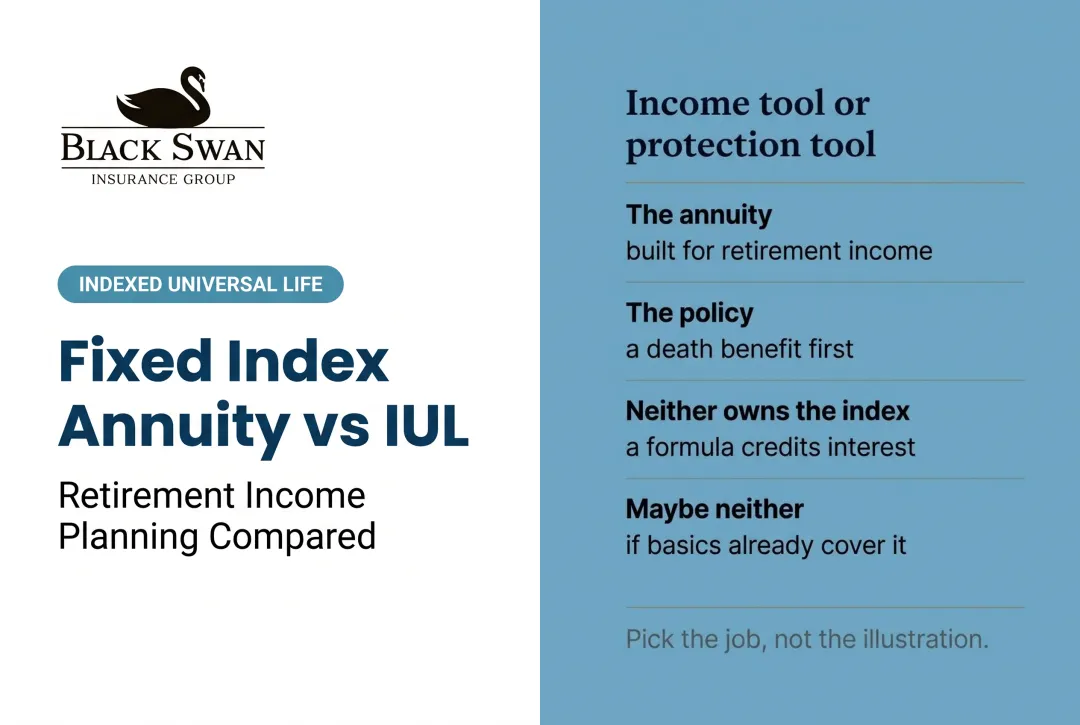
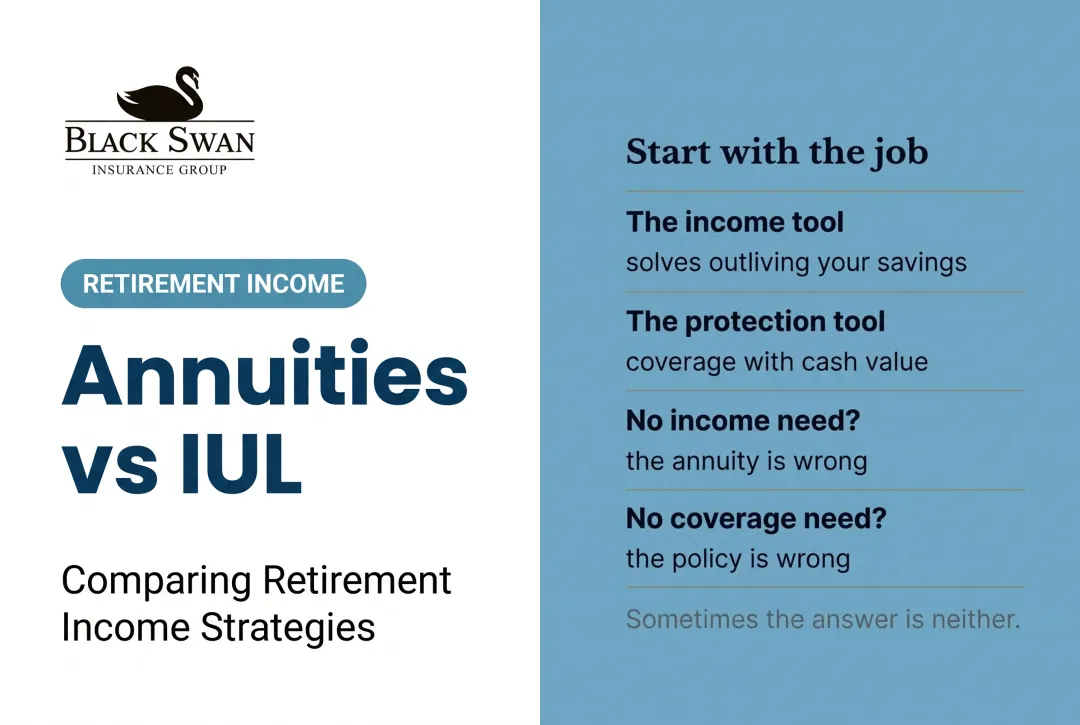
Two insurance contracts, two completely different risks. An indexed universal life policy is built around the risk that you die too soon. An annuity is built around the risk that you live too long. Both get filed under "retirement products" in conversation, and that filing error is responsible for a great many bad purchases.
For a $150K+ earner who has maxed the 401(k) and is now being shown insurance-based options, getting this distinction right is the whole decision. One of these instruments protects beneficiaries. The other converts savings into a paycheck. Neither does the other's job well, and a product sold against the wrong risk disappoints no matter how good the contract is.
The pressure to buy something is real. A 2024 Society of Actuaries survey found 78% of pre-retirees worry their savings will not keep pace with inflation. That anxiety pushes people toward quick-fix products before they have named the risk they are hedging.
The short answer: Name the risk first. If the risk is dying too soon and leaving a gap — income replacement, estate liquidity, business continuity — you are in life insurance territory, and an IUL is life insurance first. If the risk is outliving your money, you are in annuity territory. Buying one to solve the other's problem is the most expensive mistake in this category.
A great IUL is engineered. A bad IUL is sold.
Key Takeaways
- IUL pairs permanent life coverage with index-linked cash value; annuities focus on accumulation or income conversion
- IUL strengths — death benefit, flexible premiums, tax-deferred growth — are offset by policy charges, caps and lapse risk
- Annuities offer guaranteed income options and tax deferral, with surrender charges, limited liquidity and taxable distributions
- Match the product to the job: legacy protection points to IUL; predictable lifetime income points to an annuity
- Keep both alongside 401(k)s, IRAs and other assets rather than treating either as a standalone plan
Side by Side
| Factor | Indexed Universal Life (IUL) | Annuity |
|---|---|---|
| Primary purpose | Permanent life insurance; cash value is a secondary feature | Tax-deferred accumulation or converting a premium into income |
| Death benefit | Contractual, but loans, withdrawals or lapse can reduce it | Varies by contract; often requires a rider |
| Income potential | No guaranteed paycheck; access comes through loans or withdrawals | Can provide guaranteed income, including lifetime payouts, depending on contract type |
| Growth mechanism | Index-linked interest with caps, participation rates, spreads and a floor | Fixed, fixed indexed or variable, each with different risk and guarantee levels |
| Taxes and liquidity | Tax-deferred cash value; cost of insurance, fees, surrender periods and MEC rules apply | Tax-deferred growth; earnings taxed as ordinary income; surrender charges and early-withdrawal penalties may apply |
Three rules apply to both. Growth is not a direct market investment in either case. Every guarantee — death benefit or lifetime income rider — depends on the insurer's claims-paying ability. And neither product is FDIC-insured.
Tax treatment gets technical quickly. Withdraw annuity funds before age 59½ and the taxable portion generally faces an additional 10% tax under IRS rules, separate from any surrender charge the contract imposes. Confirm current treatment with a licensed professional before acting.
The IUL Side of the Ledger
Permanent life insurance with a death benefit and a cash-value account, where the cash value earns interest credits linked to an external index such as the S&P 500 — without your money being invested in the market. Premiums split across cost of insurance, policy expenses, cash value and any optional riders. The funding approach and the insurer's design determine whether the contract stays sustainable for decades.
Pros
- A permanent death benefit that stays in force as long as the policy does
- Tax-deferred cash value accessible through withdrawals or policy loans
- Flexible premiums that can adjust with changing income or business cash flow
Cons
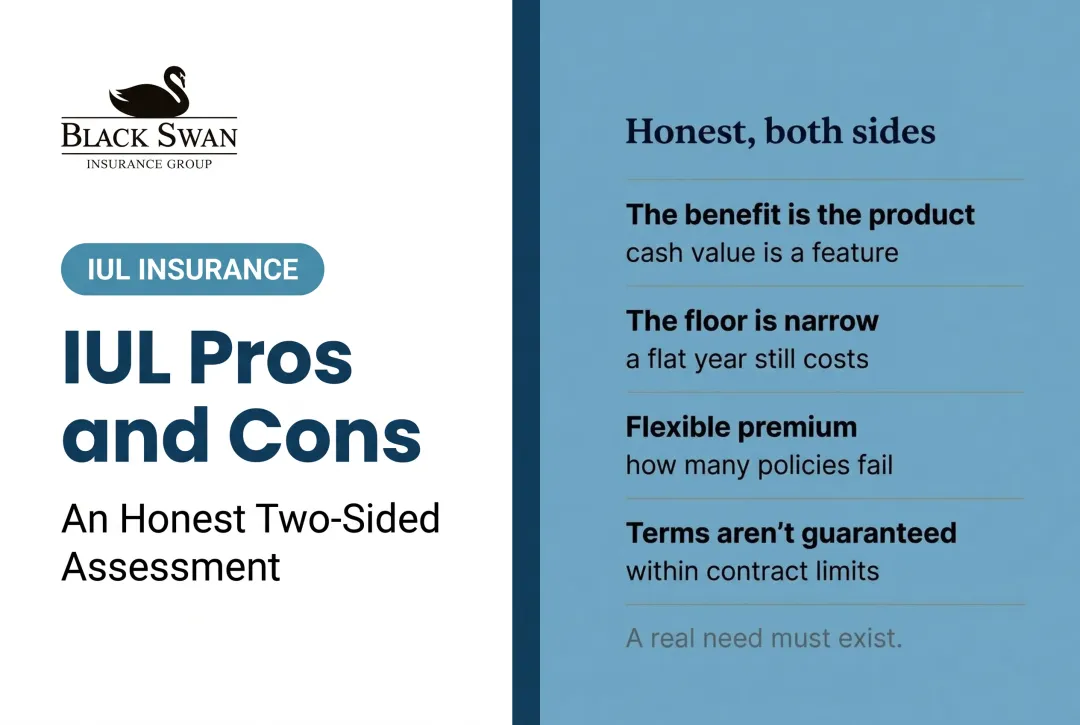
Caps, participation rates and spreads limit upside, and insurers can change these terms over time within contract limits. A 0% floor protects against a negative index credit but does not stop ongoing insurance and administrative charges from eating into cash value.

Zero is your hero in a down year — but the floor applies to the credit, not to the charges.
Other risks worth naming: poor funding or excessive withdrawals can cause a lapse; an outstanding loan at lapse can trigger an unexpected taxable event; and surrender charges make early exits costly.
A policy fits someone with a genuine permanent insurance need, stable surplus cash flow and the patience to monitor a contract for years. It is not a substitute for a low-cost brokerage account, and it should never be presented as one.
Who Typically Evaluates One
- Affluent families wanting legacy protection and estate liquidity
- Business owners separating personal assets from company risk
- High-income professionals who have maxed 401(k) and Roth contributions and want tax diversification
- Late-start high earners, often 45 to 55, who need permanent protection on a compressed funding runway
Before buying, compare against term life, whole life, qualified plans and taxable investing. Consider a 50-year-old physician who started saving late: she needs permanent coverage but also has to protect her emergency fund and retirement contributions. The right move depends entirely on her numbers, not a generic illustration.
The Annuity Side of the Ledger
An annuity is a contract with an insurance company. You fund it with a lump sum or a series of premiums, and in exchange you get accumulation, future withdrawals, or a defined income stream.
The Main Types
- Fixed annuities — contractual interest guarantees for a set period
- Fixed indexed annuities — interest linked to an index, not direct stock ownership, limited by caps and participation rates
- Variable annuities — value tied to investment subaccounts, so gains and losses follow market performance
Immediate versus deferred describes timing: income can start now or at a future date you choose.
Pros
Annuities can create predictable income, including lifetime payouts that directly address longevity risk. A 2025 EBRI/Greenwald survey found 81% of workers worried rising living costs would make saving harder — guaranteed income is built for exactly that pressure. Tax-deferred growth and optional riders for inflation adjustment, spousal continuation or legacy goals round out the case, usually at extra cost.

Cons
- Surrender charges and market value adjustments restrict early access
- Taxable earnings are taxed as ordinary income on distribution
- Fixed payments lose purchasing power to inflation over time
- Variable annuities expose you to investment losses and layered fees
The typical buyer is nearing or already in retirement, wants reliable income, and can leave funds committed for a set period. Take a couple in their early 60s deciding whether roughly 20% of their portfolio should fund guaranteed income. Payout size hinges on ages, premium, contract type, current rates and the income option selected. A current insurer illustration — not a rule of thumb — is what makes that concrete.
The Ultimate IUL Blueprint
If the risk you are hedging turns out to be the protection one, the Blueprint covers what an IUL design has to survive: funding levels, charges, the MEC line, loan timing and what to demand from an illustration.
What the Critics Get Right
Both products attract criticism, and in both cases the sharpest version is about who benefits from the sale.
On the IUL side: charges are front-loaded, caps can be cut after issue, illustrations flatter, and the contract depends on the owner funding and monitoring it for decades. On the annuity side: surrender periods can be long, rider costs compound, and complexity makes genuine comparison shopping hard. In both cases the commission is paid at the front and the consequences arrive later.
The honest reply is not to defend either product. It is to insist on the sequencing. Neither belongs in a plan before the employer match is captured, reserves are built and core retirement accounts are funded — and neither should be bought to solve a risk you have not named. The 401(k) is not the villain here. A one-bucket retirement plan is, and the cure may well be a brokerage account rather than either of these contracts.
Stronger Fit
Evaluate an IUL when you:
- Have a genuine need for permanent death-benefit protection
- Can sustain premiums through changing market or career conditions
- Have time for cash-value accumulation and are willing to monitor the policy annually
Evaluate an annuity when you:
- Want predictable income or protection against outliving your savings
- Accept trading some liquidity for contractual guarantees
- Understand the specific surrender schedule, rider costs and tax treatment
Weaker Fit
Not everyone should buy either one. Walk away, at least for now, if:
- Existing term coverage already meets your family's protection needs and no permanent need exists
- Your emergency reserves are thin or high-interest debt is unresolved
- Your employer match is unclaimed
- You cannot leave annuity funds committed for the surrender period
- You would be buying for the illustration rather than for a named risk
Some plans use both, but only when each serves a distinct role and the combined cost stays sustainable.
Two Decision Profiles
The business owner. A dental practice owner has significant equity tied up in her business and wants permanent protection plus liquidity outside the practice for her family. A policy is under evaluation, but term insurance and a taxable brokerage account need to be ruled out first. The risk to stress-test: what happens to her death benefit if caps drop and she cannot fund premiums during a slow year?
The near-retiree. A 63-year-old engineer wants predictable income once he stops working. An annuity is on the table, but so are Social Security timing strategies and systematic withdrawals from his 401(k). The risk to stress-test: how does a surrender charge affect him if he needs the funds sooner than expected?
Before committing to either path, request guaranteed and non-guaranteed illustrations, review every fee and surrender term, and ask how loans or withdrawals affect long-term performance.

An illustration is a model, not a guarantee.
Risks to Understand Before You Sign Either Contract
- Both depend on the insurer. Every guarantee rests on the carrier's claims-paying ability, so the financial strength rating is not a formality.
- Surrender charges restrict exit on both sides, and they are the costliest surprise for buyers who misjudged their liquidity.
- IUL caps and participation rates can be reduced going forward, subject to contract minimums.
- IUL cost of insurance rises with age, and underfunding over time is the leading cause of lapse.
- A lapse with an outstanding loan can produce taxable income with no cash in hand.
- MEC status from overfunding is generally permanent and changes the tax treatment of every future distribution.
- Inflation erodes fixed annuity payments, which is a slow risk rather than a sudden one.
Find Out Where You Actually Stand
This starts with the Tax-Free Wealth Blueprint Fit Review. If you earn $150K+ and you are trying to work out whether your real risk is dying too soon or living too long, we name it before we compare products — then test the candidates against term, brokerage, Social Security timing and doing nothing. We stress-test funding through lower-crediting and zero-credit years and show the charges in plain numbers. If IUL does not fit, we will tell you that too.
Frequently Asked Questions
Which is better, an annuity or an IUL?
It depends on whether your primary need is permanent life insurance and legacy protection or predictable retirement income. Product type, fees, health, liquidity needs and funding capacity all factor in.
How much will a $100,000 annuity pay per month?
Payout depends on your age, payout type, contract terms, interest rates and whether payments are immediate or deferred. Request a current illustration from the insurer for accurate figures.
Is an IUL an annuity?
No. An IUL is permanent life insurance with cash value; an annuity is a contract designed primarily for accumulation or income. They carry different guarantees, tax rules and purposes.
Can you lose money in an IUL?
The floor can protect against a negative index credit, but insurance costs, administrative fees, loans, withdrawals and surrender charges can still reduce cash value or cause the policy to lapse.
Are annuity payments taxable?
The taxable portion of annuity distributions is generally treated as ordinary income. Treatment depends on whether the contract is qualified or nonqualified and how distributions are taken.
What should I review before buying either one?
Request both guaranteed and non-guaranteed illustrations, review fees and surrender periods, confirm the insurer's financial strength, compare alternatives, and make sure the product addresses a documented need.
Sources
- Society of Actuaries — 2024 retirement survey results
- IRS — Publication 575, Pension and Annuity Income
- EBRI / Greenwald — 2025 Retirement Confidence Survey
- NAIC — Life Insurance Illustrations
Disclosure: This article is educational and is not personal tax, legal or investment advice. Indexed universal life is life insurance first. Guarantees in any insurance contract depend on the claims-paying ability of the issuing insurer. Any potential tax-advantaged access depends on the policy being properly structured, funded and managed. Actual results depend on policy design, carrier, crediting options, caps, participation rates, expenses, funding and ongoing management. Illustrated values are not guarantees; actual results depend on policy terms, crediting, costs and funding. This strategy is not appropriate for everyone. Policy loans and withdrawals reduce cash value and the death benefit, and can create tax consequences if the policy lapses or becomes a modified endowment contract. Consult your own tax, legal and financial professionals for advice specific to your situation.
And remember, it's not what you earn, it's what you keep… enjoy the ride.