By Robert Balgac, Founder, Black Swan Insurance Group | October 7, 2026
Reading IUL reviews usually leaves people more confused than when they started. The product bundles permanent life insurance, flexible premiums, a cash-value account, index-linked crediting, internal charges and optional riders into one contract — and every carrier formats caps, participation rates and loan provisions differently, so comparison breaks down quickly.
Most reviews also answer the wrong question. "Is this carrier good?" is far less useful than "does this design fit what I actually need, and can I fund it for thirty years?"
The short answer: A credible review judges a policy on its insurance purpose, contractual guarantees, realistic cash-value assumptions and long-term affordability — then compares it against the retirement tools you already hold. A review that quotes a cap rate and a carrier rating has told you almost nothing. Reviews should end in fit or no fit, not good or bad.
Key Takeaways
- Cash value is not invested in the index; crediting depends on caps, participation rates, spreads, floors and contract periods
- A 0% floor blocks index losses — not policy charges, rising insurance costs, loan interest or lapse risk
- Credible reviews compare guaranteed against illustrated values and stress-test funding before recommending anything
- Best fit: a genuine permanent death-benefit need, strong cash flow and a long funding horizon
- Carrier brand matters far less than contract version, riders, charges and your own funding discipline
How the Product Works
Permanent coverage pairing a lifelong death benefit with a cash-value account that can earn interest tied partly to a market index such as the S&P 500.
Premiums are not simply saved. Policy expenses and cost of insurance come out of each payment first; the remainder is credited under the fixed or indexed strategies you selected.
The policy never owns the index. Per the NAIC, indexed policies carry an interest-rate guarantee, and index-linked crediting is not ownership. Index performance and policy performance are two separate numbers, and conflating them is the single most common error in this category.
A handful of terms decide what is credited: the cap (maximum rate regardless of how far the index climbs), the participation rate (share of gains used in the formula), the spread (a deduction before crediting, where applicable), the floor (minimum credited rate, often 0%), and the crediting period (commonly one year).
With a 9% cap, 100% participation and a 0% floor: index up 13% credits 9%, not 13. Index down 13% credits 0%, not −13. Simplified mechanics, not a prediction.

Zero is your hero in a down year — but the floor applies to the credit, not to the charges.
Every illustration carries guaranteed values (the contractual minimum) and non-guaranteed illustrated values (current assumptions). Caps, participation rates and bonus crediting can change, subject to contract and carrier practice. A review showing only the illustrated column is not a review. Loans and withdrawals reduce cash value and death benefit, raise lapse risk, and can create taxable income if the policy ends with a balance outstanding.
The Ultimate IUL Blueprint
Before you weigh any carrier's product, the Blueprint covers what the design has to survive: funding levels, caps and charges, the MEC line, loan timing, and what to demand from an illustration.
How to Read a Review Properly
Start with the insurer, not the illustration. Check current financial-strength ratings from AM Best, S&P, Moody's or Fitch; the operating history and claims record; and the exact legal entity issuing the policy rather than the marketing brand. A high cap from a weak insurer is worth very little.
Then the design. Intended death benefit, the insured's age and health class, premium schedule and funding period, and the riders attached. Ask whether the design prioritises protection, accumulation, income or a mix — because a policy built for accumulation still has to work as insurance, and cost-of-insurance charges do not pause because growth is the goal.
Then the costs, from the actual charge schedule rather than a summary: premium loads and policy fees, cost of insurance rising with age, rider costs and surrender charges, indexed-account fees or spreads, and loan interest provisions. High charges or thin funding erode cash value even in years the index performs well.
Then stress-test it. Ask for runs at guaranteed values only; at lower crediting than illustrated; with missed or reduced premiums; across extended distribution periods; and with higher loan rates and charges.
Under NAIC's revised illustration guideline, an illustrated indexed-credit rate cannot exceed the lesser of a 25-year historical average or 145% of the insurer's annual net investment earnings rate. That is a ceiling on what may be shown, not a forecast of what you will earn — a distinction worth holding onto when an illustration looks impressive.

And the loan mechanics, which move long-term results as much as the illustrated rate. Fixed loans charge a set rate and may not credit the borrowed cash value. Participating loans can still credit index interest on borrowed amounts. Non-participating loans typically stop credits on the borrowed portion.
Request in writing: the full illustration with both columns, the specification pages and complete charge schedule, rider descriptions and surrender schedule, and a written explanation of tax treatment.
What the Critics Get Right
The criticisms of this product are substantially fair, and a review that skips them is marketing.
Illustrations have been optimistic enough that regulators capped what can be shown — twice. Fee structures are genuinely hard to compare across carriers. Caps and participation rates can be lowered after you buy. Volatility-controlled indices are complex enough that few buyers could explain what they own. And the product is routinely pitched as risk-free, which it is not.
What the criticism misses is that suitability turns on design, funding capacity, insurance need, horizon and the alternatives — not on the product category. A well-funded policy with conservative assumptions and annual review is a different object from the one in the complaints. The difference is engineering, which does not make for a compelling headline.
A great IUL is engineered. A bad IUL is sold.
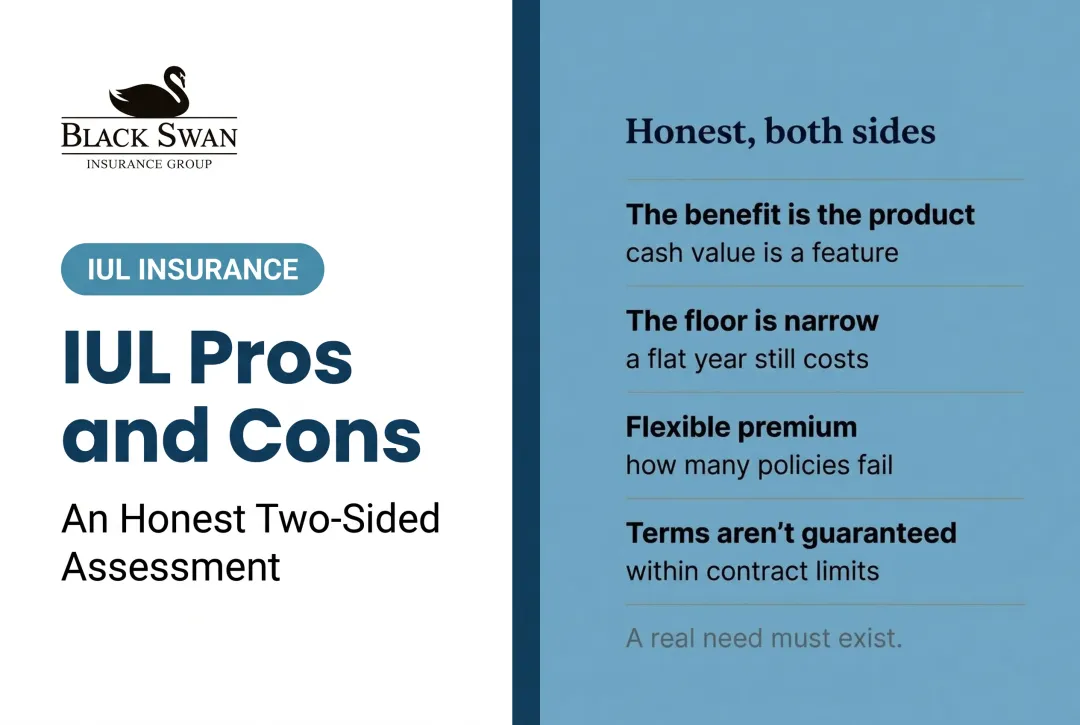
Benefits and Risks, Stated Plainly
The benefits: permanent protection supporting income replacement, estate planning or business continuity while in force; tax-deferred growth potential, with loans or withdrawals possibly income-tax-free where the policy stays active and outside MEC status; a downside floor on index crediting; and optional riders adding living benefits — verify eligibility, cost, and whether using them reduces the death benefit.
LIMRA reported IUL new premium reached $4.5 billion in 2025, up 17% on 2024 and a quarter of total individual life new premium. Growing popularity is not evidence of suitability for your household.

The risks: premiums are not locked as they are in whole life, and that flexibility cuts both ways. Underfunding threatens long-term sustainability. Fees, insurance charges, withdrawals and loan interest all erode cash value. The floor protects crediting, not total value — charges keep deducting in flat or negative years. And unpaid loan balances compound, with tax consequences if the policy lapses or is surrendered.
Against the Alternatives
| Factor | 401(k) | IUL |
|---|---|---|
| Employer match | Often available | None |
| Contribution limits | Capped annually by the IRS | Flexible, but capped by MEC rules |
| Market exposure | Direct | Index-linked crediting, not ownership |
| Death benefit | None | Built in |
| Early access | Often penalised before 59½ | Loans and withdrawals, with trade-offs |
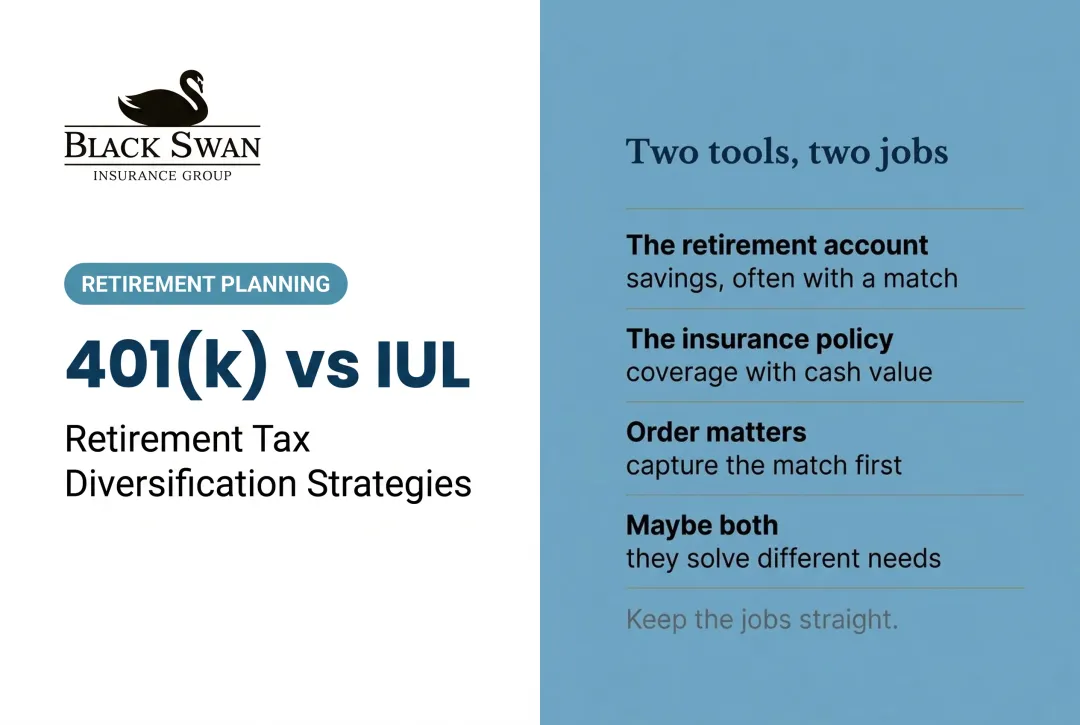
If your employer offers a match, take it before funding a policy for accumulation. That is not a close call.
Term covers temporary protection at lower initial cost with no cash value. Whole life emphasises guarantees — fixed premiums and a guaranteed growth rate. IUL sits between, more flexible than whole life with non-guaranteed crediting that requires monitoring. Against a brokerage account, Roth, IRA or annuity, compare on market exposure, guarantees, flexibility, fees, taxation, liquidity and whether a death benefit is included — using your own savings rate, tax bracket, horizon and reserves rather than a generic ranking.
Stronger Fit
- Earning $150K+ with a genuine permanent insurance need
- Stable surplus cash flow beyond retirement contributions already being made
- Adequate emergency reserves already in place
- Strong insurability and willingness to fund for many years and review annually
Weaker Fit
Not everyone should own one. Look elsewhere if you need inexpensive temporary coverage, lack consistent surplus cash flow, carry high-interest debt or thin reserves, may need near-term liquidity, or expect guaranteed investment-like returns.
Late starters need a different lens. A shorter horizon raises the weight of underwriting outcomes, premium sustainability and design. Compare accelerated funding schedules, term-plus-investing, qualified plans and Roth strategies, brokerage assets and annuities, and other permanent designs side by side before committing.
Risks to Understand Before You Buy
- Caps and participation rates can be lowered after purchase, within contract limits.
- Cost of insurance rises with age and can overtake crediting in a thinly funded policy.
- Underfunding is the leading cause of failure, and it surfaces decades later.
- MEC status is generally permanent and removes the living-access advantage.
- An unpaid loan at lapse or surrender can create taxable income with no cash received.
- Carrier ratings describe the company, not whether your specific contract will perform.
Before signing, ask your adviser directly: how are you compensated on this policy; which carriers did you consider and why this one; is this replacing existing coverage and what are the risks; what are the tax implications of a loan or surrender; and what does ongoing monitoring actually include. Availability, licensing, terms, tax treatment and suitability all vary by state and circumstance.
An annual review is how you catch funding gaps before they become lapse risk — caps, participation rates and charges shift across a policy's life.
This is not set-it-and-forget-it. It is design-it, fund-it, review-it.
Black Swan Insurance Group is a brokerage and guidance resource, not the insurer. A BBB rating or a base of client reviews says something about service and transparency; it predicts nothing about how a specific contract performs.
Find Out Where You Actually Stand
This starts with the Tax-Free Wealth Blueprint Fit Review. If you earn $150K+ and are comparing carriers or reviews, bring the illustrations. We define the actual insurance need, establish a premium you can sustain for decades rather than next year, read guaranteed values alongside illustrated ones, stress-test under worse-than-expected assumptions, and examine the loan terms in detail. If the honest answer is to take the match and buy term, we will say so. If IUL does not fit, we will tell you that too.
Frequently Asked Questions
Are IUL reviews positive or negative?
Neither is the useful frame. A good review ends in fit or no fit for your situation — permanent need confirmed, funding capacity verified, realistic cash-value analysis run, alternatives compared. Skip a step and the review is incomplete.
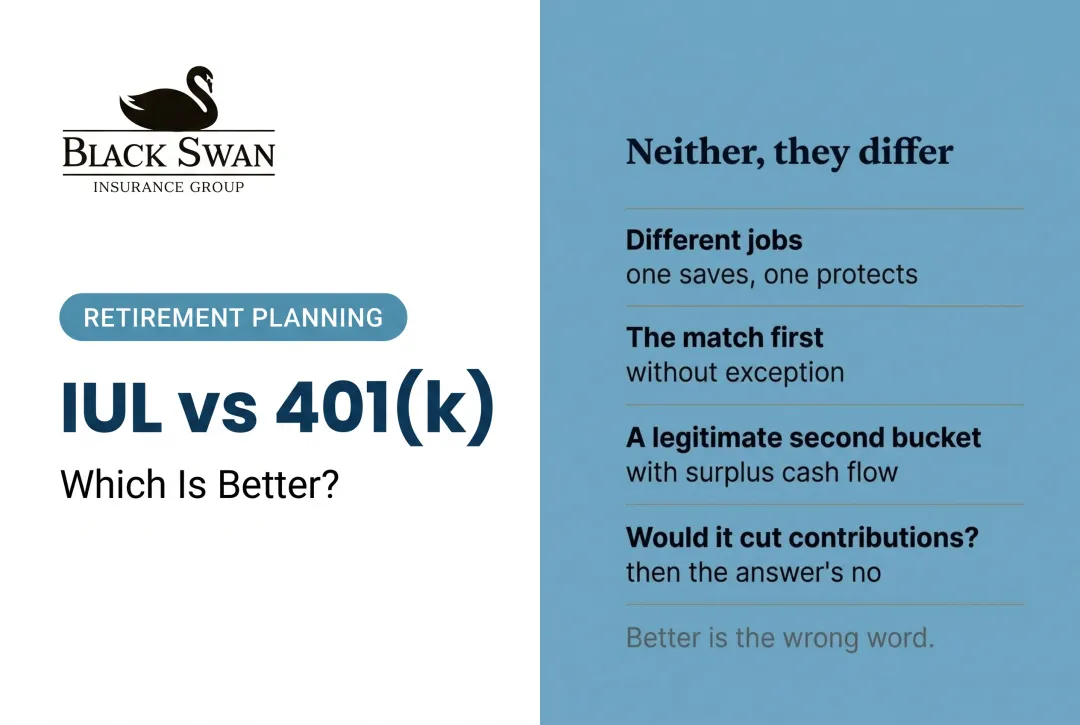
Which is better, a 401(k) or an IUL?
Neither universally. Weigh the employer match, contribution limits, fees, tax treatment, liquidity and whether you genuinely need permanent life insurance. Where a match exists, that comes first.
Is National Life Group IUL good?
Quality depends on the policy version, state availability, riders, charges, guarantees and funding design — not the carrier name. Review the current contract and compare it independently.
What is an IUL product?
Permanent life insurance combining a death benefit with cash value that may earn interest linked to an index. Caps, participation rates, charges, loans and lapse risk all shape actual performance.
What is FlexLife insurance?
FlexLife is National Life Group's name for an indexed universal life policy, often underwritten by Life Insurance Company of the Southwest. Verify the current contract, state availability, crediting terms and guarantees before applying.
Is an IUL a retirement account?
No. It is life insurance with indexed cash-value potential, not a guaranteed retirement account and not a substitute for investing directly. Treating it as one is how people end up disappointed fifteen years in.
Sources
- NAIC — Life insurance topic overview
- NAIC — illustrated rate ceiling guidance
- LIMRA — U.S. individual life insurance new premium tops $17.5 billion in 2025
- NAIC — Life Insurance Illustrations
Disclosure: This article is educational and is not personal tax, legal or investment advice. Indexed universal life is life insurance first. Carrier products, riders, crediting terms, state availability and ratings change and must be verified against the current contract before applying; ratings reflect an insurer's claims-paying ability, not the suitability of any policy. Illustrated values are not guarantees; actual results depend on policy terms, crediting, costs and funding. Any potential tax-advantaged access depends on the policy being properly structured, funded and managed. Actual results depend on policy design, carrier, crediting options, caps, participation rates, expenses, funding and ongoing management. This strategy is not appropriate for everyone. Policy loans and withdrawals reduce cash value and the death benefit, and can create tax consequences if the policy lapses or becomes a modified endowment contract. Consult your own tax, legal and financial professionals for advice specific to your situation.
And remember, it's not what you earn, it's what you keep… enjoy the ride.