By Robert Balgac, Founder, Black Swan Insurance Group | October 9, 2026
You cannot open a max-funded IUL at a bank, a brokerage firm or an investment app. It is purchased through a properly licensed insurance professional and issued by a life insurance carrier. That is the short version of "where," and it takes one sentence.
The longer and more useful question is from whom, because with this product the distribution channel shapes the outcome almost as much as the carrier does. A $150K+ earner who has maxed the 401(k) and hit the Roth phase-out is a valuable prospect, and the design you are shown is heavily influenced by who is showing it to you and what they are appointed to sell.
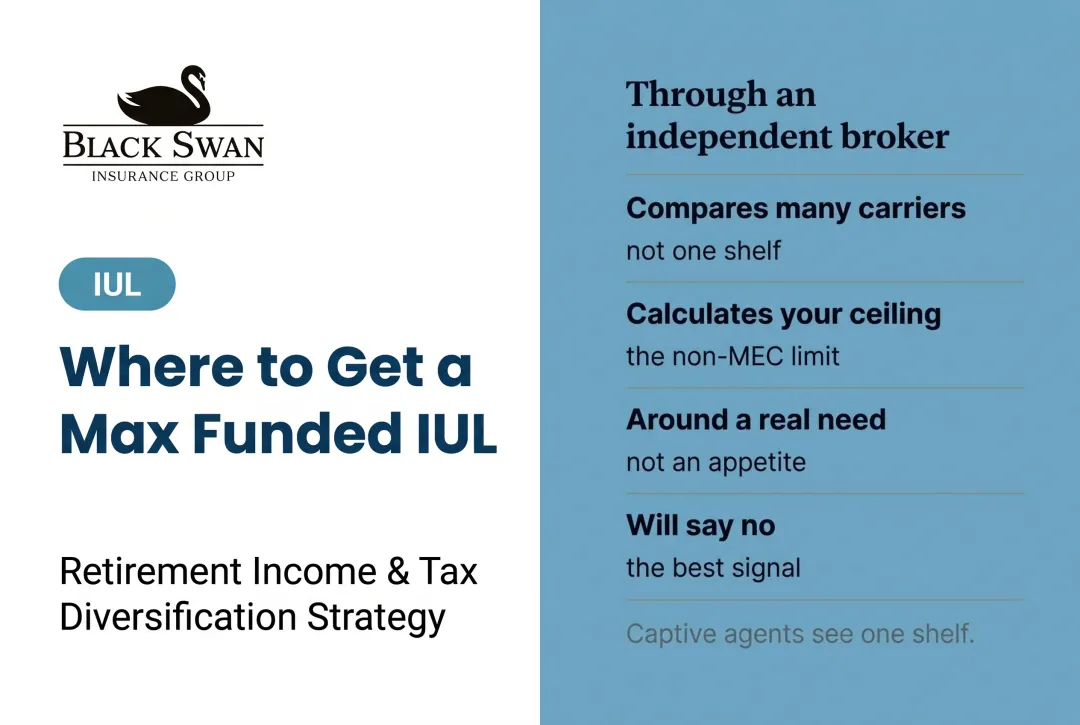
The short answer: buy from someone who compares more than one carrier, will show you the guaranteed column without being asked, and can explain the MEC line and the loan provisions before you raise them. Design, carrier strength, internal costs, underwriting outcome, funding capacity and ongoing service decide whether this works. The advertised cap rate decides almost nothing.
Key Takeaways
- A max-funded IUL is a funding strategy applied to a permanent policy, not a separate account type
- Independent brokerages compare policies across carriers; captive agents typically represent one insurer
- Before applying, request illustrations, guaranteed and non-guaranteed values, policy charges and MEC-limit testing
- Fit requires a long horizon, sustainable cash flow, insurability and a genuine permanent coverage need
- Who sells it to you influences the design, the carrier and whether anyone reviews the policy in year ten
What a Max-Funded IUL Is
Indexed universal life is permanent life insurance pairing a death benefit with a cash-value account whose interest crediting is linked to an external index, often the S&P 500. You are not buying shares. The insurer applies a crediting formula to decide how much interest is added each period.
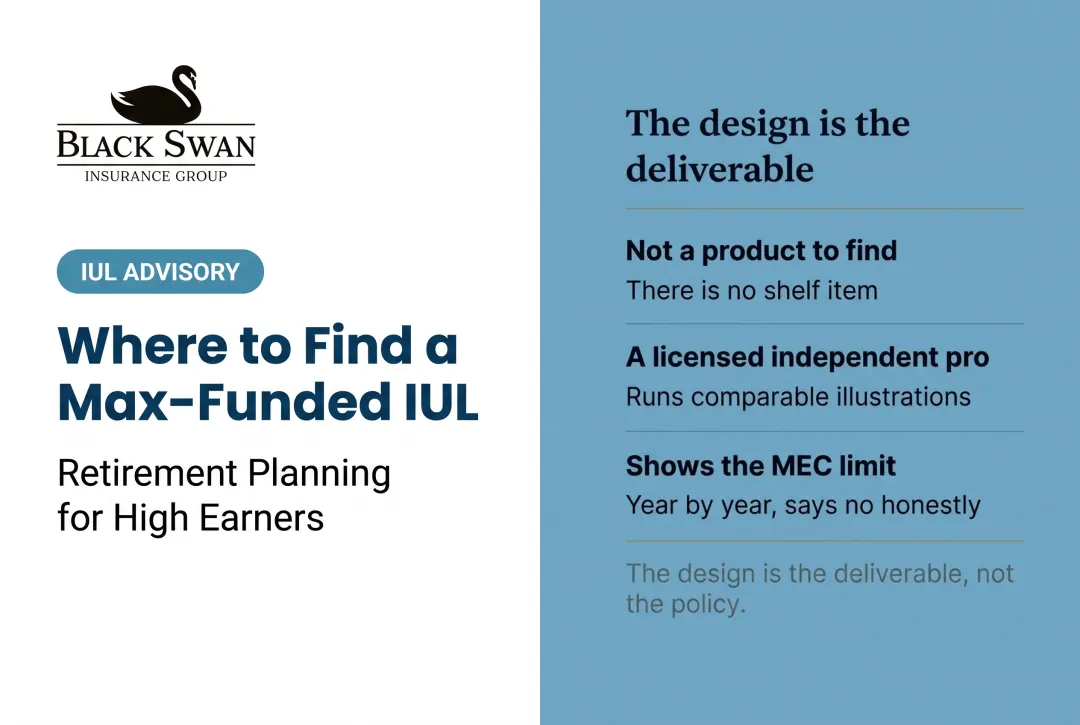
"Max-funded" describes a funding strategy, not a product. It means designing the policy to direct as much premium as reasonably allowed toward cash value while staying inside the IRS limits for life insurance contracts.
Under Section 7702A, if cumulative premiums paid in the first seven contract years exceed the allowable seven-pay limit, the policy becomes a modified endowment contract (MEC). That status change affects how distributions are taxed, according to IRS Revenue Ruling 2005-6.
There is no universal dollar figure for maximum funding. The allowable amount depends on your age and health classification, the death benefit selected, how the policy is designed, and premium timing against the applicable seven-pay test.
Know the mechanics the contract tracks before you shop: premiums (flexible payments you choose), policy charges (cost of insurance, administrative fees, rider costs), the crediting formula (caps, participation rates, spreads, floors), cash value and death benefit, and policy loans that accrue interest against the cash value.
A zero floor is not a guarantee against loss
A 0% indexed-crediting floor protects against negative index performance in a given period. It does nothing about cost of insurance, premium loads, administrative charges, rider costs or surrender charges, all of which keep applying. An underfunded or poorly designed policy loses value even in a year the floor holds.
Zero is your hero in a down year — but the floor applies to the credit, not to the charges.
Where You Can Actually Buy One
| Channel | Carrier Access | What to Know |
|---|---|---|
| Independent brokerage | Multiple appointed carriers | Can compare designs across insurers |
| Captive agent | Typically one insurer | Limited to that company's products |
| Fee-based/investment advisor | Varies | Must partner with a licensed life agent if not licensed themselves |
| Direct-to-consumer website | Varies | Online forms often route you to an agent, not a self-serve policy |
A fee-based financial adviser can add real planning value, but an investment-adviser designation is not a state life insurance licence. Whoever acts as agent or broker on your application needs an active life licence in your state.
Buying life insurance is not opening a brokerage account. The application requires underwriting, design decisions, beneficiary designations and carrier approval. Even where a carrier allows online applications, the insurer still reviews your health, age and financial information before deciding whether — and on what terms — to issue coverage.
A checklist before you apply
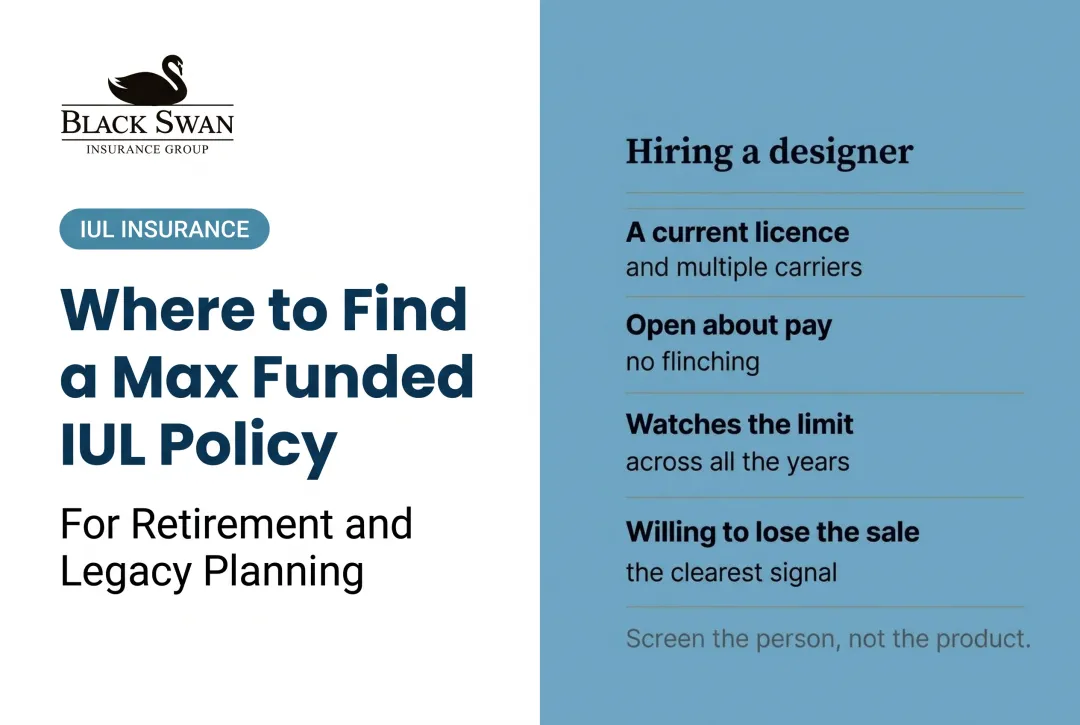
- Verify the licence. Confirm the professional's life insurance licence in your state through your state insurance department or the NAIC's lookup tool.
- Ask about carrier appointments. Find out which carriers they are appointed with, and whether your comparison includes more than one suitable option.
- Clarify ongoing service. Determine who explains the illustration, manages underwriting, and conducts future policy reviews.
- Understand compensation. Ask how they are paid and whether they will disclose relevant costs and trade-offs upfront.
That fourth question makes people uncomfortable to ask and should make nobody uncomfortable to answer.
Where Black Swan Insurance Group fits
Black Swan Insurance Group is an Ohio-based independent brokerage founded in 2017. Clients move through a five-step process: needs assessment, coverage exploration, policy customisation, transparent sign-up, and continued guidance with annual reviews. We compare IUL against the alternatives — whole life, term, 401(k)s and Roth accounts — before recommending a fit.

If you are exploring whether a max-funded IUL belongs in your plan, confirm current state availability, licensing, carrier appointments and product eligibility directly before applying. These details vary by state and by individual circumstances.
Red flags
Do not select a provider based solely on a promised tax result, a single illustration with no stress-testing, the highest advertised current cap rate, or claims that an IUL is "guaranteed" to outperform a 401(k), Roth IRA or market portfolio.
A great IUL is engineered. A bad IUL is sold.
The Ultimate IUL Blueprint
Before you shortlist anyone, know what you are shopping for. The Blueprint covers what a max-funded design has to survive: funding levels, caps and charges, the MEC line, loan timing, and what to demand from an illustration.
Evaluating the Agent, the Brokerage and the Carrier
These are two separate checks, not one. The agent provides advice and service. The carrier issues the policy, sets contractual terms, processes claims and manages the crediting provisions. A strong agent with a weak carrier design — or the reverse — still leaves you exposed.
Judge the design, not the headline rate. Before comparing caps, review the death-benefit option, face amount, premium schedule and funding period; the internal charges, meaning cost-of-insurance structure, administrative fees, rider expenses and surrender charges; and whether caps, participation rates and spreads are guaranteed or subject to change.
Check carrier financial strength. AM Best, Moody's, S&P Global and Fitch score insurers on balance-sheet strength and claims-paying capacity. Look up the rating for the specific issuing entity on the agency's own site rather than a figure quoted secondhand. Confirm the current rating and outlook, which legal entity issues the policy, and the date of the latest rating action.
Scrutinise the loan provisions. Compare fixed versus indexed or participating loan options and their rates, understand how loan interest and crediting treatment interact, and ask about overloan protection as it applies to that specific policy and its conditions. These riders are not universal or unconditional.
The loan is not the problem. The unmanaged loan is the problem.
Demand realistic illustration analysis. An illustration is a projection built on assumptions, not a promise. Separate guaranteed from non-guaranteed values and request scenarios showing lower crediting rates, reduced or missed premiums, and early policy-loan activity.
NAIC's illustration guideline, AG 49-A, restricts how insurers can illustrate indexed-credit assumptions and loan leverage. It limits what carriers can show you, not what the policy will deliver (NAIC AG 49-A guidance).
Then bring in your other advisers. Once design, carrier strength, loans and illustrations check out, have your tax professional, financial planner and attorney review how the policy fits retirement income, estate plans or business goals before you sign.
What the Critics Get Right
The fairest criticism of this product's distribution is simple: the people best positioned to explain a max-funded IUL are the people paid the most when you buy one, and the compensation on a maximum-funded design is substantial.
That conflict is real and no disclosure fully resolves it. The practical defences are to insist on more than one carrier's illustration on identical assumptions, to require the guaranteed ledger without asking twice, and to notice whether anyone volunteers a reason not to proceed. An adviser who has never talked a client out of this product is not an adviser you should take this advice from.
The second fair criticism is that "max funded" sounds like an optimisation and is often an overcommitment. Funding to the absolute MEC ceiling leaves no headroom if income dips, and headroom is what keeps these contracts alive.
What to Expect When You Buy
- Clarify objective and budget. Document the permanent death-benefit need, cash-value goals, time horizon, liquidity needs, existing coverage and emergency reserves.
- Complete a preliminary needs and underwriting review. Age, health, medications, family history, occupation and lifestyle all affect what is available and at what cost.
- Compare carrier illustrations on consistent assumptions. Premiums, cash value, death benefit, surrender value and charges at key policy years, guaranteed and non-guaranteed, side by side.
- Determine a sustainable funding target. Have your agent calculate your non-MEC premium capacity for your case, not a generic "maximum." Confirm whether premiums are level, increasing or flexible, and what happens if you pay less than planned.
- Submit the application and complete underwriting. The carrier may request medical records, an exam, lab work or financial documentation.
- Review the issued policy before accepting. Compare it against the original illustration and confirm the free-look period, beneficiaries, premium schedule, and any changes from the underwriting decision.
- Maintain the policy with regular reviews. Monitor cash value, loans and lapse risk. Loans, lower premiums or death-benefit changes can alter tax treatment and long-term results.

This is not set-it-and-forget-it. It is design-it, fund-it, review-it.
Max funding should never crowd out emergency savings, debt payments, qualified retirement contributions or other core priorities. Document major policy changes with your agent, and talk with a tax professional before large distributions.
Stronger Fit
- A genuine permanent life insurance need
- Earnings of $150K+ with stable surplus cash flow beyond emergency reserves
- Insurability and a long time horizon — decades, not years
- Interest in tax diversification, rather than a wholesale replacement for every retirement account
Weaker Fit
Other tools deserve priority if you have insufficient emergency savings or high-interest debt, unstable income or short-term liquidity needs, no identifiable permanent insurance need, or an expectation of uncapped, direct-market-level returns. This is not appropriate for everyone, and a thin-funded policy bought for the wrong reason is worse than no policy.
How it compares with qualified plans and Roth accounts
An IUL, a 401(k) and a Roth IRA do different jobs. Employer matches, contribution limits, liquidity rules, investment choices and insurance protection all differ. Qualified plans and Roth accounts usually have lower internal costs and statutory contribution caps. An IUL adds a permanent death benefit and policy-loan liquidity mechanics — along with policy charges and loan rules those accounts do not have. Term insurance remains the cheaper answer whenever the protection need has an end date.

Weigh the full trade-offs before reallocating savings.
Risks to Understand Before You Buy
- Early surrender charges and policy expenses can leave cash value below premiums paid in the early years.
- Non-guaranteed caps and participation rates can change over time, subject to contract minimums.
- Policy loans and withdrawals reduce available value and death benefit, increasing lapse risk.
- MEC status generally taxes gain before basis on distributions, with a possible 10% additional tax before age 59½.
- Funding to the absolute ceiling removes the headroom that protects the contract in a lean year.
- Cost of insurance rises with age, which is what breaks thinly funded designs late.
- Replacing existing coverage triggers new underwriting, surrender charges and fresh contestability.
Find Out Where You Actually Stand
This starts with the Tax-Free Wealth Blueprint Fit Review. If you earn $150K+ and you are trying to work out who to buy from and whether to buy at all, we define the job the coverage has to do, compare carrier designs on identical assumptions, read guaranteed against illustrated values side by side, test the non-MEC funding capacity for your actual case, and stress-test the design through lower crediting and a reduced-income year. If term solves your problem, we will say so and you will have spent nothing. If IUL does not fit, we will tell you that too.
Frequently Asked Questions
Where can I buy a max-funded IUL?
Through a properly licensed insurance professional, issued by an insurance carrier — not opened at a bank or brokerage. Verify state licensing, carrier appointments and product availability before applying.
How do I max fund an IUL?
The policy must be designed around your age, health, death benefit and premium capacity while staying within applicable seven-pay and MEC limits. The funding amount should come from the carrier's illustration system, not a rule of thumb, and must remain sustainable for your budget.
Is a max-funded IUL a good idea?
It depends on a genuine permanent insurance need, a long horizon, insurability, stable cash flow and adequate liquidity. It is not appropriate for everyone and should be compared against alternatives like 401(k)s and Roth accounts first.
What should I look for in an agent?
State licensing, carrier appointments and transparent compensation. Favour agents who use realistic illustrations, explain MEC rules and loan risks clearly, and commit to ongoing policy reviews.
Can I buy one directly from an insurance company?
The policy is issued by an insurance company, but it is typically purchased with help from a licensed agent or brokerage, because underwriting and design require guidance. Understand who provides service after the sale before you apply.
Sources
Disclosure: This article is educational and is not personal tax, legal or investment advice. Indexed universal life is life insurance first. Illustrated values are not guarantees; actual results depend on policy terms, crediting, costs and funding. Any potential tax-advantaged access depends on the policy being properly structured, funded and managed. Actual results depend on policy design, carrier, crediting options, caps, participation rates, expenses, funding and ongoing management. This strategy is not appropriate for everyone. Policy loans and withdrawals reduce cash value and the death benefit, and can create tax consequences if the policy lapses or becomes a modified endowment contract. Product availability, underwriting outcomes and state licensing vary. Consult your own tax, legal and financial professionals for advice specific to your situation.
And remember, it's not what you earn, it's what you keep… enjoy the ride.