By Robert Balgac, Founder, Black Swan Insurance Group | October 5, 2026
The word "scam" is doing something specific in this search. It usually means: I have been pitched something I do not fully understand, by someone whose pay depends on my saying yes, and the numbers looked too smooth. That instinct is healthy. Keep it.
Indexed universal life is a regulated life insurance contract, not a fraud. It is life insurance first, and any potential tax-advantaged access to its cash value depends on the policy being properly structured, funded and managed. It is also one of the most frequently mis-sold products in personal finance, and both of those statements are true at the same time. The useful question is not whether the category is legitimate. It is whether the specific policy in front of you was designed for your numbers or for someone else's commission.
The short answer: IUL is a legitimate, state-regulated life insurance product. It is not a scam. The complaints are real and mostly trace to three things: policies funded at the minimum premium with an oversized death benefit, illustrations presented as forecasts, and loans left unmanaged until the contract collapses. A properly designed policy behaves very differently from a badly designed one, and most people who are pitched an IUL should not buy one.
Key Takeaways
- IUL is regulated life insurance, sold by licensed agents, with state guaranty association backing — the category is legitimate
- The common complaints are accurate descriptions of badly designed policies, not of the product category
- Minimum funding plus a large death benefit is the configuration behind most angry reviews
- Illustrations are models, not promises; caps and current charges can be adjusted within contract limits
- The honest test is whether you need permanent coverage at all — most households do not
Where the Bad Reputation Comes From
An IUL is permanent life insurance first. When it fails, it usually fails in one of four identifiable ways, and none of them requires anyone to have broken the law.
One: Minimum Funding, Maximum Death Benefit
A clean round death benefit — $250,000, $500,000, $1 million — often signals a policy sized for the illustration rather than optimised for cash value. Pair that with a minimum premium and the cost of insurance eats the account. Fifteen years later the owner receives a notice demanding a premium they never expected.
Two: The Illustration Treated as a Forecast
A single assumed rate applied every year for thirty years has never described a real index. If the illustration only works when everything goes right, it is not a plan. It is a wish with a binder.

Three: The Unmanaged Loan
Loans are presented as access. They are debt. Interest accrues whether or not you pay it, the death benefit falls by the balance, and charges continue on top. The loan is not the problem. The unmanaged loan is the problem.
Four: Nobody Reviewed It
This is not set-it-and-forget-it. It is design-it, fund-it, review-it. A contract with adjustable crediting terms and rising insurance costs requires an annual look, and most owners never get one after the sale.
This is not on you. You were the client. You were supposed to be guided.
What the Critics Get Right
Take the strongest version of the criticism seriously, because it is largely correct.
- Fees are higher than an index fund's. They are. The question is whether the design leaves enough net value after costs.
- Caps can be reduced after you buy. They can, within contract limits. The guaranteed minimum is what you actually contracted for.
- Many agents do not explain lapse risk. Too many policies are designed poorly and must be audited.
- Returns lag the market. They do. Price-return indices exclude dividends and caps limit the upside.
- It is oversold to people who do not need it. This is the most accurate criticism of all.
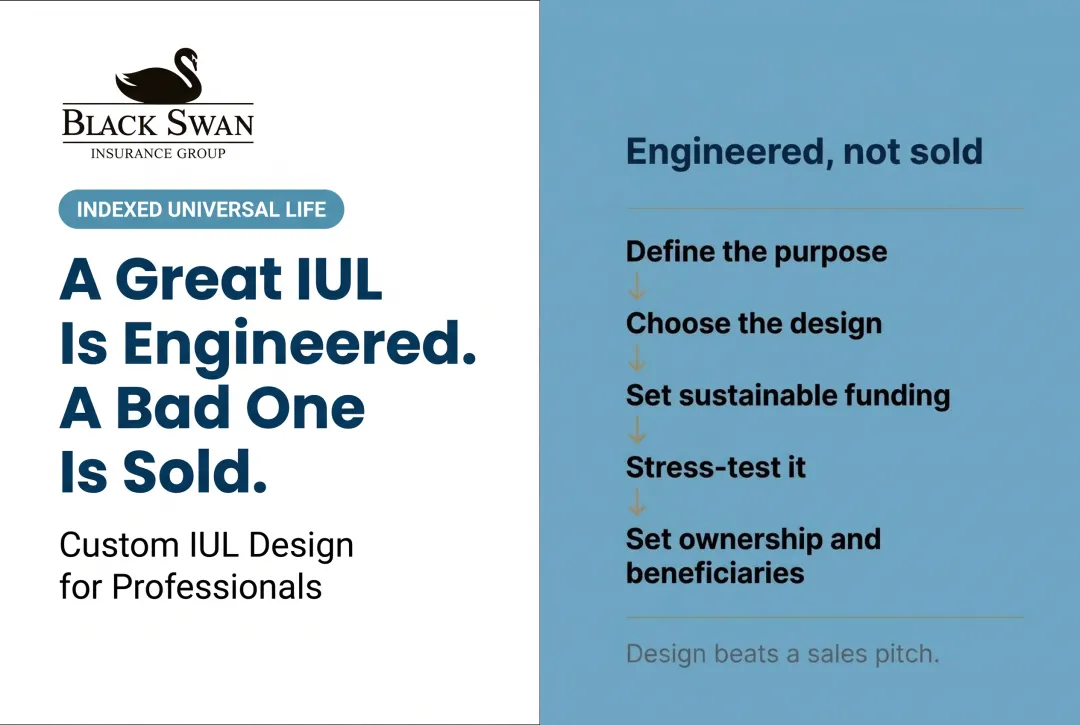
Where the criticism overreaches is in the conclusion. "Badly designed IUL deserves criticism" is not the same statement as "IUL is a scam." A great IUL is engineered. A bad IUL is sold.

How to Tell Which One You Are Being Shown
Ask these six questions. The answers, and the willingness to give them, tell you most of what you need to know.
- What is the guaranteed column — what happens at maximum charges and minimum crediting?
- Show me the projection with two or three zero-credit years in the first decade.
- What is the guaranteed minimum cap and the guaranteed maximum spread?
- What is the full surrender charge schedule, year by year?
- Is this the minimum, target, planned or maximum premium?
- How are you paid on this policy?
The last one is not an accusation. The insurance company pays compensation if a policy is issued. That is exactly why transparent design matters, and an agent who answers it calmly is usually the one worth continuing with.
Compare It Against the Alternatives
Before concluding either that it is a scam or that it is the answer, price the honest comparisons: term insurance plus investing the difference, your 401(k) with the full employer match, a Roth if your income allows one, a taxable brokerage account, and whole life if guarantees matter more than flexibility.
What Regulation Actually Covers
Knowing where the protections are, and where they stop, is more useful than a verdict on the category.
Licensing and suitability. Agents are state-licensed, and suitability obligations apply to life insurance sales in most states. That does not mean every sale is suitable; it means there is a standard to point at when one is not.
Illustration standards. The NAIC Life Insurance Illustrations Model Regulation governs how projections may be presented, including the requirement to show guaranteed values. An illustration that omits the guaranteed column is not following the intent of that framework.
The free-look period. Every state provides a window after delivery — commonly ten to thirty days — in which you can return the policy for a refund. This is the single most valuable consumer protection in the product and the most underused.
Guaranty associations. If a carrier becomes insolvent, state guaranty associations provide coverage up to statutory limits, which vary by state and by benefit type.
What regulation does not do is make an unsuitable purchase suitable, or stop a carrier reducing a non-guaranteed cap within the contract's limits. Those remain your responsibility to evaluate before signing.
If you are inside your free-look window right now and unsure, that is the time to get a second reading — not after it closes.
The Ultimate IUL Blueprint
A plain-English walkthrough of how these policies are designed, how they fail, and the questions that separate a design from a sales illustration.
Who It May Fit, and Who Should Walk Away
Stronger Fit
- $150K+ stable income with $500–$2,500 a month of sustainable funding capacity
- A genuine permanent protection, legacy or business-continuity need
- Already capturing the full employer match and funding available retirement accounts
- Willing to fund near the maximum rather than the minimum, and to review annually
- Comfortable that this is not a market substitute
Weaker Fit
Not everyone should buy an IUL, and most people who land on this page from this search term should not. If you came here suspicious, the suspicion is usually well founded.
- Being pitched a minimum-funded policy with a large round death benefit
- No permanent protection need
- Unstable income, no emergency reserve, or high-interest debt outstanding
- Any pressure to decide quickly
- An agent who will not produce the guaranteed column

Risks to Understand Before You Buy
- Underfunding leading to lapse is the dominant failure mode and often surfaces fifteen or more years in.
- Non-guaranteed elements can be adjusted within contract limits, including caps and current charges.
- Charges continue in a zero-credit year, so cash value can fall.
- Surrender charges can apply for ten to fifteen years.
- Policy loans and withdrawals reduce cash value and the death benefit, and a lapse or surrender with gain and an outstanding loan can create taxable income with no cash received to pay it.
- MEC risk. Crossing the seven-pay limit under I.R.C. § 7702A permanently changes distribution taxation for that contract.
Find Out Where You Actually Stand
Start with the Tax-Free Wealth Blueprint Fit Review. If you earn $150K+ and want someone to read the illustration back to you honestly — including telling you to walk away — that is what this review is for. We check the funding level, the guaranteed column, the crediting assumptions and the alternatives. If IUL does not fit, we will tell you that too.
Frequently Asked Questions
Is IUL a scam?
No. It is a regulated life insurance product. Badly designed IUL deserves the criticism it gets, and the question worth asking is whether a properly structured policy fits your numbers.
Why do so many people say IUL is a ripoff?
Because minimum-funded policies with oversized death benefits fail years later, and because illustrations were presented as forecasts. Those are design and sales failures, and they are common.
Can an IUL policy actually collapse?
Yes, if underfunded, over-loaned or ignored. That is why funding level and annual reviews matter more than the crediting rate.
Are the returns guaranteed?
No. The floor applies to indexed crediting, and caps, participation rates and current charges are generally non-guaranteed within contract limits.
How do I know if my agent is being straight with me?
Ask for the guaranteed column, the surrender schedule, which premium level you were quoted, and how they are compensated. Reluctance on any of those is your answer.
I already own one and I am worried. What now?
Request a current in-force illustration at guaranteed and non-guaranteed values before making any decision. Surrendering on impulse can destroy the only value left in the contract.
Sources
- NAIC — Life Insurance — product definitions and consumer guidance
- NAIC, Life Insurance Illustrations Model Regulation (Model #582) — illustration and non-guaranteed element standards
- FINRA — Investor guidance — evaluating insurance-based products
- National Association of Insurance Commissioners buyer's guide — affordability and periodic review
- I.R.C. § 7702A — Modified Endowment Contract and the seven-pay test
- I.R.C. § 72 — additional tax on early distributions
Disclosure: The information on this page is educational in nature and does not constitute personalized financial, tax, or legal advice. Actual results depend on policy design, carrier, crediting options, caps, participation rates, expenses, funding, loans, and ongoing management. Policy loans and withdrawals reduce cash value and the death benefit, and can create tax consequences if the policy lapses or becomes a modified endowment contract. Consult a licensed insurance professional and, where appropriate, a tax or financial advisor before making any insurance or financial decision. Indexed universal life is life insurance first. Illustrated values are not guarantees; actual results depend on policy terms, crediting, costs and funding. This strategy is not appropriate for everyone.
And remember, it's not what you earn, it's what you keep… enjoy the ride.