By Robert Balgac, Founder, Black Swan Insurance Group | October 5, 2026
Life insurance used to mean one thing: a payout after death. The pitch has changed, and the most common version now is "what does this policy do for me while I am still here?"
It is a fair question, and the honest answer has a price attached. Living benefits on an indexed universal life policy mean two things: access to cash value, and riders that let you accelerate part of the death benefit after a qualifying illness. Accelerating reduces what your beneficiaries eventually receive. That is not a footnote. It is the mechanism.
The need behind the question is genuine. In 2024, 23% of U.S. adults faced a major unexpected medical expense, with a median cost between $1,000 and $1,999, per the Federal Reserve's 2025 report on household economic well-being. For a $150K+ household the number is bigger, and so is the income disruption behind it.
The short answer: Living benefits combine cash-value access with riders accelerating the death benefit for chronic, critical or terminal illness. Accelerated benefits reduce the death benefit your beneficiaries later receive. Cash value is not invested in an index — caps, participation rates and charges shape the result. These work best where you need permanent coverage and can fund the policy consistently for years, and they are not a substitute for health insurance, disability coverage, long-term care insurance or an emergency fund.
Key Takeaways
- Living benefits combine cash-value access with riders accelerating the death benefit for qualifying illness
- Accelerated benefits usually reduce the death benefit beneficiaries later receive
- Cash value is not invested in an index; caps, participation rates and charges shape returns
- They fit best where permanent coverage is needed and the policy can be funded consistently
- They complement, and never replace, health, disability and long-term care coverage
What Living Benefits Actually Are
Features that let a policy deliver value while you are alive. On an IUL they fall into two buckets.
Cash value access. Part of your premium builds cash value over time, reachable through withdrawals or policy loans subject to contract rules and available balance.
Accelerated death benefit riders. These advance part of the death benefit early on a qualifying chronic, critical or terminal illness diagnosis.
How Cash Value Grows
This is where the confusion usually starts. Cash value is not invested in the S&P 500 or any index. FINRA explains that IUL policies use a chosen index purely as a reference point for calculating interest credits. You are not buying shares or fund units.
- Floor — the minimum credited rate even when the index performs poorly, often 0%
- Cap — the maximum credited rate, however well the index performs
- Participation rate — the percentage of index gains actually credited
- Policy charges — cost of insurance, administrative fees and rider costs, deducted regardless of index performance
The NAIC draws a firm line between guaranteed values fixed at issue and illustrated, non-guaranteed values based on current assumptions that can change. Never treat an illustration as a promise.

Zero is your hero in a down year — but the floor applies to the credit, not to the charges, and the rider costs come out too.
Living benefits typically support emergency liquidity, medical or care-related costs, income gaps during illness, and retirement supplementation. They are a feature within a permanent policy, not a substitute for health insurance, disability coverage, long-term care insurance or your emergency fund.
Cash-Value Access, and Its Cost
Cash value can serve as a liquidity source through loans or withdrawals, subject to policy rules, available balance and any surrender charges.
Practical uses for high earners and business owners: supplementing retirement income in lower-bracket years; bridging a temporary cash-flow gap without selling investments at a bad moment; covering an unexpected expense without disrupting a business or portfolio.
The trade-offs weigh the same. Loans and withdrawals reduce cash value and the death benefit, and unpaid loan balances accrue interest.
Per the NAIC, a policy stays in force only while cash value can cover ongoing insurance costs. Run that balance too low and the policy lapses.
Review regularly: cash surrender value, net cash value, outstanding loan balance, death benefit, premium sufficiency, and both guaranteed and non-guaranteed projections.
Illness Riders, and What They Require
Accelerated death benefit riders can release part of your death benefit after a qualifying terminal, chronic or critical illness diagnosis. Availability depends on the contract and your state.
The underlying need is real. The 2024 Genworth and CareScout Cost of Care Survey put annual costs at:
- $77,792 for a home health aide
- $70,800 for assisted living
- $111,325 for a semi-private nursing home room
- $127,750 for a private nursing home room

These riders help with treatment costs, household bills, income disruption or home modifications. They are not comprehensive health or long-term care insurance, and treating them as such is how families discover the gap at the worst possible time.
Before relying on one, confirm:
- Qualification standard — medical certification, activities-of-daily-living thresholds, or cognitive impairment definitions
- Waiting periods — how long before a claim can be paid
- Benefit percentage and maximum — how much of the death benefit can be accelerated
- Rider status — built in, or added at extra cost
This matters most for families with dependents, business obligations or thin care reserves.
What the Critics Get Right
The criticism of living-benefit marketing is fair, and stating it plainly costs nothing.
Critics are right that "living benefits" is a phrase engineered to make a death benefit sound like an asset, and that accelerating it is spending the same money twice in the family's mind. They are right that the rider definitions are narrow, the qualification standards are strict, and plenty of people who expected to qualify will not. And they are right that a standalone long-term care or disability policy usually provides better coverage for the specific risk than a rider bolted onto a life contract.
Where the criticism runs out is in households that need permanent coverage anyway. If the death benefit is being bought regardless, a rider that releases part of it during a qualifying illness is a reasonable addition — provided everyone understands it reduces what is left. The failure is not the rider. It is selling the rider as care coverage.
Permanent Protection, With Conditions
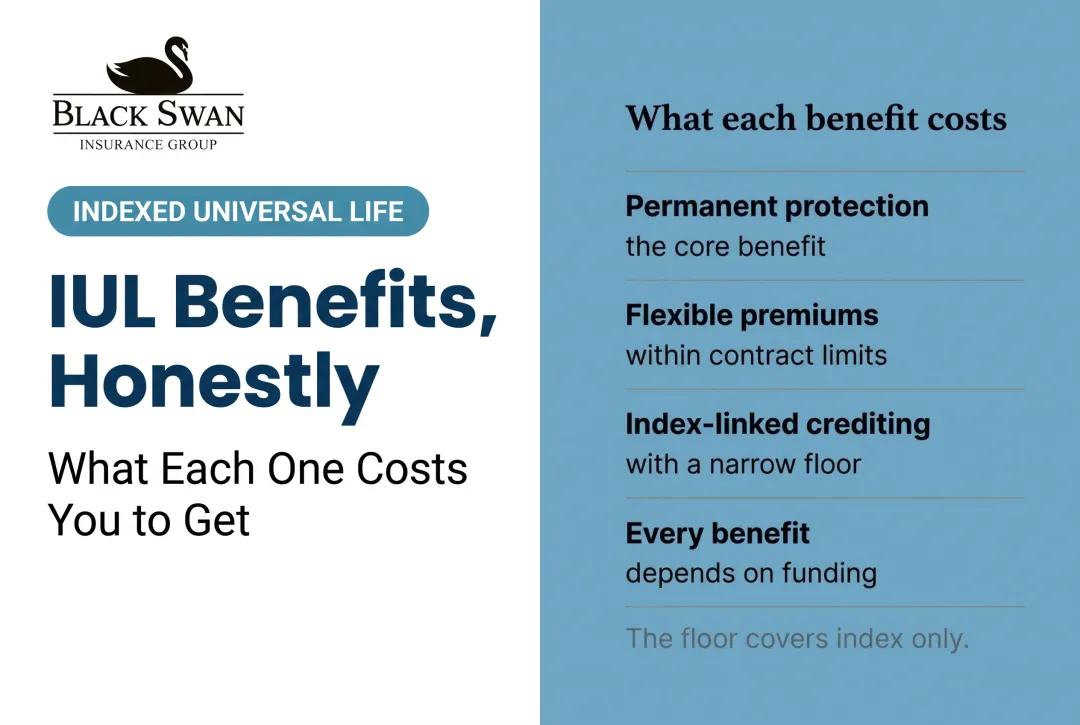
An IUL combines a permanent death-benefit goal with flexible premium and death-benefit options, as long as you keep meeting the funding requirements. Living benefits complement — they do not replace — term insurance, 401(k)s, IRAs, brokerage accounts, disability insurance and long-term care planning.
Cash value growth is generally tax-deferred, and policy loans are typically not taxed while the policy stays in force. That is potential tax-advantaged access, conditional on the contract being properly structured, funded and managed.
The IRS notes that surrender proceeds above your cost basis are taxable, and policies classified as modified endowment contracts face less favourable distribution rules.
Track over time: funding consistency, cost of insurance, premium allocation, death-benefit adequacy, and whether the policy stays in force under conservative assumptions rather than the illustration.
The Ultimate IUL Blueprint
If living benefits are part of why you are considering a policy, the Blueprint covers the design decisions that determine whether they are reachable: funding levels, rider costs, the MEC line and loan timing.
What Goes Wrong When Nobody Reviews It
Treating a policy as set-and-forget causes real damage. A LIMRA and Society of Actuaries lapse study covering 33.5 million policy exposures from 2015–2021 found lapse rates consistently rising in policy year 15 and beyond — precisely when owners assume everything is on autopilot.
- Cash value falls short of projections when premiums, charges or crediting assumptions were misunderstood at purchase
- Illness claims are denied when the condition, waiting period or rider definition is not satisfied
- Beneficiaries receive less than planned after an acceleration reduces the death benefit
- Loans and withdrawals compound quietly, raising lapse risk and creating tax exposure if the policy terminates with a balance outstanding
- The wrong tool was bought where inexpensive term insurance, guaranteed accumulation, or standalone disability or long-term care coverage fitted better
Who It Fits
Stronger Fit
- A genuine need for lifelong coverage, standing on its own merits
- Household income of $150K+ with sustainable surplus cash flow
- Foundational protection and retirement needs already handled
- Dependents, business obligations or thin care reserves that create real exposure to a diagnosis
- Willingness to review funding, rider terms and performance every year
Weaker Fit
Not everyone should buy an IUL for its living benefits. Standalone disability and long-term care coverage usually pay more per dollar of premium.
- The real requirement is care coverage — a standalone long-term care or disability policy covers that risk better
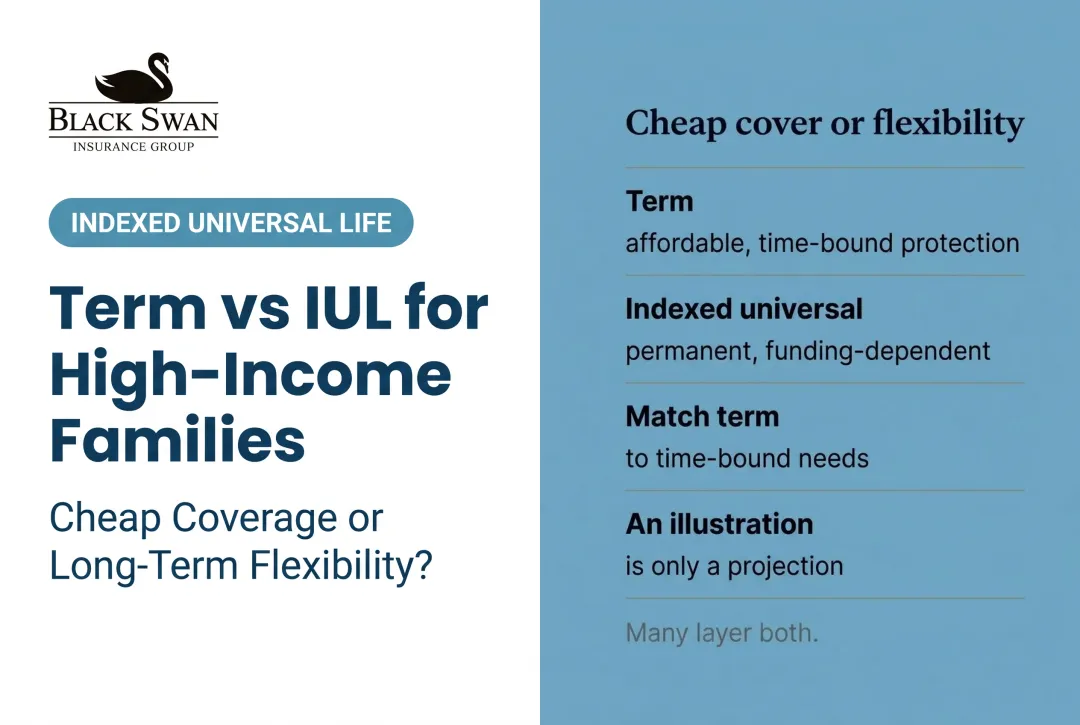
- The real requirement is temporary protection — term insurance is cheaper and cleaner
- Funding cannot be sustained through a downturn
- Liquidity is needed in the near term
- Nobody will monitor the contract
Getting Real Value From Them
Before you apply, compare: the amount and duration of permanent coverage you actually need; guaranteed and non-guaranteed values under conservative assumptions; rider definitions, costs, eligibility standards and how acceleration affects the death benefit; and premium affordability during lower-income years, career shifts or business downturns.
Make an honest fit-or-no-fit call first, comparing against term insurance, whole life and other universal life designs; 401(k)s, Roth strategies and brokerage accounts; and disability coverage and long-term care solutions.
Review regularly: policy values, premium sufficiency and crediting assumptions against actual performance; cost of insurance increases, loan balances and withdrawal history; beneficiary designations; and rider terms, remaining acceleration capacity and claim documentation readiness.

This is not set-it-and-forget-it. It is design-it, fund-it, review-it — and the lapse data shows exactly what happens to the people who skip the third part.
Risks to Understand Before You Rely on Them
- Accelerating the death benefit reduces what beneficiaries receive, permanently
- Rider qualification standards are narrow, and a diagnosis does not automatically mean a claim
- Waiting periods can delay payment when the need is immediate
- Rider charges reduce cash value whether or not you ever claim
- Charges continue in a 0% crediting year, so cash value can fall with the floor intact
- Cost of insurance rises with age and is deducted regardless of index performance
- Loans and withdrawals reduce cash value and death benefit, and a lapse with a loan outstanding and gain in the contract creates taxable income
- Crossing the seven-pay limit makes the contract a MEC and changes distribution taxation
- Lapse rates rise from policy year 15, which is when most owners have stopped paying attention
Find Out Where You Actually Stand
This starts with the Tax-Free Wealth Blueprint Fit Review. If you earn $150K+ and living benefits are part of the appeal, we read the rider definitions rather than the brochure, test whether you would actually qualify, price standalone long-term care and disability coverage alongside, and model what an acceleration leaves for your beneficiaries. If it does not fit, we will tell you that too.
Frequently Asked Questions
Does using a living benefit reduce the death benefit?
Usually, yes. Accelerating advances part of the death benefit early, and beneficiaries receive correspondingly less. Confirm the exact mechanics in your rider before relying on it.
Is an accelerated benefit rider the same as long-term care insurance?
No. Riders help with costs during a qualifying illness; they are not comprehensive care coverage. If care is the risk you are hedging, price a standalone policy against the rider.
What qualifies me to claim?
It depends on the rider: medical certification, activities-of-daily-living thresholds, or cognitive impairment definitions, usually with a waiting period. Read those definitions before assuming eligibility.
Are the riders free?
Some are included at issue and some cost extra, and either way the charge affects cash value. Confirm which yours is and what it costs annually.
Are policy loans taxed?
Generally not while the policy stays in force and is not a modified endowment contract. A lapse or surrender with a loan outstanding and gain in the contract can create taxable income.
Should I buy term insurance and a separate care policy instead?
Frequently, yes, and it deserves pricing. Term plus standalone disability or long-term care coverage often provides better protection per dollar for a household without a permanent insurance need.
Sources
- Federal Reserve — Economic Well-Being of U.S. Households in 2024
- Genworth and CareScout — 2024 Cost of Care Survey
- FINRA — Insurance products
- NAIC — Life Insurance
- IRS Publication 525 — Taxable and Nontaxable Income
- LIMRA and Society of Actuaries — 2015–2021 UL lapse rate study
Disclosure: This article is educational and is not personal tax, legal or investment advice. Indexed universal life is life insurance first. Rider availability, definitions and costs vary by contract and by state; accelerating a death benefit reduces the amount payable to beneficiaries. Living benefit riders are not health insurance, disability insurance or long-term care insurance. Actual results depend on policy design, carrier, crediting options, caps, participation rates, expenses, funding and ongoing management. Policy loans and withdrawals may reduce cash value and death benefit and can create tax consequences if the policy lapses or becomes a modified endowment contract. This strategy is not appropriate for everyone. Illustrated values are not guarantees; actual results depend on policy terms, crediting, costs and funding. Consult your own tax, legal and financial professionals for advice specific to your situation.
And remember, it's not what you earn, it's what you keep… enjoy the ride.