By Robert Balgac, Founder, Black Swan Insurance Group | October 9, 2026
Choosing between indexed universal life and variable universal life comes down to one question that nobody phrases honestly: how much market risk are you willing to take inside a life insurance contract, where a bad year does not just cost you money — it can cost you the policy?
Both are permanent life insurance with flexible premiums and a death benefit. Both build cash value. The way that cash value grows, and the way it can shrink, differs enough that the wrong choice can strain your ability to keep premiums sustainable, disrupt retirement income plans, or leave you carrying more investment risk than you intended.
For a $150K+ earner who has maxed the 401(k) and hit the Roth phase-out, this distinction has real weight. Policy terms, tax treatment, costs and availability vary by insurer and state, and nothing here replaces a conversation with a licensed professional reviewing your actual situation.
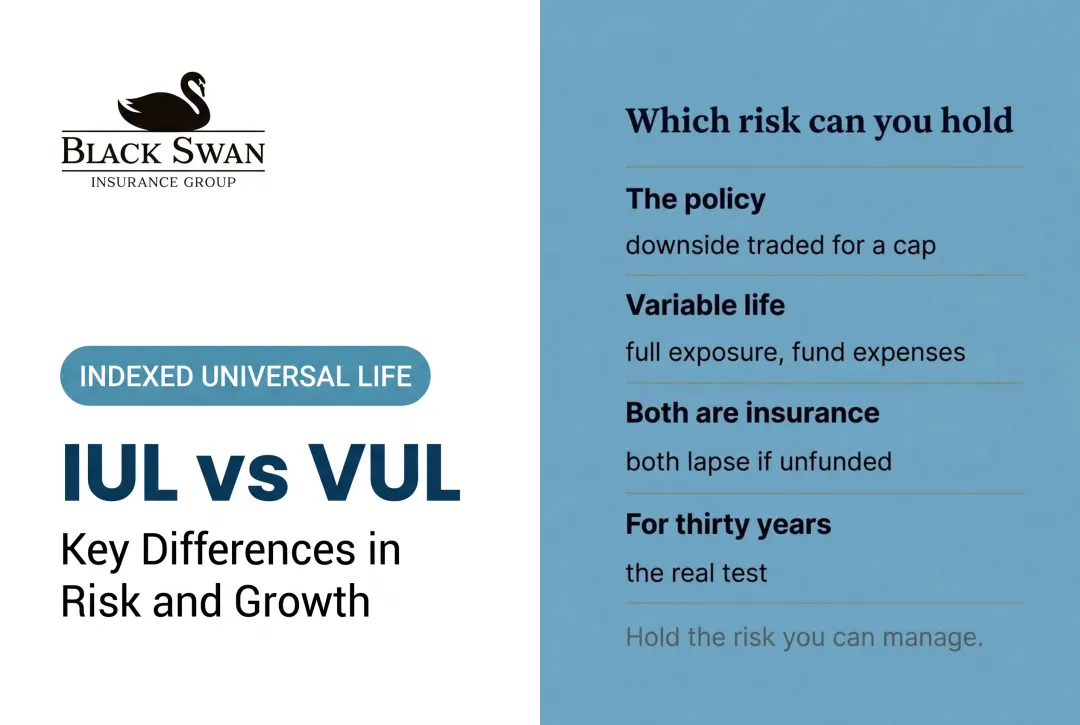
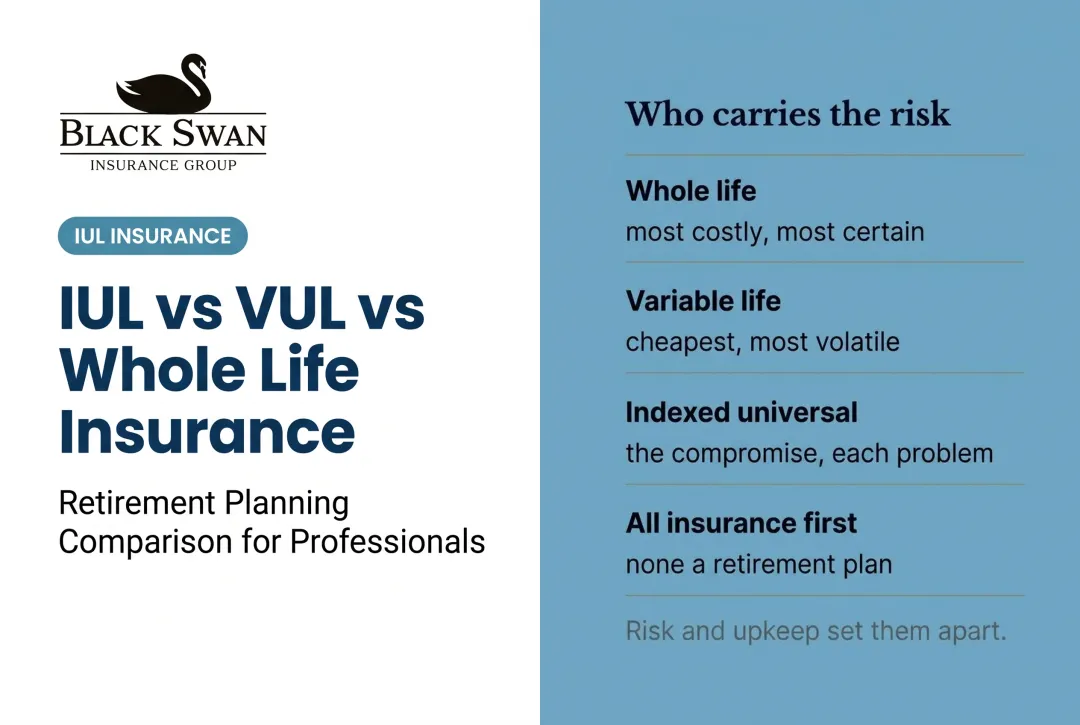
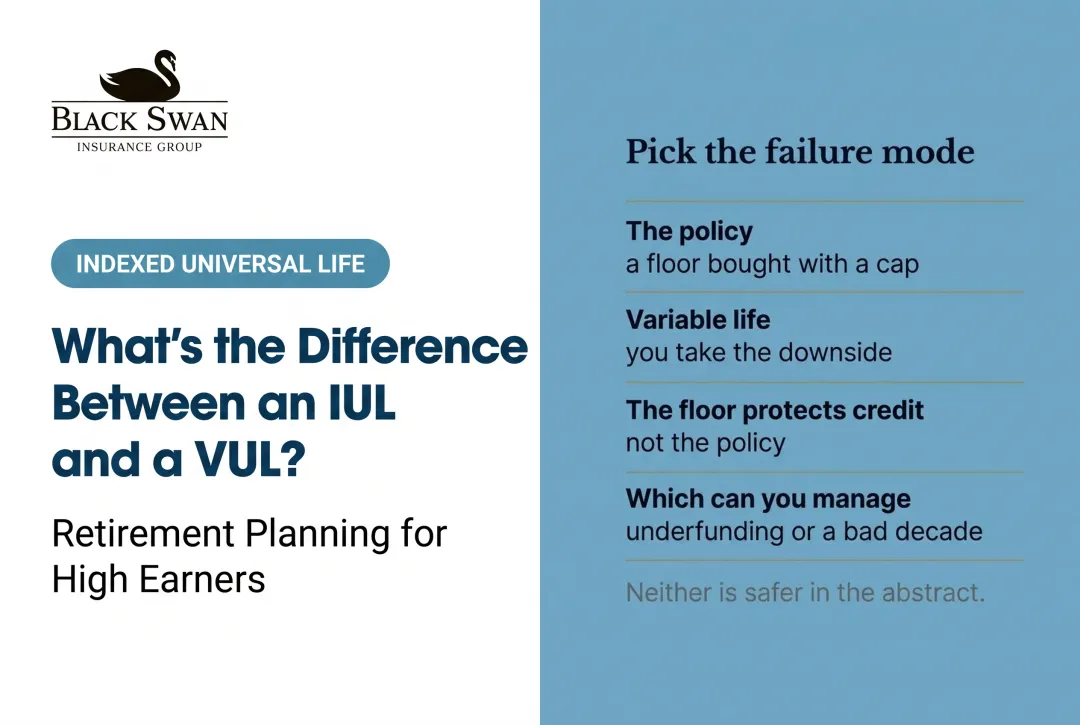
The short answer: IUL gives you a floor on the index credit and a cap on the upside, with the carrier controlling both after you buy. VUL gives you direct subaccount exposure with no cap and no floor, and leaves the allocation decisions to you. Neither removes the real risk, which is the same in both: charges that keep coming out whether or not performance arrives. Pick on whether you will actively manage the thing, not on which illustration looks better.
Key Takeaways
- IUL credits interest from an external index using caps, participation rates and floors — not direct market investment
- VUL puts cash value in insurer-offered subaccounts, so you take real market gains and losses
- Both carry insurance charges, admin fees and lapse risk if premiums or performance fall short
- Choose on risk tolerance, funding capacity, horizon and liquidity needs rather than a generic "which is better"
- Neither is a substitute for term coverage, qualified plans or a diversified portfolio
Side by Side
| Factor | IUL | VUL |
|---|---|---|
| Cash value growth | Credited based on index performance (such as the S&P 500), subject to caps and participation rates | Invested directly in subaccounts resembling stock, bond or balanced portfolios |
| Market risk | A floor (often 0%) limits negative index crediting, but charges can still reduce value | Market declines reduce cash value directly, with no index-credit floor |
| Upside potential | Limited by caps, participation rates and spreads | Generally uncapped, but reduced by fund and policy expenses |
| Investment control | Insurer sets available index strategies | Policyholder selects and reallocates among subaccounts |
| Policyholder role | Monitor crediting terms and policy health | Actively manage allocations and investment risk |
According to FINRA's overview of insurance products, IUL credits interest based on a selected index without giving the owner direct ownership of securities.
VUL is a security. Cash value goes into investment subaccounts the owner selects, which is why VUL sales require securities licensing and IUL sales do not. That regulatory difference is worth noticing: it tells you which product the regulator decided needed investor protection.
Both typically include cost of insurance, administrative charges, premium loads and surrender charges. What keeps each one standing differs. IUL needs crediting assumptions — caps, participation rates, spreads — to hold up over time. VUL needs investment performance to cover ongoing charges.
Both usually allow flexible premiums and adjustable death benefits where permitted, with tax-deferred cash value growth. Neither is automatically tax-advantaged in practice: loans, withdrawals and lapses can trigger tax consequences in either, and structure plus real-world use decide the outcome.
How IUL Works
Permanent life insurance with a death benefit, flexible premiums and cash value credited according to an external index strategy. Your money is not buying shares of the S&P 500. The insurer calculates an interest credit based on how the index performs, filtered through contract terms.
A simplified example based on crediting mechanics Guardian describes in its IUL explainer:
- If the index gains 10% and your policy has a 5% cap, you are credited 5%
- If instead your policy uses a 50% participation rate with no cap, a 10% index gain also produces roughly a 5% credit
Illustrative only — actual caps, participation rates and spreads vary by insurer and change over time, usually without a phone call.
A floor is not a guarantee of growth. A 0% floor can prevent a negative index credit in a down year. It does nothing to offset cost of insurance, administrative charges, rider fees or surrender charges, all of which can still reduce cash value or push an underfunded policy toward lapse.
Zero is your hero in a down year — but the floor applies to the credit, not to the charges.
Advantages: market-linked growth potential without direct index-loss exposure; flexible premiums and adjustable death benefits; permanent protection with potential tax-deferred accumulation; access to cash value through loans and withdrawals under contract rules.
Limitations: capped upside in strong market years; complex crediting formulas varying by insurer; non-guaranteed caps and participation rates that can be reduced after issue; and an ongoing monitoring obligation that most buyers underestimate.
This is not set-it-and-forget-it. It is design-it, fund-it, review-it.
Where IUL Gets Used
High-income professionals typically look at IUL after maxing qualified retirement contributions and building reserves — not as a replacement for those foundations. For a physician or executive earning $250,000+ with surplus cash flow, it can pair permanent protection with tax-diversified retirement planning.
Business and practice owners sometimes use it for supplemental liquidity outside the business, where concentrated risk already lives. It does not substitute for succession planning, buy-sell agreements or retirement plans, though it can sit alongside them.
For a 52-year-old executive who reached peak earnings late, suitability hinges less on projected index returns and more on current health and insurability, the ability to fund consistently for enough years, liquidity needs before retirement, and whether a shorter runway argues for a lower death benefit or a different funding schedule.
The Ultimate IUL Blueprint
Before choosing between these structures, the Blueprint covers what an indexed design has to survive: funding levels, caps and charges, the MEC line, loan timing, and what to demand from an illustration.
How VUL Works
Also permanent universal life, but the cash value sits in separate accounts the policyholder selects — subaccounts that function like mutual funds. Performance is tied directly to those investments, in both directions.
An SEC-filed VUL prospectus lists subaccount types illustrating typical variety: Money Market, Core Bond, International Equity Index and Total Stock Market Index options, though the exact menu depends on the insurer and policy.
Potential benefits: direct market participation with no index-credit cap; control over allocation; flexible premiums and tax-deferred growth; lifelong death-benefit potential.
The risks are concrete. Market losses reduce cash value directly, with no floor cushioning a bad year. Nationwide's VUL prospectus warns that unfavourable subaccount performance combined with ongoing policy and fund charges can deplete cash value and cause a lapse even when scheduled premiums are paid in full. Extra premiums may still be required after extended downturns.
Read that again. Paying every premium on schedule does not guarantee the policy survives. That is the single most important sentence in any VUL prospectus.

VUL is not a brokerage account wearing a life insurance label. Insurance charges, mortality and expense fees and contract rules apply regardless of subaccount performance, and lapse consequences are severe when the policy is not actively managed.
A suitable VUL buyer typically has high risk tolerance, a long horizon, genuine investment experience and the willingness to manage allocations through a decline — which is exactly when people stop opening statements. Compare VUL against direct investment accounts, term insurance, other permanent options and existing retirement accounts first. The insurance wrapper adds cost a taxable brokerage account does not carry.
What the Critics Get Right
Both products attract a shared criticism, and it lands: the insurance wrapper adds cost to something you could do more cheaply elsewhere. Buy term, invest the difference in low-cost funds, and you get uncapped market exposure, full liquidity and transparent fees without mortality and expense charges or a surrender schedule. For anyone without a documented permanent insurance need, that is simply the better answer and we are not going to argue it.
Each also has a specific weakness. IUL's is that the cap, participation rate and spread are non-guaranteed, so the carrier holds an option against you that you cannot price at purchase. VUL's is that the floor everyone assumes exists in permanent insurance does not exist at all, and the prospectus language above proves the carrier knows it.
Where the critique stops short is the permanent-need case. If you are going to own permanent insurance anyway, the question is not "insurance versus investing" — it is which crediting structure suits your temperament and your willingness to manage it. That is a narrower question and it has a real answer.
A great IUL is engineered. A bad IUL is sold.
Which One Fits
Start with the harder filter: do you have a genuine need for permanent life insurance? If yes, the next question is how much investment risk you can tolerate inside the policy.
IUL limits direct index-loss exposure through its floor, but caps reduce how much upside you capture, and the work is mostly monitoring crediting terms, cap changes and policy health. VUL offers more direct exposure — larger potential gains and larger potential losses — and the work is closer to managing a retirement account.
Funding risk exists in both. Either can lapse when charges exceed available cash value. Market declines add pressure in a VUL; lower-than-expected crediting or rising internal charges create the same squeeze in an IUL. Neither a floor nor a cap removes the need for adequate funding.

Ignore generic claims about which is cheaper. Compare guaranteed against non-guaranteed illustration values, expense disclosures and surrender schedules, loan provisions and death-benefit options, and illustration results under conservative assumptions rather than the headline rate.
An illustration is a model, not a guarantee.
Stronger Fit
- IUL when you want permanent protection, moderate risk and index-linked growth without direct market volatility — and the premium stays affordable long term
- VUL when you need permanent coverage, have a long horizon, high risk tolerance and can manage allocations through a sustained decline
Weaker Fit
Not everyone should own either. Consider alternatives first if you lack a documented permanent need, carry high-interest debt, have not maxed core retirement accounts, or cannot sustain the premium. Term insurance plus a brokerage account is cheaper, simpler and better for most people in that position.
Risks to Understand Before You Apply
Work through this before signing anything:
- Complete a needs analysis and underwriting review
- Confirm premium affordability under multiple income scenarios
- Request both guaranteed and current illustrations
- Stress-test against lower crediting or sustained market declines
- Review tax and legal implications with your own advisers
- Confirm beneficiary designations
- Schedule annual policy reviews
Consider a 45-year-old attorney earning $300,000, already maxing a 401(k), with three years of expenses in reserve, weighing both. Under strong markets, a VUL's subaccounts could outperform an IUL's capped crediting and build cash value faster. Under a significant decline, the VUL's cash value could drop sharply and require additional premium to avoid lapse, while the IUL's floor would prevent a negative index credit that year — though policy charges apply either way.

Neither outcome is guaranteed. The point is understanding how each structure behaves when conditions shift, not predicting returns.
A 53-year-old business owner with a compressed runway will usually find that funding consistency and insurability matter more than projected upside, because a shorter timeline leaves less room to recover from a bad VUL year or absorb an IUL cap reduction. And an owner weighing permanent coverage alongside succession obligations should keep personal insurance planning distinct from key-person or buy-sell funding — concentrating everything in one policy or one entity increases risk rather than reducing it.
Other shared risks: MEC status from overfunding, generally permanent; surrender charges in the early years; and a lapse with a loan outstanding producing taxable income with no cash received.
The loan is not the problem. The unmanaged loan is the problem.
Find Out Where You Actually Stand
This starts with the Tax-Free Wealth Blueprint Fit Review. If you earn $150K+ and are weighing IUL against VUL, we confirm the permanent need first, then line up the same inputs across both structures — guaranteed and non-guaranteed values, fee structures, funding requirements, loan provisions — and stress-test each through lower crediting, a sustained market decline and paused funding. We also price the term-plus-brokerage alternative so you can see what the wrapper actually costs. We explain compensation before anyone funds anything. If neither structure fits, we will tell you that too.
Frequently Asked Questions
Is a VUL better than an IUL?
Neither is universally better. VUL may suit someone comfortable with direct market exposure and real losses. IUL may suit someone who prefers index-linked crediting with less direct exposure. Suitability depends on policy design, temperament and goals.
Is IUL safer than VUL?
IUL generally carries less direct market risk because of its crediting floor. Fees, insurance charges, loans, withdrawals and insufficient premiums can still reduce cash value or cause a lapse in either product.
Can you lose money in an IUL?
Yes — typically through policy charges, cost of insurance, loans, withdrawals or lapse rather than negative index performance. The floor addresses index crediting, not overall policy costs.
What are the disadvantages of VUL?
Direct exposure to market losses plus investment and policy expenses. It requires active management, can create premium pressure after poor performance, and carries real consequences if the policy lapses or loans go unmanaged — including when every scheduled premium was paid.
Does IUL or VUL have better growth potential?
VUL generally offers more direct, uncapped exposure, while IUL limits both downside index crediting and upside through caps and participation rates. Growth potential is a trade-off against risk, not a ranking.
Are IUL and VUL good alternatives to a 401(k) or IRA?
No. They serve different purposes. Compare contribution limits, tax treatment, costs, liquidity and investment choices before assuming either replaces a qualified retirement account — and capture any employer match first.
Sources
- FINRA — Insurance products
- Guardian — Indexed universal life insurance
- SEC — Nationwide variable universal life prospectus
Disclosure: This article is educational and is not personal tax, legal or investment advice. Indexed universal life is life insurance first, and variable universal life is both life insurance and a registered security sold by prospectus. Carrier products, caps, participation rates, subaccount menus, charges and state availability change frequently and must be confirmed against current policy forms and prospectuses before applying. Illustrated values are not guarantees; actual results depend on policy terms, crediting, investment performance, costs and funding. Any potential tax-advantaged access depends on the policy being properly structured, funded and managed. Actual results depend on policy design, carrier, crediting options, caps, participation rates, expenses, funding and ongoing management. This strategy is not appropriate for everyone. Policy loans and withdrawals reduce cash value and the death benefit, and can create tax consequences if the policy lapses or becomes a modified endowment contract. Consult your own tax, legal and financial professionals for advice specific to your situation.
And remember, it's not what you earn, it's what you keep… enjoy the ride.