By Robert Balgac, Founder, Black Swan Insurance Group | October 7, 2026
Buying life insurance online used to mean comparing term quotes and clicking buy. That works because term is one number against one promise. Indexed universal life is not that product, and the online experience around it is doing something the interface quietly hides.
You will find slick calculators showing confident growth, pages that skim the charge structure, and an application flow smoother than the contract underneath it. An IUL pairs a lifelong death benefit with cash value credited through an index-linked formula — not stock ownership — and that single distinction governs everything else.
The short answer: Online tools genuinely simplify quotes, documents and account access. They do not remove underwriting, policy charges, carrier differences, or the need for someone to watch the contract in year 15. The convenience is real; what it conceals is that the decision is harder than the form.
If you earn $150K+, have maxed the 401(k) and run into the Roth limits, you are the person these funnels are built for. Worth knowing what the quote engine cannot tell you.
Key Takeaways
- IUL is permanent life insurance first — not a guaranteed investment and not an index fund
- Online applications add convenience; carriers, guarantees, crediting methods and lapse protection still need comparing
- Illustrated returns are projections; real results depend on funding, charges, caps and participation rates
- It may fit high earners with a genuine permanent need, after term, retirement accounts and brokerage assets
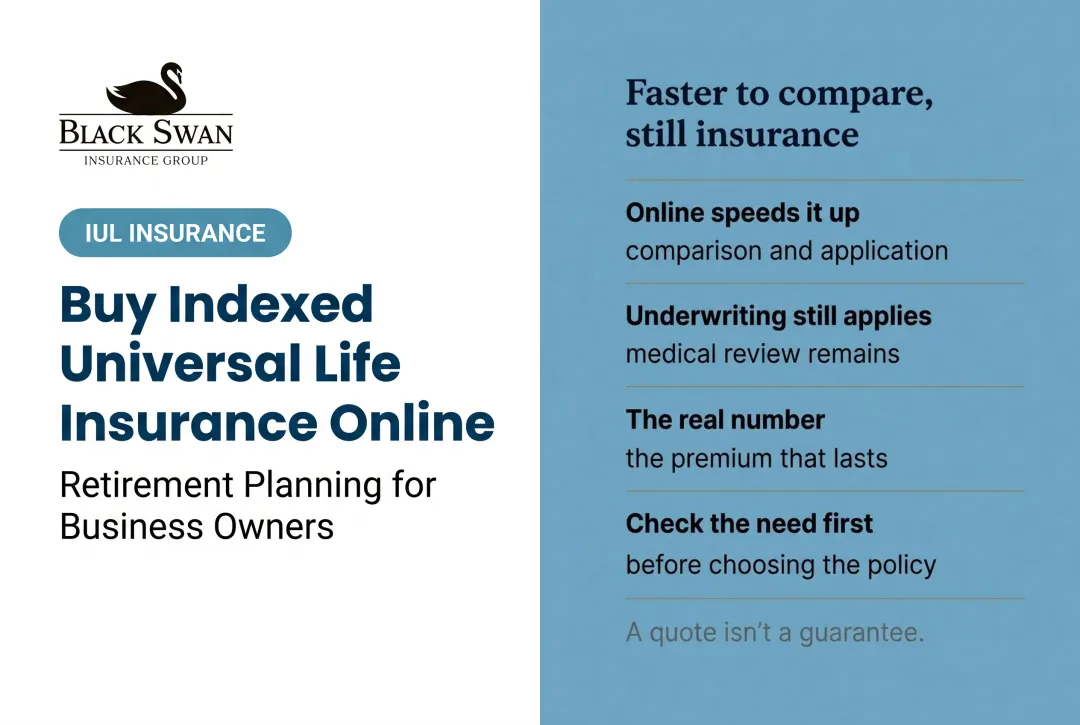
- A quote is not an offer — underwriting decides the actual price
How the Product Works
An IUL has two working parts: a death benefit for your beneficiaries, and a cash value account accessible while you are alive. The NAIC describes IUL as a form of universal life where interest credits are tied to an external index, with a guaranteed minimum crediting rate even in down years.
Premium does not flow into cash value. The insurer first deducts cost of insurance, administrative and premium-load charges, rider costs, and other contract-specific expenses. What survives is allocated across fixed and indexed accounts.
Crediting then runs through four levers: the floor (often 0%), the cap, the participation rate, and sometimes a spread subtracted before interest is credited. You never own a share of the index.
Zero is your hero in a down year — but the floor applies to the credit, not to the charges.
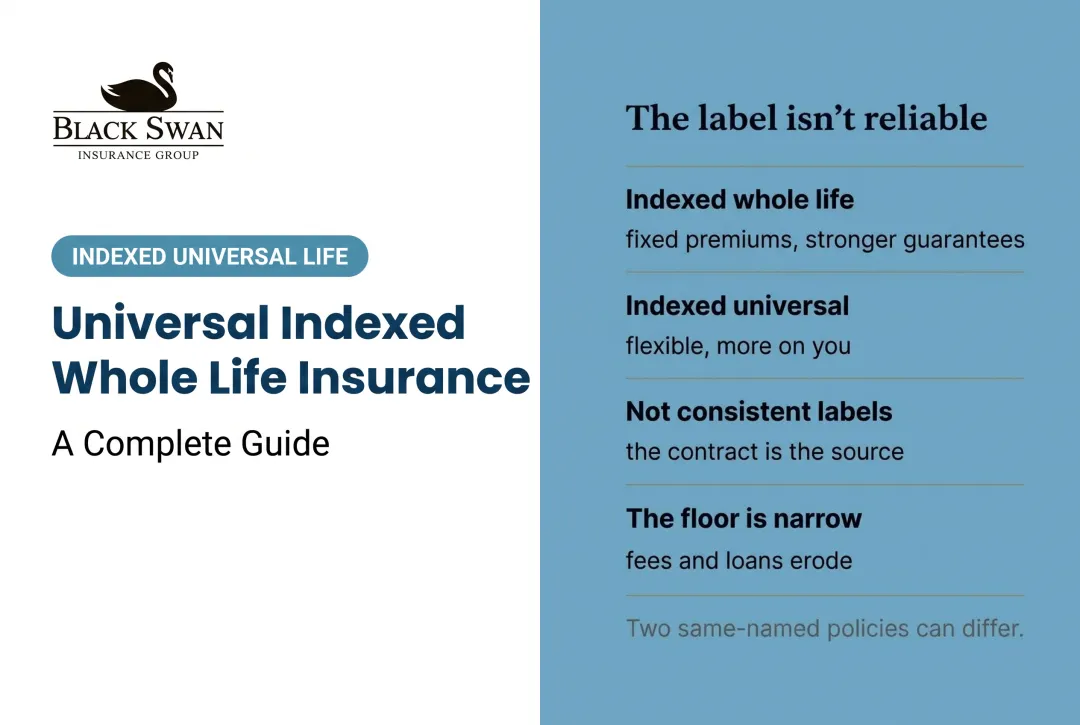
A floor protects the crediting calculation from going negative. It does not guarantee total cash value cannot fall. Charges, loans, withdrawals and rising insurance costs continue regardless.
Flexible premiums and adjustable death benefits are genuine advantages with strings attached. Reduce or skip payments long enough and the policy is underfunded; underfunded, it lapses once cash value can no longer carry the cost of insurance.
Buying It Online, Step by Step
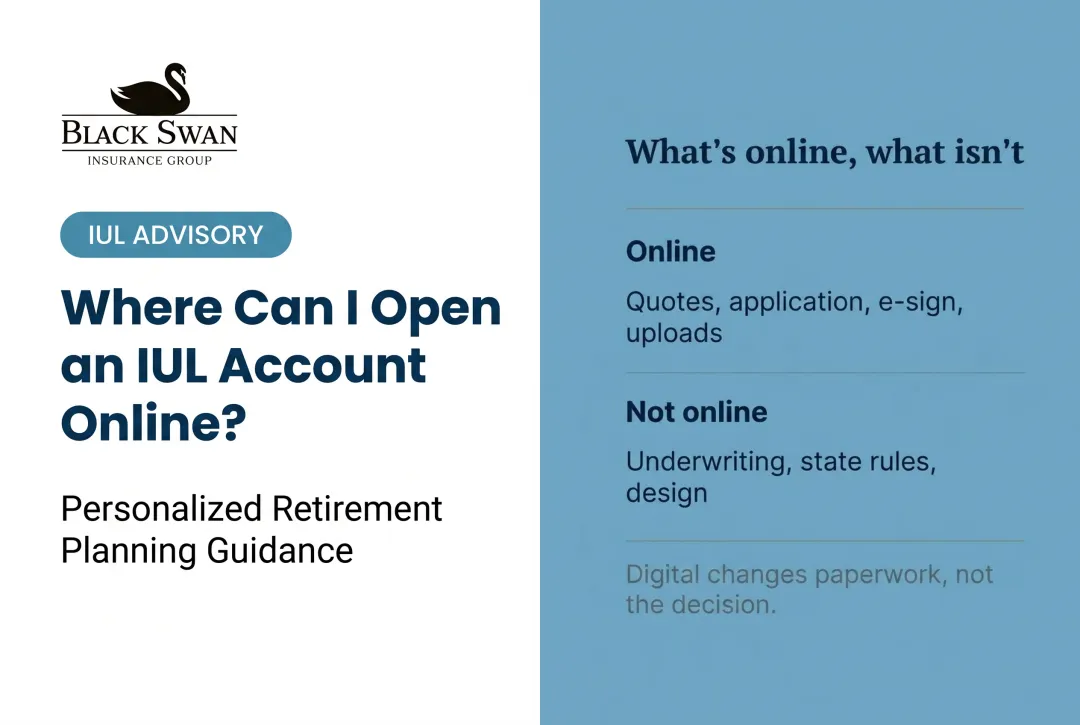
Define the coverage need — amount, duration, purpose. Request an initial quote. Complete the application with financial and medical disclosures. Complete underwriting, whether electronic, remote or traditional. Review the formal illustration for guaranteed and non-guaranteed values. Accept delivery of the issued policy. Set up account access for premiums and monitoring.

An online estimate is not an offer. It is a preliminary number from limited information. The carrier still underwrites, and depending on your history that may mean additional questions or a paramedical exam before anything is final.
Have ready: government ID, income and net worth documentation, details of existing policies, beneficiary information, medical history and current medications, and your intended premium.
Vet the carrier, not the website. The platform does not pay the claim — the issuing insurer does. Check its independent financial-strength rating, claims history, and whether it is licensed in your state.
The Ultimate IUL Blueprint
Before you complete an online application, the Blueprint covers what the design has to survive: funding levels, caps and charges, the MEC line, loan timing, and what to demand from an illustration.
When the formal illustration arrives, read both columns. The guaranteed column is what the contract promises. The non-guaranteed column reflects assumed index credits that can change. Check surrender values over time, loan assumptions and their effect on the death benefit, and results under a lower-performance scenario.
Some situations outgrow a form entirely: business ownership or succession planning, estate planning involving trusts, large coverage amounts, complicated health history, policy replacement, or a compressed retirement timeline. In those cases a quote engine is the wrong instrument.
What the Critics Get Right
The criticism of buying IUL online is sharp and largely fair: the interface implies a simplicity the product does not have.
A term quote engine is honest because term is simple. Apply the same interface to a contract with caps, participation rates, spreads, surrender schedules, loan provisions and a seven-pay limit, and the design itself becomes misleading. You can complete an application in twenty minutes without once seeing the guaranteed column.
Where the criticism overreaches is treating the channel as the problem. Online research, electronic documents and digital servicing are genuinely better than what came before. The failure is presenting a decision that needs a conversation as a checkout flow.
Returns, Costs and Risks
If you have searched for "average IUL return", the numbers disagree because there is no such figure.
Caps and participation rates restrict how much of an index gain reaches the policy, and insurers can adjust those terms subject to contract guarantees. The Society of Actuaries notes that these non-guaranteed elements directly limit credited upside, separately from how the index actually performed. A 25% index year and a 25% credited year are different things.

A hypothetical, not a forecast — 10% cap, 100% participation, 0% floor. Index up 18%: credited 10%. Index down 12%: credited 0%. Index up 2%: credited 2%. Note that even the strong year left gains on the table, and the protected year did not grow cash value because charges continued.
Expect cost of insurance rising with age, premium loads and administrative charges, surrender charges in early years, rider costs, loan interest, and charges tied to policy changes. Ask for the specific schedule in your contract rather than a generic fee summary.
Loans and withdrawals reduce available cash value and can reduce the death benefit; unmanaged loan interest compounds and raises lapse risk. A policy lapses when charges outpace cash value — driven by underfunding, lower-than-illustrated credits, rising cost of insurance, or prolonged borrowing.
On tax: cash value generally grows tax-deferred and the death benefit is typically income-tax-free to beneficiaries, with exceptions. If the contract becomes a Modified Endowment Contract, usually from overfunding too quickly, distributions are generally taxed income-first. Surrendering or lapsing with a loan outstanding can create taxable income.
Stronger Fit
Worth considering if you:
- Have a genuine permanent protection need, not a temporary one
- Can commit to stable, long-term funding through a weak year
- Already hold adequate emergency reserves
- Have a horizon long enough to absorb a slow stretch
- Are insurable at a reasonable rate class
- Will review performance annually
Weaker Fit
Not everyone should buy one. Step back if you answered no to more than one of the above, or if you have an unclaimed employer match, need liquidity soon, or only need a death benefit for a defined period — term is cheaper and solves that completely.
High-income professionals, executives and business owners, often at $150,000 to $500,000+ household income, look at IUL for supplemental retirement access, estate liquidity, business continuity or permanent protection. It makes sense after core insurance and retirement contributions, not instead of them.
| Option | Primary purpose | Guarantees | Key trade-off |
|---|---|---|---|
| IUL | Permanent protection + index-linked cash value | Minimum crediting rate | Capped upside, ongoing charges |
| Term life | Temporary protection | Level premium for term | No cash value |
| Whole life | Permanent protection, steady cash value | Guaranteed cash value growth | Less flexibility |
| Variable UL | Permanent protection, market sub-accounts | No floor | Can lose value with the market |
| 401(k)/Roth/Brokerage | Retirement saving or investing | Varies | No death benefit |

Risks to Understand Before You Apply
- Do not replace existing coverage without a full side-by-side review — replacement triggers new underwriting, surrender charges and a fresh contestability period.
- Do not cut retirement contributions to free up premium, particularly where a match is involved.
- Do not use emergency savings to start or sustain the policy.
- Caps and participation rates can fall, subject to contract minimums.
- Cost of insurance rises with age, and underfunding is the leading cause of failure.
- Lapsing with a loan outstanding can produce taxable income with no cash received.
Find Out Where You Actually Stand
This starts with the Tax-Free Wealth Blueprint Fit Review. If you earn $150K+ and a quote engine has produced a number you are unsure about, bring it. We define the actual permanent need, identify a funding range you can sustain, compare illustrations across carriers, read the guaranteed column alongside the risks, and stress-test the design through lower-crediting and zero-credit years. If the answer is term plus maxing your accounts, we will say so. If IUL does not fit, we will tell you that too.
Frequently Asked Questions
Can I buy indexed universal life insurance online?
Yes — online tools support quotes, applications, electronic documents and account management. Medical review, state availability and the need for guidance still vary by carrier and applicant.
What is the average rate of return on an IUL?
There is no universal average. Performance depends on index credits, caps, participation rates, charges, funding levels and your specific contract.
Is IUL a good investment?
It is life insurance with a cash value feature, not an investment account. Whether it is right depends on your permanent coverage need, funding capacity, risk tolerance and the alternatives.
What are the disadvantages?
Complexity, non-guaranteed growth, capped upside, ongoing charges, lapse risk, surrender restrictions and loan-related risks — plus the requirement to monitor it for decades.
How much does it cost?
It depends on age, health, coverage amount, design, underwriting, riders and carrier. Compare formal illustrations from a licensed producer rather than an online estimate.
How do I choose between policies?
Compare the issuing carrier's financial strength, guaranteed against non-guaranteed values, crediting terms, charges, loan provisions and lapse protection — then check how it fits the wider plan.
Sources
- NAIC — Life Insurance
- Society of Actuaries — overview of non-guaranteed elements
- NAIC — Life Insurance Illustrations
Disclosure: This article is educational and is not personal tax, legal or investment advice. Indexed universal life is life insurance first. Online availability, carrier features, underwriting requirements and state licensing vary and should be confirmed before applying. Illustrated values are not guarantees; actual results depend on policy terms, crediting, costs and funding. Any potential tax-advantaged access depends on the policy being properly structured, funded and managed. Actual results depend on policy design, carrier, crediting options, caps, participation rates, expenses, funding and ongoing management. This strategy is not appropriate for everyone. Policy loans and withdrawals reduce cash value and the death benefit, and can create tax consequences if the policy lapses or becomes a modified endowment contract. Consult your own tax, legal and financial professionals for advice specific to your situation.
And remember, it's not what you earn, it's what you keep… enjoy the ride.