By Robert Balgac, Founder, Black Swan Insurance Group | October 9, 2026
Both indexed universal life and whole life promise lifelong protection and cash value growth. The similarity ends roughly there.
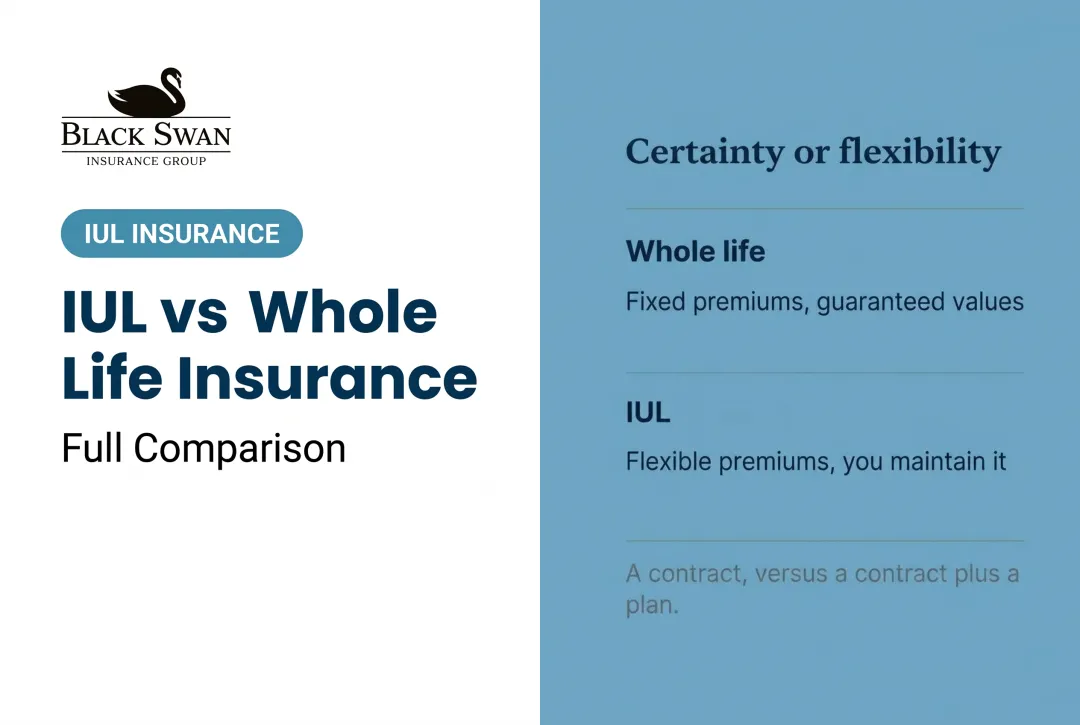
Whole life hands you a fixed, predictable path. IUL hands you flexibility — and the responsibility for keeping the policy funded and performing for the next forty years. For a high earner, that distinction matters more than any illustration, because the two products fail in completely different ways.
The short answer: Whole life's risk is cost — a fixed premium you must pay whether or not the year suited it. IUL's risk is lapse — a flexible premium that lets you underfund your way into a collapse twenty years out, long after anyone is watching. Choose based on which risk you would rather carry, not on which ledger looks better.
Key Takeaways
- IUL offers flexible premiums and index-linked crediting; whole life offers fixed premiums and contractual guarantees
- A 0% floor limits negative index crediting but does not stop cash value declining once insurance costs apply
- Whole life suits buyers wanting predictability; IUL suits those comfortable with complexity and active monitoring
- Always separate guaranteed values from illustrated projections before committing to either
- Neither replaces emergency savings, retirement accounts, or professional tax and legal guidance
The Comparison That Matters
Premiums. Whole life runs on a fixed schedule set at issue — pay it and the policy stays in force under its terms. IUL premiums adjust within policy limits, which sounds appealing until a skipped payment meets a cash value that cannot cover ongoing charges. Reduced or skipped IUL premiums create lapse risk years before anyone notices.
Cash value. Whole life grows under contractual guarantees, sometimes supplemented by non-guaranteed dividends on participating policies. IUL growth depends on index-linked crediting shaped by caps, participation rates, spreads and charges.
Guarantees. The NAIC's Life Insurance Illustrations Model Regulation requires insurers to separate guaranteed from non-guaranteed values and to warn that actual results can differ. That separation is the single most important thing to understand before buying either.
Death benefit and access. Whole life generally has a fixed structure, with loans and withdrawals reducing the benefit and accruing interest. IUL has potentially flexible options, but loans, withdrawals and underfunding erode both cash value and the benefit. Both carry surrender charges and varying tax treatment — read the contract before assuming either offers free money.

How IUL Works
Permanent life insurance pairing a death benefit with a cash value account credited by reference to an index such as the S&P 500. You do not own the index and do not receive its full return — the crediting formula decides what reaches your cash value.
After costs are deducted, remaining premium supports cash value, shaped by caps (maximum credited interest), participation rates (what share of gains count) and spreads (an amount subtracted before crediting).
The floor is not a cash value guarantee. A 0% floor limits negative index crediting. It does not guarantee total cash value will not decline, because insurance costs and charges continue regardless.
Zero is your hero in a down year — but the floor applies to the credit, not to the charges.
Wisconsin's insurance regulator warns specifically that cost-of-insurance charges in universal life policies, including IUL, increase as the insured ages. A premium that looks comfortable at 40 may not cover charges at 70 — which is the whole problem in a sentence.

Flexibility is not affordability. Low crediting years, thin funding or an outstanding loan can each weaken performance and put the contract at risk.
The Ultimate IUL Blueprint
If you are weighing these two, the Blueprint covers what an IUL design has to survive: funding levels, caps and charges, the MEC line, loan timing, and what to demand from an illustration.
How Whole Life Works
Permanent insurance providing lifelong coverage while required premiums are paid, combining a fixed premium, a death benefit, and cash value governed by contractual guarantees.
Cash value grows on a guaranteed schedule written into the contract. Participating policies may also pay dividends — never guaranteed, varying by insurer and year. A projected dividend scale is not a promise.
Fixed premiums cut both ways. A level premium supports predictable budgeting for decades, and that same rigidity strains a household during reduced income, since whole life typically offers less flexibility than IUL.
Access carries the usual trade-offs: loans accrue interest and reduce the death benefit if unpaid; withdrawals reduce cash value and may trigger surrender charges early; and an unpaid loan balance at lapse can create taxable income with no cash received.
And early cash value is typically lower than cumulative premiums paid, from acquisition costs and insurance charges. Review guaranteed values, surrender values and your intended funding period before assuming early access matches what you put in.
What the Critics Get Right
Both products attract criticism, and both criticisms have merit.
Against whole life: the premium is high, the growth is modest, and for most households with a temporary need, term plus investing the difference beats it comfortably. Against IUL: the complexity is real, the key variables are non-guaranteed, and the flexibility that makes it attractive is the same mechanism by which underfunded policies collapse.
What neither criticism addresses is the high earner who has already filled the cheaper buckets and genuinely needs permanent coverage. For that person the question is not whether to buy insurance instead of investing — it is which failure mode they would rather manage. That is a real decision, and it has no universally correct answer.
Deciding Between Them
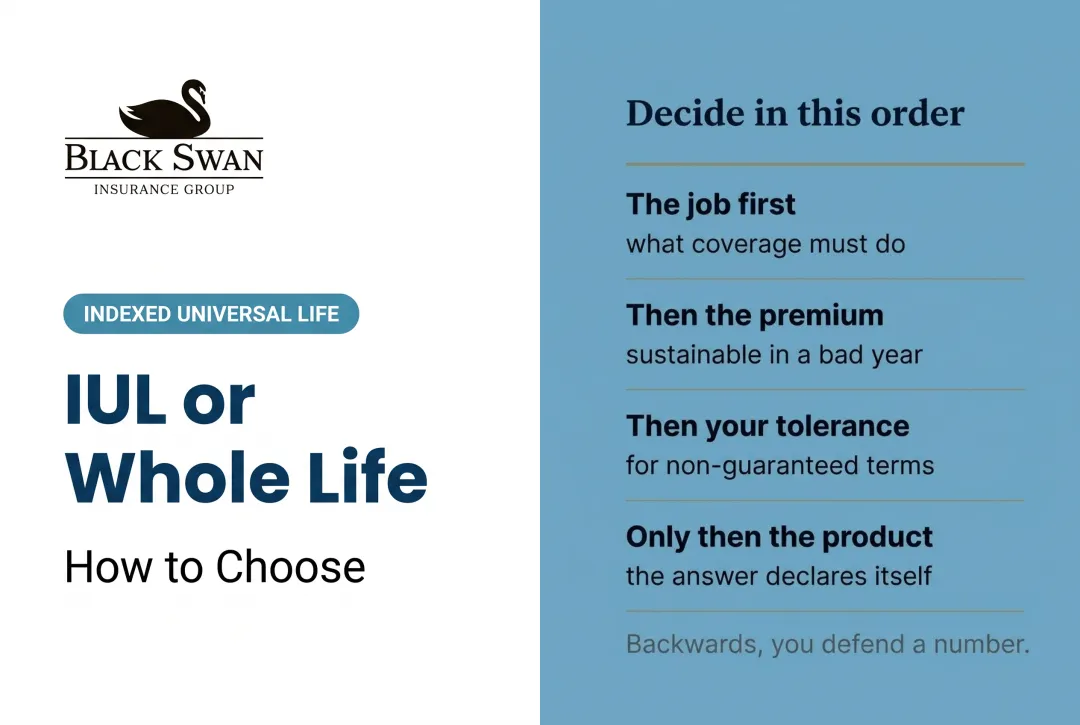
Ask what the coverage must actually do: temporary income replacement, lifelong protection, business risk, estate planning, or supplemental retirement flexibility. If permanent coverage is not genuinely required, term life makes more sense than either product here.
Compare the planned premium against dependable surplus cash flow — not projected bonuses or a strong year. Factor in emergency reserves, retirement contributions, debt and business liquidity. For late-start high earners with a compressed runway this matters more, because a shortened funding window leaves too little time for an IUL's cash value to absorb early costs before you need income from it.
Then work the illustration line by line: separate guaranteed from non-guaranteed; identify every charge including cost of insurance, premium loads, administrative fees, rider costs and surrender charges; review cap and participation assumptions and what happens if they fall; test a lower-crediting scenario; and ask directly what premium keeps the policy in force long term.
Compare access mechanics too — loan interest rates, direct against non-direct recognition where applicable, withdrawal rules, and how an unpaid balance contributes to lapse. These differ meaningfully between the two.
This is not set-it-and-forget-it. It is design-it, fund-it, review-it.
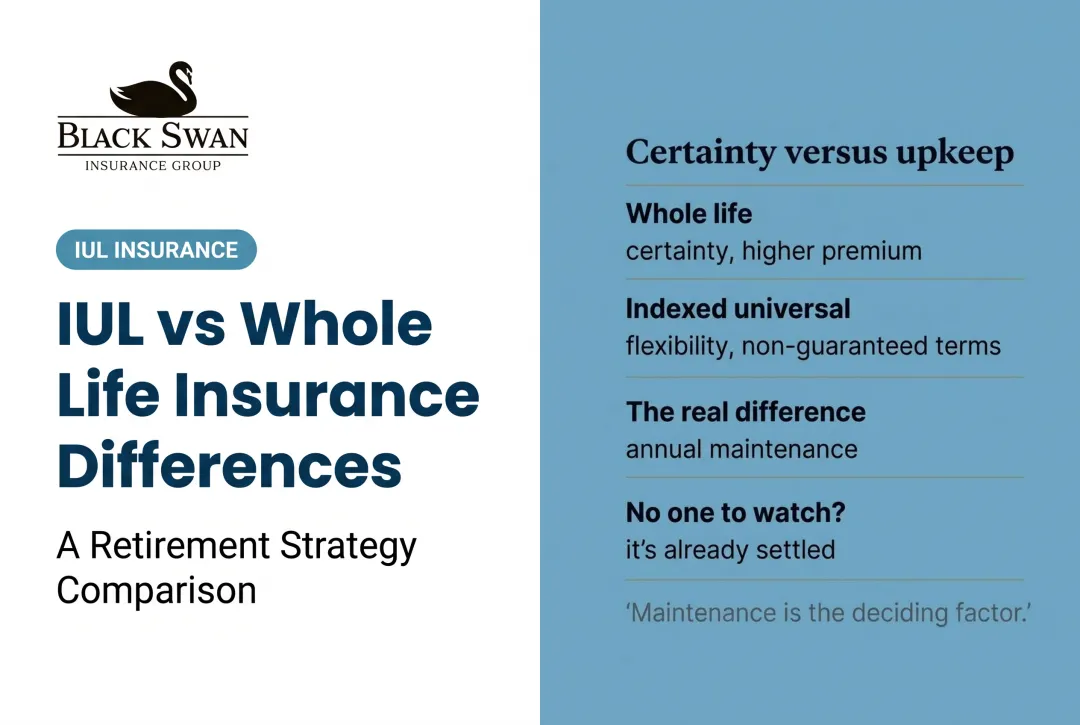
Whole life generally demands less attention. IUL demands annual review of crediting, funding adequacy and charge changes. "Flexible" does not mean maintenance-free — it means the responsibility sits with you.
A Real-World Example Worth Studying
MassMutual's 2026 Quality and Performance Report reconstructs a whole life policy issued to a hypothetical 35-year-old woman in 1995 — $250,000 face amount, $3,450 annual premium to age 65 — using actual historical dividends.
Guaranteed cash value reached $136,858; total cash value with dividends reached $249,908. Guaranteed death benefit $250,000; total with dividends $456,511.

One company's historical experience, not a forecast. The lesson is the gap itself: the guaranteed column and the dividend-enhanced column differ by roughly $113,000 in cash value on this example. Always separate them, and never assume past dividend performance predicts future results.
Apply the same discipline to any replacement or 1035 exchange — gather current illustrations, request a side-by-side, and stress-test both guarantees and assumptions before a change you cannot easily undo.
Stronger Fit
Permanent coverage of either kind deserves consideration if you:
- Earn $150K+ with dependable surplus after reserves, debt and maxed retirement contributions
- Have a genuine lifelong protection, estate or business need
- Are insurable at a reasonable rate with a long horizon
- Will review the policy annually, if you choose IUL
Weaker Fit
Not everyone should buy either. Step back if you need inexpensive temporary coverage, have uneven cash flow, carry higher-priority debt or retirement savings gaps, need near-term liquidity, or will not read an annual statement.
Risks to Understand Before You Choose
- IUL's main risk is lapse — underfunding compounds quietly and surfaces decades later.
- Whole life's main risk is opportunity cost — a fixed premium regardless of the year.
- Cost of insurance rises with age on flexible-premium designs, as Wisconsin's regulator warns.
- Caps and participation rates can be lowered, subject to contract minimums.
- Dividends are never guaranteed, however long a mutual insurer has paid them.
- An unpaid loan at lapse can create taxable income with no cash received.
- Replacing existing coverage triggers new underwriting, surrender charges and fresh contestability.
Find Out Where You Actually Stand
This starts with the Tax-Free Wealth Blueprint Fit Review. If you earn $150K+ and are weighing these two, we define the job the coverage has to do first — then read guaranteed against illustrated values side by side, compare loan and access mechanics, and stress-test both designs through lower crediting and a reduced-income year. If term solves your problem, we will say so and you will have spent nothing. If IUL does not fit, we will tell you that too.
Frequently Asked Questions
How do I compare the two?
On premiums, guarantees, cash value mechanics, fees, death benefit flexibility and how much ongoing management each demands. The right fit follows from your objective and tolerance for complexity.
Which is more affordable?
It depends on age, health, coverage amount, design and funding pattern. Never compare premiums alone without reviewing guaranteed values and future funding requirements — a lower starting premium is not a lower lifetime cost.
Does an IUL guarantee cash value?
No. The floor applies to index crediting, not total cash value. Insurance costs and charges can reduce cash value even in a 0% crediting year.
Which is better for a guaranteed death benefit?
Both can pay when contract requirements are met. Whole life offers a more fixed guarantee; IUL's sustainability depends on funding and ongoing management.
Can you lose money in an IUL with a 0% floor?
Yes. The floor limits negative credits, but rising insurance costs, loans, withdrawals and fees can still reduce cash value and threaten the policy.
Is either better for retirement income?
Neither should be a standalone retirement plan. Compare loan mechanics, tax treatment and lapse risk, and coordinate whichever you choose with qualified retirement accounts and professional advice.
Sources
- NAIC — Life Insurance Illustrations Model Regulation (Model 582)
- Wisconsin OCI — universal life insurance consumer alert
- MassMutual — 2026 Quality and Performance Report
Disclosure: This article is educational and is not personal tax, legal or investment advice. Indexed universal life is life insurance first. Product features, guarantees, dividends and availability vary by carrier and state, and all guarantees are subject to the issuing insurer's claims-paying ability; dividends on participating policies are never guaranteed and historical dividend performance does not predict future results. Illustrated values are not guarantees; actual results depend on policy terms, crediting, costs and funding. Any potential tax-advantaged access depends on the policy being properly structured, funded and managed. Actual results depend on policy design, carrier, crediting options, caps, participation rates, expenses, funding and ongoing management. This strategy is not appropriate for everyone. Policy loans and withdrawals reduce cash value and the death benefit, and can create tax consequences if the policy lapses or becomes a modified endowment contract. Consult your own tax, legal and financial professionals for advice specific to your situation.
And remember, it's not what you earn, it's what you keep… enjoy the ride.