By Robert Balgac, Founder, Black Swan Insurance Group | October 5, 2026
Montgomery buyers researching indexed universal life hit the same wall as everyone else: a glossy illustration promising strong growth, and almost no explanation of the machinery underneath it.
An IUL is not a savings account and not a fund with an insurance wrapper. It is a permanent insurance contract with caps, participation rates, floors, cost-of-insurance charges and surrender schedules — all of which decide what you actually keep.
If you earn $150K+ in Alabama and are weighing this for permanent coverage, cash value or supplemental retirement income, the single most useful habit is reading the guaranteed ledger before the illustrated one. That column is what the carrier is obligated to. Everything else is a projection.
The short answer: An IUL pairs permanent life coverage with index-linked cash value, bounded by insurer caps, participation rates and floors. Premiums, charges and underwriting decisions shape the real outcome far more than illustrated index returns do. A 401(k) and an IUL serve different purposes — neither is an upgrade on the other, and the employer match comes first. Alabama gives you a minimum 10-day free-look, a Buyer's Guide before the initial premium, and documented replacement rules. Review guaranteed values, loan terms and lapse risk before signing.
Key Takeaways
- Permanent life coverage with index-linked cash value, limited by insurer caps, participation rates and floors
- Premiums, charges and underwriting shape real performance more than illustrated index returns
- A 401(k) and an IUL serve different purposes; neither is a universal upgrade
- Alabama requires a minimum 10-day free-look and a Buyer's Guide before the initial premium
- Review guaranteed values, loan terms and lapse risk before signing anything
How the Policy Works
Permanent coverage: a death benefit paired with a cash-value account, staying in force for life as long as the policy has enough value to cover ongoing charges. The NAIC describes IUL as having both fixed and variable features, with credited interest tied to an external index such as the S&P 500 plus a guaranteed minimum interest rate built into the contract.
Where the premium goes: the cost of insurance (the mortality charge for the death benefit); administrative and policy fees; and then cash value allocation — what remains after charges, credited on index performance. The split varies by insurer, design and underwriting class. There is no standard formula.
Four Levers Decide the Credit
- The index selected, often the S&P 500
- The cap — the maximum credited rate, however well the index performs
- The participation rate — the percentage of index gain that counts
- The floor — the minimum credited rate, often 0%, protecting against a negative index year

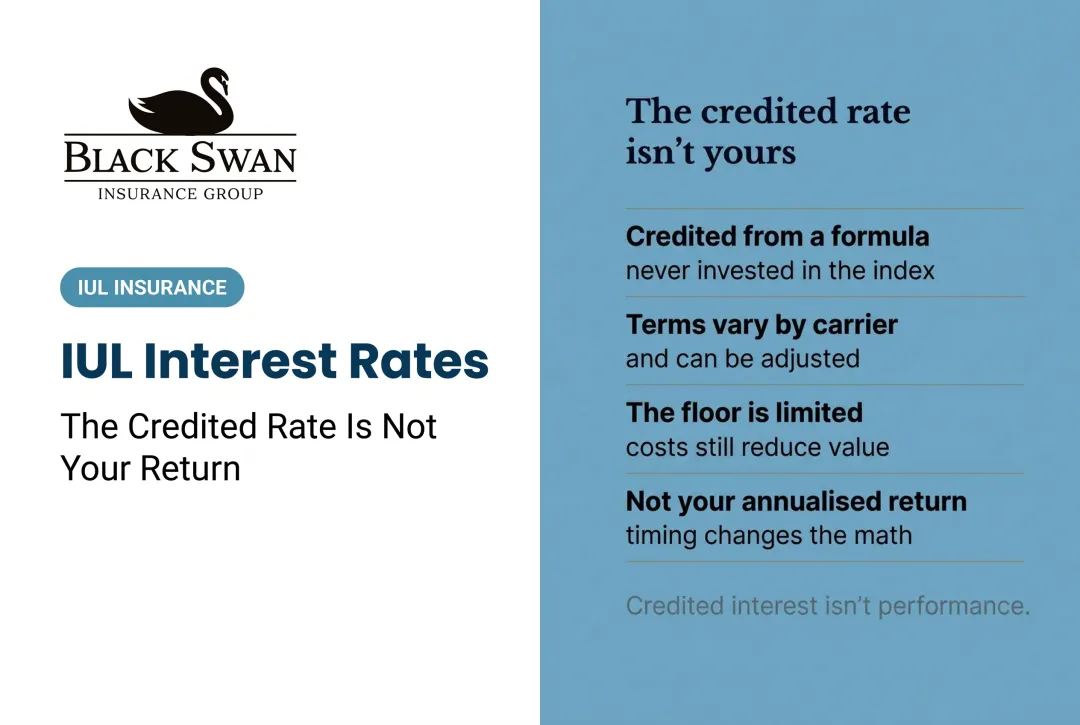
A floor prevents losses from index performance. It does not eliminate policy charges, and cash value can still fall if fees exceed credited interest.
Zero is your hero in a down year — but the floor applies to the credit, not to the charges.
Guaranteed Versus Non-Guaranteed
Every legitimate illustration separates guaranteed elements — the minimum interest rate and contractual charges — from non-guaranteed ones such as current caps and projected accumulation. Ask for both columns. If only one arrives, that is information about the person selling it.
Flexible Premiums Cut Both Ways
Flexible design lets you adjust payments. The downside is that skipping payments or underfunding can force higher premiums later, or lapse the policy once cash value runs out.
Loans and withdrawals add another layer. Both reduce available cash value and the death benefit, and a lapse with a loan outstanding and gain in the contract can create income tax on money you never received in cash.
Where It Genuinely Helps
For Montgomery households with a real permanent-coverage need, an IUL can do two jobs: lifelong death-benefit protection and a cash-value component that may supplement other savings.
- Families with dependents who need coverage past a term policy's end date
- Business owners needing succession funding or permanent coverage outside the business
- Households with estate liquidity goals
- Parents building a long-term education-funding strategy alongside other tools
Cash value grows tax-deferred, and loans or withdrawals may offer potential tax-advantaged access under the right conditions. Those conditions matter: the contract has to avoid modified endowment status and stay in force, and it must be properly structured, funded and managed. If it lapses with a loan outstanding, the tax picture changes quickly. Verify current treatment with a CPA before treating any figure as tax-free.
High-income professionals and business owners sometimes look here as one piece of tax diversification, after an adequate emergency fund, employer retirement contributions including any match, and other core priorities are handled.
Late-start high earners reaching peak income in their late 40s or 50s need a different lens. A compressed horizon means less runway before charges take a larger share. This group needs a genuine suitability analysis on insurability, time horizon and sustainable funding — not a better-looking illustration.
Charges, crediting assumptions and funding gaps compound across decades. A policy funded inconsistently in year three behaves nothing like one funded on schedule for twenty years, under identical index assumptions.
What the Critics Get Right
The scepticism aimed at this product holds up, and meeting it directly is more useful than working around it.
Critics are right that illustrations have been used as sales instruments rather than disclosures, and that the guaranteed column exists precisely because projections proved unreliable. They are right that a minimum-funded policy sold to someone who could not sustain more is a predictable failure. And they are right that comparing a capped, dividend-excluded credit against market returns is not a fair comparison.
Where the criticism runs out is the coverage question itself. A family with a dependent who will need support for life, or an owner whose business cannot be sold quickly, has a permanent need that term insurance stops answering at a certain age. That is a different problem from accumulation, and it is the only problem this product is genuinely built for.
What It Costs
There is no honest Montgomery-specific premium figure. Cost depends on age and health at application, tobacco use and underwriting class, the death benefit and design, riders selected, the premium schedule and funding level, and the insurer. Anyone quoting a single average without that information is skipping steps.
Three Funding Approaches
- Minimum premium — the smallest payment keeping it in force, designed mainly for death-benefit protection
- Planned premium — a set schedule the agent recommends
- Maximum non-MEC funding — as much as the tax code allows, prioritising cash-value accumulation
A policy built for protection has a different cost structure from one built for accumulation. Confusing the two produces mismatched expectations and disappointed owners.
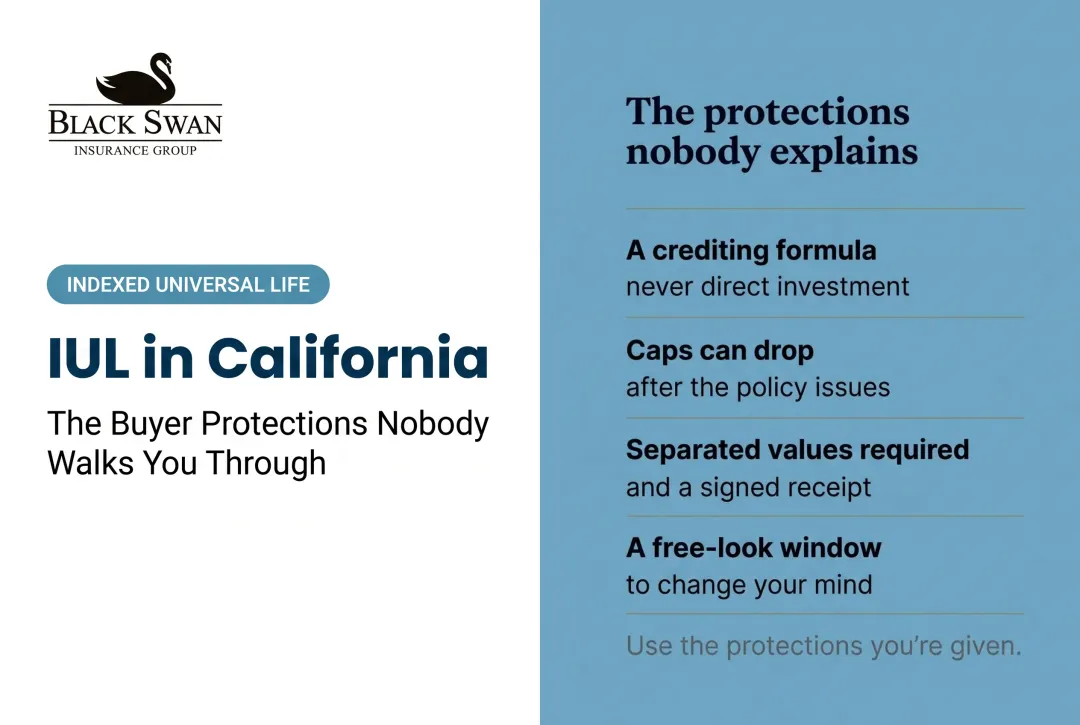
Your Alabama Protections
- Free-look period — Alabama Code requires a minimum 10-day inspection period after delivery, with a full premium refund
- Buyer's Guide — insurers must provide one before taking the initial premium, unless the policy includes an unconditional refund
- Replacement rules — if a new policy would replace existing coverage, the producer must document the replacement and notify your current insurer
The Ultimate IUL Blueprint
If a permanent need genuinely exists, the Blueprint covers the design decisions that follow: funding levels, the MEC line, index-strategy selection and loan timing.
Who It Fits
Stronger Fit
- A genuine need for permanent rather than temporary coverage
- Household income of $150K+ with stable surplus cash flow beyond the regular budget
- An emergency fund already in place and retirement contributions on track
- Insurability supporting favourable underwriting
- A long enough horizon for charges to normalise against growth
- Willingness to review the policy every year
Weaker Fit
Not everyone should buy an IUL. If the guaranteed ledger shows the policy lapsing in your seventies, the contract is telling you no.
- You need short-term liquidity
- Planned premiums cannot be reliably sustained
- You prefer simple, low-cost investing
- Health concerns limit underwriting options
- No real permanent-coverage need — where protection is temporary, term insurance is the right answer and costs far less
- You are relying on an optimistic illustration rather than the guaranteed ledger
Before committing, ask to see: the guaranteed ledger beside the current one; policy charges and the surrender schedule; cap and participation-rate history; loan provisions and break-even timing; and stress-tested lapse scenarios.
Against a 401(k)
These solve different problems. A 401(k) is an employer-sponsored retirement plan governed by IRS rules and your plan document. An IUL is permanent life insurance with a cash-value feature governed by an insurance contract.
| Factor | 401(k) | IUL |
|---|---|---|
| Primary purpose | Retirement savings | Permanent life insurance |
| Employer match | Often available | Not applicable |
| Contribution limits | Set annually by the IRS | No IRS cap; limited by MEC rules |
| Investment choice | Plan-selected funds | Index-linked crediting formula |
| Early access | Restricted before 59½, often with penalty | Loans and withdrawals, with trade-offs |
| Death benefit | None built in | Core feature |
For 2026 the IRS set the employee elective-deferral limit at $24,500, with a catch-up at 50 and over and a higher catch-up for those turning 60 to 63, per IRS guidance on 2025 retirement plan limits. These change annually.

Sequencing
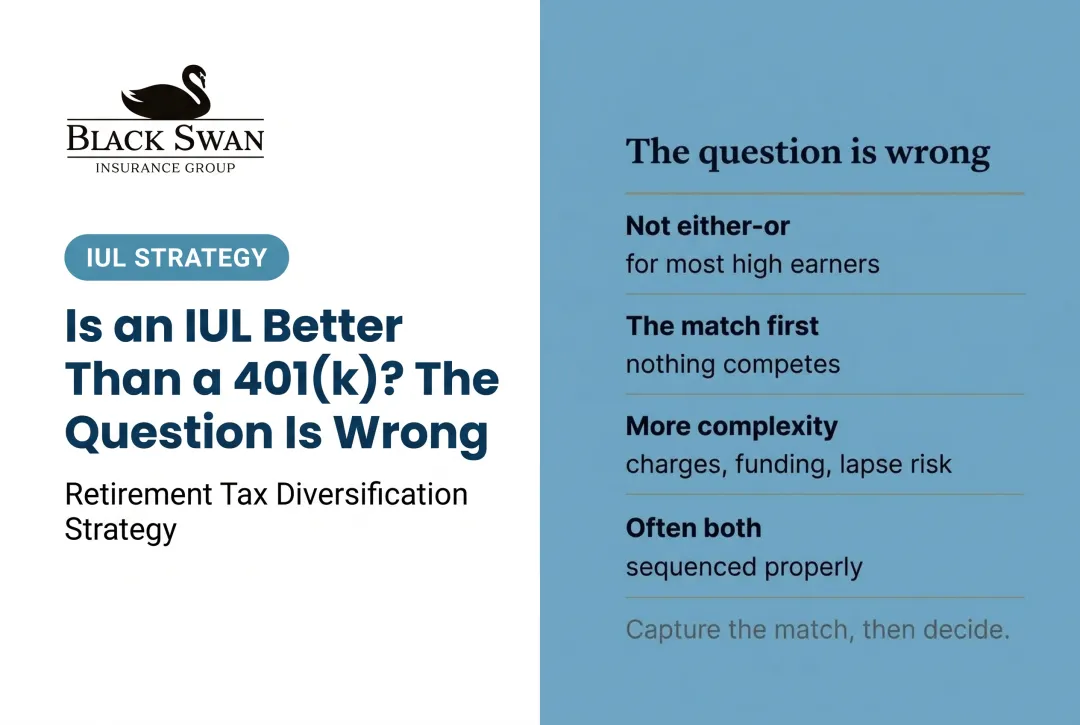
Capture the employer match first. That match is an immediate return on deferred pay, and no illustration replicates it with the same certainty. A 401(k) is not the enemy here — depending on it as the only serious bucket is the part worth examining. After the match and appropriate retirement contributions, some households then evaluate permanent insurance, term insurance, Roth accounts, brokerage investing or annuities as additional layers.
The other comparisons: term insurance costs less and lasts a set period with no cash value, fitting pure income replacement; whole life builds guaranteed cash value, usually at higher premiums; Roth accounts allow tax-free qualified withdrawals subject to limits; brokerage accounts give full liquidity and market exposure without insurance charges or a death benefit.

Do not buy the highlight reel. Watch the game film. In this case the game film is the guaranteed ledger, and it is already in the envelope.
Risks to Understand Before You Apply
- Charges continue in a 0% crediting year, so cash value can fall with the floor intact
- Cost of insurance rises with age and is deducted regardless of index performance
- Caps and participation rates are non-guaranteed and can be reduced after issue
- Minimum funding is fragile, and it is the most common route to lapse
- Surrender charges apply in the early years and make exiting expensive
- Loans reduce the death benefit and accrue interest, and a lapse with a loan outstanding and gain in the contract creates taxable income with no cash received
- Crossing the seven-pay limit makes the contract a MEC and changes distribution taxation permanently
- A compressed time horizon magnifies every one of these for a late starter
- Illustrated values are projections, and the guaranteed ledger is the commitment
Find Out Where You Actually Stand
This starts with the Tax-Free Wealth Blueprint Fit Review. If you earn $150K+ in the Montgomery area, we read the guaranteed ledger beside the illustrated one, stress-test the funding through a bad stretch, check the MEC line and loan assumptions, and compare term plus your existing accounts on identical terms. If it does not fit, we will tell you that too.
Frequently Asked Questions
How much does an IUL cost in Montgomery?
There is no local average worth quoting. Cost depends on age, health, tobacco use, underwriting class, the death benefit, design, riders and funding level. Ask for a personalised illustration.
What is Alabama's free-look period?
A minimum of 10 days after delivery, during which you can return the policy for a full premium refund. Use it to have the contract read by someone who is not selling it.
Can an IUL lapse?
Yes. Insufficient funding, ongoing charges, loans or withdrawals can all cause it, and a lapse with a loan outstanding can create a tax bill.
Is an IUL better than a 401(k)?
They are not comparable in that way. Capture the employer match first, then decide what the next dollar should do. An IUL is evaluated as a supplemental bucket with a protection purpose, not as a plan replacement.
What is the difference between minimum and maximum funding?
Minimum keeps the policy technically alive and builds little cash value. Maximum non-MEC funding prioritises accumulation within the tax code's limits. They produce very different policies from the same product.
Should I buy term instead?
If the protection need has an end date, yes. Term insurance is cheaper and simpler for income replacement, and there is no reason to buy permanent coverage for a temporary problem.
Sources
- NAIC — Life Insurance
- Alabama Department of Insurance — life and health filing requirements
- IRS Notice 2024-80 — 2025 retirement plan limits
- NAIC — Life Insurance Illustrations
- I.R.C. § 7702A and Rev. Proc. 2008-39 (modified endowment contracts and the seven-pay test)
Disclosure: This article is educational and is not personal tax, legal or investment advice. Indexed universal life is life insurance first. State rules, carrier product availability and licensing requirements change; confirm current details before applying. Contribution limits change annually. Actual results depend on policy design, carrier, crediting options, caps, participation rates, expenses, funding and ongoing management. Policy loans and withdrawals may reduce cash value and death benefit and can create tax consequences if the policy lapses or becomes a modified endowment contract. This strategy is not appropriate for everyone. Illustrated values are not guarantees; actual results depend on policy terms, crediting, costs and funding. Consult your own tax, legal and financial professionals for advice specific to your situation.
And remember, it's not what you earn, it's what you keep… enjoy the ride.