By Robert Balgac, Founder, Black Swan Insurance Group | October 5, 2026
Buying an indexed universal life policy is nothing like opening a brokerage account, and the people who approach it that way are the ones who end up disappointed.
You are not buying shares of the S&P 500. You are buying permanent life insurance where the credited interest on your cash value is linked to how an index performed, subject to caps, floors and participation rates the insurer sets and can change.
That distinction decides everything downstream. Outcomes depend on policy design, funding consistency, insurance costs, crediting rules, and whether you take loans along the way. Two people can buy the identical product from the identical carrier and land in completely different places on funding discipline alone.
If you earn $150K+ and have decided a permanent need exists, here is the order to do this in — and the mistakes that cost first-time buyers the most.
The short answer: Confirm a genuine permanent insurance need exists first; if it does not, stop here. Gather your financial and health details, because underwriting drives both premium and how much death benefit you can support. Compare real designs on guaranteed and current-assumption illustrations, not one projection. Then fund at a level you could sustain through a bad year, and review it annually. Address emergency savings, high-interest debt and any employer match before a single premium dollar goes in.
Key Takeaways
- It is life insurance first; treat cash-value growth as the secondary benefit, because that is what it is
- A 0% floor limits negative index credits; fees and insurance charges can still erode value
- Emergency savings, high-interest debt and retirement-account matches come before funding a policy
- Compare guaranteed and non-guaranteed illustrations rather than trusting one optimistic projection
- Annual reviews catch funding gaps and lapse risk while they are still cheap to fix
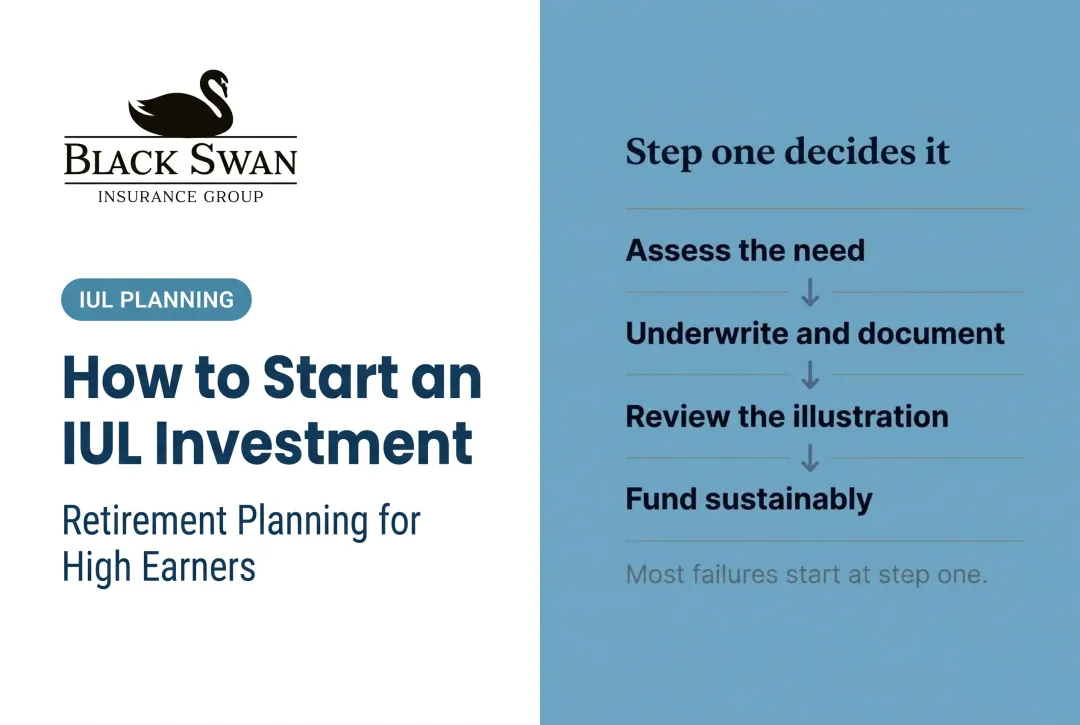
The Four Steps

Step 1: Confirm the Policy Fits Before Requesting a Single Illustration
Get clear on why you are considering one:
- Permanent death-benefit protection for a spouse, business partner or dependents
- Supplemental retirement income through policy loans in later years
- Estate or legacy planning and wealth transfer
- Business succession and owner or partner protection
- A combination of protection and long-term cash-value access
Then the harder question. Do you have a genuine, lasting need for permanent coverage? Can the household commit to premiums for 15, 20 or 30 years without shortchanging reserves, debt payoff or existing retirement contributions?
If the honest answer is "maybe," resolve that now rather than in year three when the premium starts feeling heavy. An IUL is an insurance contract with an index-linked crediting feature. It is not a securities account and it does not deliver market-like returns.
Step 2: Gather Financial and Health Information
Insurers underwrite both. Pull together income, cash flow, assets and liabilities; existing policies and retirement contributions; dependents, business obligations and intended retirement age; and health history including tobacco use, medications and family history.
Your underwriting class directly affects the premium and how much death benefit you can support. Before meeting anyone, define your target death benefit, a premium range sustainable through a bad year, your liquidity needs and your horizon. That groundwork turns a generic pitch into a design built around your situation.
Step 3: Compare Designs, Not Projections
- Premium allocation, cost of insurance and administrative charges
- Surrender schedule and death-benefit options
- Index accounts, fixed account options and available riders
- Cap, floor, participation rate, spread, averaging method and crediting period
- Whether each of those is guaranteed or subject to change under the contract
Request both a current-assumption illustration and a guaranteed illustration, then compare cash value, death benefit, premiums and expenses at multiple future points — not only year 20 or year 30. If the numbers only work in the rosiest column, that is the finding.
Do not buy the highlight reel. Watch the game film.
Step 4: Fund, Monitor, Adjust
Set a premium schedule you could maintain if income dropped, revenue slowed, or retirement arrived earlier than planned.
- Review annual statements for cash value, credited interest and any changes to caps or participation rates
- Track loan balances against the projected lapse date
- Model the impact before reducing premiums, taking a withdrawal or initiating a loan — on death benefit, cash value and tax treatment
- Schedule periodic reviews, and involve a tax or legal advisor for anything material
Funding consistency, more than any crediting method, separates the policies that perform from the ones that lapse.
This is not set-it-and-forget-it. It is design-it, fund-it, review-it.
What the Critics Get Right
The people who say most buyers should not be doing this at all are broadly correct, and saying so improves rather than weakens the case.
They are right that the product gets sold to people whose foundational priorities are not covered — no emergency fund, an uncaptured employer match, consumer debt still running. They are right that early-year cash values are modest enough that anyone who exits in the first several years loses money. And they are right that "how to invest in an IUL" is a framing that sets the wrong expectation before the first sentence.
Where the criticism stops short is the household that has already done the groundwork and still has an unaddressed permanent protection need. For them the question is not whether to invest — it is how to structure and fund coverage they need anyway, and that is a legitimate question with a technical answer.
When It Fits, and When It Does Not
Stronger Fit
- A long time horizon for the policy to work as designed
- A lasting need for permanent life insurance that stands on its own
- Household income of $150K+ with stable surplus cash flow to fund premiums
- Adequate liquidity held outside the policy
- Willingness to monitor a genuinely complex contract, every year
- Any potential tax-advantaged access understood as conditional on the policy being properly structured, funded and managed
Weaker Fit
Not everyone should buy an IUL. If any of the four steps below cannot be completed honestly, the answer at step one is no.
- You need short-term access to the money
- Premiums cannot be reliably maintained through income swings
- No ongoing need for permanent insurance — where protection is temporary, term insurance is the right answer and considerably cheaper
- An available employer 401(k) match has not been captured
- Low-cost direct market exposure is what you actually want
The NAIC's consumer buyer's guide puts it plainly: choose features that fit your needs, confirm the initial premium is affordable, and ask what the highest premium would be to keep coverage in force if assumptions change. That last question is the one almost nobody asks.
Bring to the meeting: a written needs analysis and household cash-flow review, existing policy documents and retirement-account details, health and underwriting information, and a list of questions about caps, charges and funding requirements.
Then compare against term insurance, whole life, qualified plans, IRAs and brokerage assets. A policy evaluated in isolation always looks better than it does beside your full picture.
The Ultimate IUL Blueprint
If you have cleared step one and want the detail behind steps three and four, the Blueprint covers funding levels, the MEC line, index-strategy selection, loan timing and what to demand from an illustration.
The Five Variables That Decide the Outcome
Funding Consistency
Premiums have to cover policy costs and leave enough behind to build cash value. Underfunding, skipped payments and optimistic assumptions about future affordability reduce accumulation and raise lapse risk. This is the single most controllable factor in the whole equation, and the one most often mishandled.
The Crediting Formula
Index choice and crediting method, cap and floor, participation rate and spread, reset period. A strong market year does not guarantee a proportionally strong credit — caps, participation limits and charges all cut what lands in cash value.
Charges and Surrender Costs
Cost of insurance, administrative fees, premium charges, rider costs and surrender charges all reduce funds available for growth. Early-year cash values are modest, and a long surrender period makes cancelling or replacing expensive if plans change.
Loans, Withdrawals and MEC Status
Unpaid loan interest and withdrawals reduce cash value and death benefit, and a lapse with a loan outstanding and gain in the contract can create unexpected taxation with no cash received.
Funding too aggressively creates the opposite problem. Under the IRS seven-pay test guidance, a policy becomes a modified endowment contract if premiums in the first seven years exceed the limit, changing how loans and withdrawals are taxed permanently.
Time Horizon and Monitoring
Results shift as costs, assumptions and circumstances evolve. NAIC's AG 49-A specifically notes that historical index performance in an illustration is not indicative of future returns. Annual reviews catch a funding gap while it is still cheap to fix.

Troubleshooting a Policy That Is Off Track
Cash value lower than expected? Verify actual premiums paid against the illustration, check policy charges and any cap or participation-rate changes, and confirm whether you are reading a current-assumption or a guaranteed column.
Lapse risk rising? Request an updated in-force illustration. Compare increased funding, a reduced death benefit and lower expenses before acting.
Affordability genuinely changed? Do not simply stop paying. Review the options first — a reduced death benefit often keeps coverage alive where abandonment destroys everything paid in.
The Alternatives Worth Pricing
| Alternative | Best for |
|---|---|
| 401(k) / IRA | Employer matches, tax deductions, lower-cost investing |
| Term life plus separate investing | Affordable temporary protection and more liquidity |
| Whole life or annuities | Guaranteed growth, income features, less variability |
For 2026 the employee deferral limit for a 401(k) is $24,500 and the IRA limit is $7,500. If an employer match is still on the table, that is where the first dollar goes — not into a premium.

Risks to Understand Before You Fund One
- Underfunding is the leading cause of failure, and premium flexibility makes it easy to drift
- Early-year cash values are modest and surrender charges make an early exit costly
- Cost of insurance rises with age and is charged in flat crediting years
- Caps, participation rates and spreads are non-guaranteed and can be adjusted after you commit
- Loan interest compounds, and a lapse with a loan outstanding and gain in the contract can create taxable income
- Crossing the seven-pay limit makes the contract a MEC under I.R.C. § 7702A and changes distribution taxation permanently
- Skipping the employer match to fund a premium is the most expensive sequencing error available here
- Illustrated values are not guarantees, and historical index performance does not indicate future crediting
Find Out Where You Actually Stand
This starts with the Tax-Free Wealth Blueprint Fit Review. If you earn $150K+ and are weighing a policy, we test whether the permanent need exists independently, model the funding against a genuinely bad year, read the guaranteed column, and price term plus qualified accounts alongside. If it does not fit, we will tell you that too.
Frequently Asked Questions
Is an IUL a good place to put money?
It is permanent life insurance with cash-value potential, not a standalone account, and judging it purely as a place to put money is how people get disappointed. Whether it works depends on your protection need, horizon, funding capacity and tolerance for a complex contract.
How much do I need to start one?
There is no universal figure. Premiums depend on age, health, coverage amount and design. The more useful question is how much you can sustain through a bad year, because that is the number that decides whether the policy survives.
How does the cash value actually grow?
Interest is credited under an index-linked formula subject to caps, participation rates, floors and spreads, after policy charges are deducted. Returns are not guaranteed, and loans or withdrawals carry their own consequences.
What should I fund first?
Emergency reserves, high-interest debt and the full employer match, in that order. A premium that competes with any of those is a premium you cannot afford yet.
What happens if I cannot keep paying?
Options exist — reducing the death benefit, adjusting the funding, or using cash value temporarily. Simply stopping payments is the worst of them. Ask for an in-force illustration before making any change.
Should I buy term instead?
If the protection need is temporary, yes, and pairing term with qualified accounts is a strong and much cheaper plan. Permanent coverage earns its place when the need genuinely outlasts a term.
Sources
- NAIC — Life Insurance Buyer's Guide
- NAIC — Actuarial Guideline 49-A
- IRS Rev. Proc. 2001-42 — seven-pay test guidance
- IRS Notice 2025-67 — 2026 retirement plan limits
- I.R.C. § 7702A (modified endowment contracts)
Disclosure: This article is educational and is not personal tax, legal or investment advice. Indexed universal life is life insurance first. Actual results depend on policy design, carrier, crediting options, caps, participation rates, expenses, funding and ongoing management. Policy loans and withdrawals may reduce cash value and death benefit and can create tax consequences if the policy lapses or becomes a modified endowment contract. This strategy is not appropriate for everyone. Illustrated values are not guarantees; actual results depend on policy terms, crediting, costs and funding. Consult your own tax, legal and financial professionals for advice specific to your situation.
And remember, it's not what you earn, it's what you keep… enjoy the ride.