By Robert Balgac, Founder, Black Swan Insurance Group | October 5, 2026
The question behind this question is usually not about mechanics. It is about whether the money you are about to commit will be reachable if something changes. That is a fair thing to ask before funding a policy, and it deserves a straight answer rather than a reassurance.
There is no waiting period written into most indexed universal life contracts. What there is instead is a practical constraint: you cannot borrow value that does not exist yet. In the early years, premium loads, cost of insurance and the surrender charge schedule mean very little net loan value has accumulated. The contract may permit a loan in year two. The arithmetic may not.
The short answer: Most IUL policies allow a loan as soon as there is net loan value, which usually means at least a year of funding and often several. The insurer typically advances a percentage of cash surrender value less any existing debt, so surrender charges directly reduce what you can borrow early on. Borrowing in the first few years is the most expensive timing available, because it removes the base that compounding needs and increases lapse risk for the rest of the contract.
Key Takeaways
- There is generally no fixed waiting period; the constraint is available net loan value, not the calendar
- Surrender charges reduce the borrowable amount for years, so early capacity is far smaller than cash value suggests
- Interest accrues from day one whether or not you make payments, and charges continue on top of it
- Borrowing early removes the base that compounding needs, which compounds the cost across the whole contract
- If you may need the money within five years, the policy is probably the wrong place to have put it
Why There Is No Simple Answer in Months
An IUL is permanent life insurance first. The cash value you would borrow against is a feature of that contract, and any potential tax-advantaged access depends on the policy being properly structured, funded and managed.
Four numbers on your statement look similar and are not interchangeable. Confusing them is where early borrowing decisions go wrong.
- Accumulated cash value — total living value built inside the policy
- Cash surrender value — cash value less surrender charges, if you closed it today
- Net available loan value — what the insurer will actually advance, generally surrender value less existing debt
- Death benefit — what beneficiaries receive; you do not borrow from it directly
In year two, the first number may look encouraging and the third may be close to nothing. The surrender schedule is the reason.

What Determines How Fast Value Builds
- Funding level. A policy funded near the MEC limit accumulates borrowable value far faster than one funded at the minimum premium.
- Death benefit design. A face amount sized for the largest illustration rather than for cash value slows accumulation, because more premium goes to cost of insurance.
- Premium load and charges. These are heaviest relative to a small account in the early years.
- Crediting. A flat first decade delays everything, and the floor protects the credit rather than the charges.
A great IUL is engineered. A bad IUL is sold. Two people can hold the same product and only one of them can borrow against it in year five.
The Cost of Borrowing Early
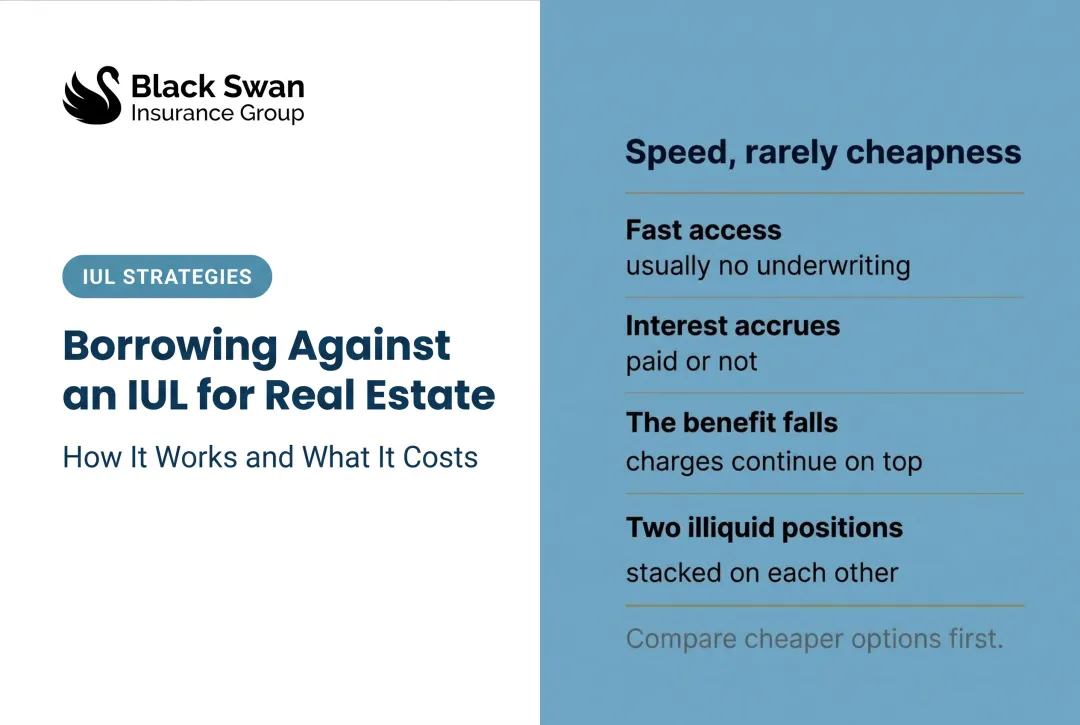
Interest accrues on the outstanding balance whether or not you pay it, and the policy keeps deducting cost of insurance and administrative charges the whole time. Take a loan in year three against a small account, leave it unpaid, and two things compound against you at once: the loan balance grows, and the account value that should have been growing is smaller by the amount borrowed.
What the Critics Get Right
Critics are right that policy loans are often presented as though borrowing from yourself is costless. It is not. A policy loan is real debt with real interest, and an unmanaged one can collapse the contract decades later. They are also right that early borrowing is frequently a symptom — the buyer was sold a premium they could not comfortably sustain, and the loan is how the shortfall gets covered.
Where the criticism overreaches is in concluding that the loan feature is therefore a trick. Used deliberately, against a well-funded policy, with a repayment plan and an annual review, it is a legitimate liquidity tool. The loan is not the problem. The unmanaged loan is the problem.

Compare It Against the Alternatives
Before borrowing against a young policy, price the other sources honestly:
- Cash reserves — the cheapest option, and the reason an emergency fund comes first
- Term insurance plus a brokerage account — if the protection need is temporary, that combination avoids this question entirely
- A HELOC or home equity loan — usually cheaper, secured against the property
- A 401(k) loan — repayment terms and what happens if you leave the employer
- A bank line of credit — rate and approval time
- Securities-based lending — margin call risk
Timing the Loan Against the Policy Year
The same loan taken at three different points in a contract's life produces three different outcomes. It is worth being concrete about why.
Years One to Five
Surrender charges are at their heaviest and the account value is at its smallest. Net loan value may be a small fraction of the premium paid in. Borrowing here is not just expensive, it is structurally damaging: the amount removed is the amount that would otherwise have spent the next twenty years compounding. If a policy needs a loan in this window, the usual diagnosis is that the premium was set too high for the household's actual cash flow.
Years Six to Fifteen
The surrender schedule is grading down and the account has a working base. This is where a deliberate, planned loan starts to make sense — a defined purpose, a repayment intention, and an in-force illustration showing the policy still holds with the balance outstanding. Ask for that illustration at guaranteed values, not only at illustrated ones.
Year Fifteen and Beyond
Surrender charges have typically expired and the account is large enough to carry a balance without threatening the contract. This is the window most retirement-income strategies assume. It is also the window where annual reviews matter most, because a loan left unwatched for a decade is how otherwise healthy policies fail.
In a good year, we talk about what was credited. In a bad year, we talk about what was protected. In either year, the loan balance still needs looking at.
A Word on Fixed Versus Indexed Loans
Some carriers offer a choice between a fixed-rate loan, where the borrowed amount is moved to a declared-rate account, and an indexed or participating loan, where the borrowed amount stays in the indexed account and may still be credited. The second sounds better and carries more risk: you are charged a loan rate while hoping the credited rate exceeds it. In a flat decade, that gap runs against you and the balance grows faster than the account. Read which type your contract offers before assuming the illustration used the conservative one.
The Ultimate IUL Blueprint
A plain-English walkthrough of funding levels, loan mechanics, surrender schedules and the questions to ask before you accept any illustration.
Who Early Access May Fit
Stronger Fit
- $150K+ stable income with a fully funded emergency reserve already in place
- A policy funded near the MEC limit, so net loan value builds quickly
- A defined purpose for the money and a written repayment intention
- Comfort with a reduced death benefit while the balance is outstanding
- Annual reviews already part of how you manage the contract
Weaker Fit
Not everyone should buy an IUL, and almost nobody should buy one intending to borrow from it early. If access inside five years is part of the plan, a brokerage account does that job without surrender charges.
- Liquidity needed within the first several policy years
- Minimum-funded policy with a large face amount
- No emergency fund, or high-interest debt still outstanding
- Variable income that could interrupt premium payments

Risks to Understand Before You Borrow
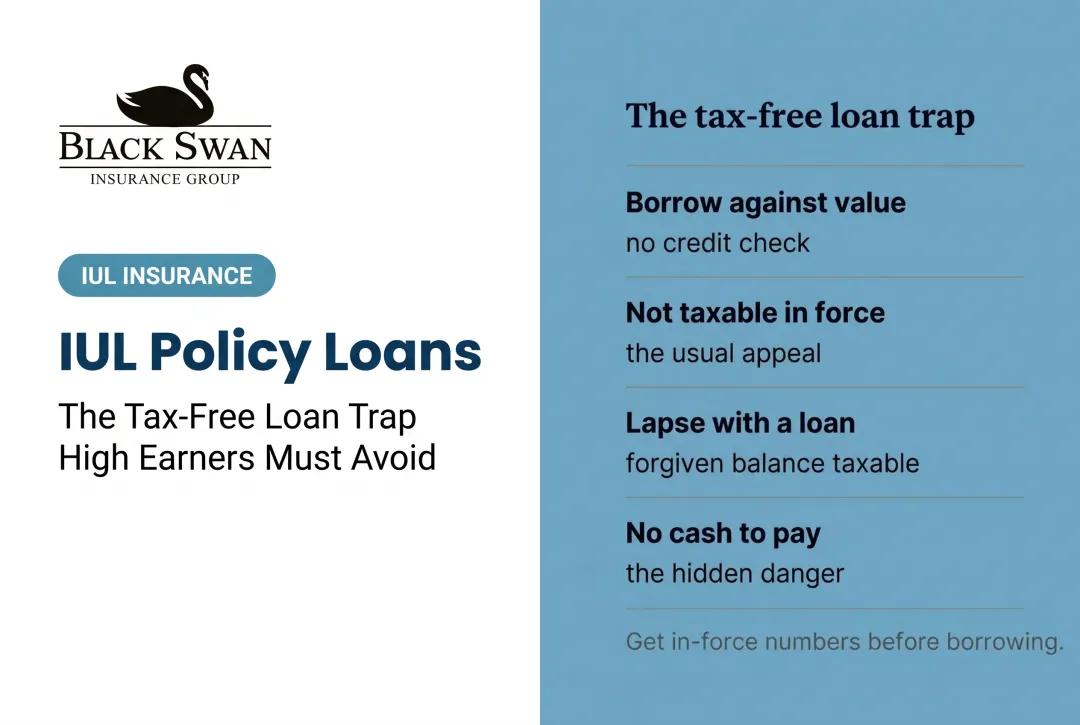
- Interest accrues from the first day whether or not you pay it, and insurance charges continue regardless.
- Net loan value is far below cash value early on, because surrender charges are subtracted first.
- Borrowing early removes the compounding base, and that shortfall persists for the life of the contract.
- Lapse risk rises when debt plus accruing interest outpaces available value and funding.
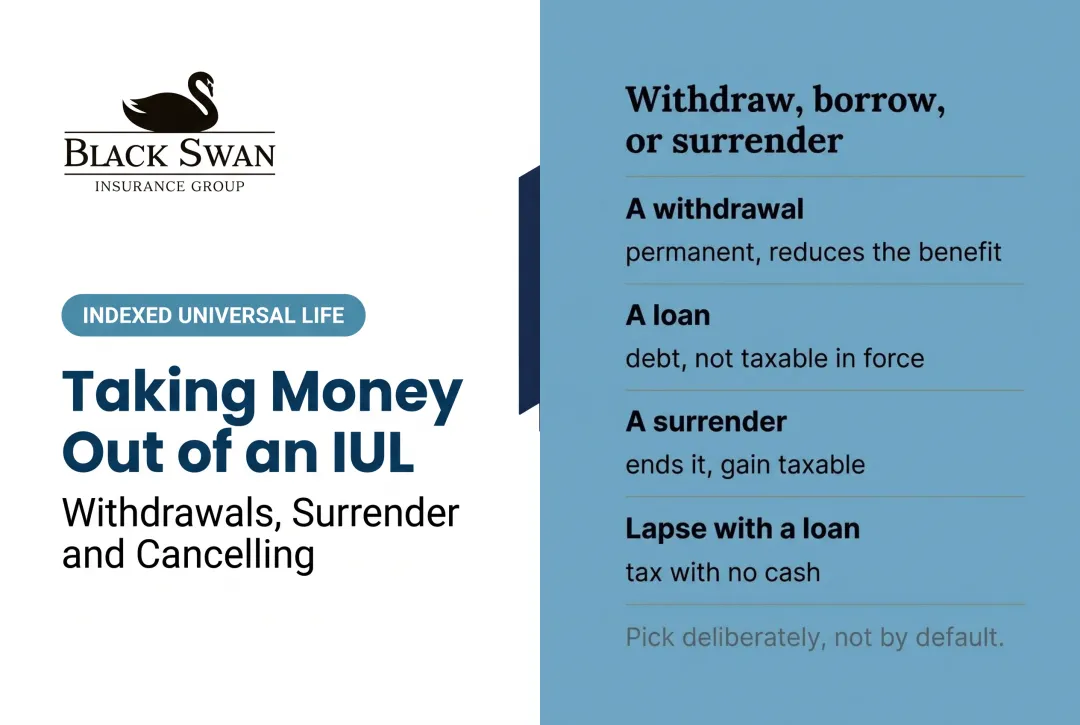
- A lapse or surrender with gain and an outstanding loan can create taxable income with no cash received to pay it.
- MEC status changes the rules. Above the seven-pay limit under I.R.C. § 7702A, loans and withdrawals are taxed last-in-first-out and a 10% additional federal tax may apply before 59½ (I.R.C. § 72).
Find Out Where You Actually Stand
Start with the Tax-Free Wealth Blueprint Fit Review. If you earn $150K+ and are weighing when the money becomes reachable, we run your contract's surrender schedule, funding level and crediting assumptions and show what net loan value actually looks like year by year — including the years where the answer is nothing. If IUL does not fit, we will tell you that too.
Frequently Asked Questions
How soon can I borrow from an IUL policy?
Once there is net loan value, which usually takes at least a year of funding and often several. The contract rarely sets a fixed waiting period; the surrender schedule and funding level set the practical one.
How much can I borrow in the early years?
Generally a percentage of cash surrender value less existing debt. Because surrender charges are subtracted first, early capacity is much smaller than the accumulated cash value figure suggests.
Does borrowing early hurt the policy?
Yes, more than borrowing later. It removes the base that compounding needs while interest accrues against the contract, and it raises lapse risk for the remaining decades.
Do I have to repay an IUL loan?
Many contracts do not require a fixed schedule. Interest still accrues, and an unpaid balance reduces the death benefit and increases the chance the policy collapses.
Is a policy loan taxable?
Generally not while the policy stays in force. If the policy lapses or is surrendered with gain and an outstanding loan, amounts above basis can become taxable income. MEC contracts follow different rules.
What should I ask my carrier first?
Current net loan value, the surrender charge schedule, the loan interest rate and whether it can change, how interest accrues, and what happens to the loan on lapse or surrender.
Sources
- NAIC — Life Insurance — cash value and policy loan definitions
- Guardian — typical borrowing limits against cash value
- National Life Group — loan processing timelines
- I.R.C. § 7702A — Modified Endowment Contract and the seven-pay test
- I.R.C. § 72 — additional tax on early distributions
- NAIC, Life Insurance Illustrations Model Regulation (Model #582) — in-force illustrations
Disclosure: The information on this page is educational in nature and does not constitute personalized financial, tax, or legal advice. Actual results depend on policy design, carrier, crediting options, caps, participation rates, expenses, funding, loans, and ongoing management. Policy loans and withdrawals reduce cash value and the death benefit, and can create tax consequences if the policy lapses or becomes a modified endowment contract. Consult a licensed insurance professional and, where appropriate, a tax or financial advisor before making any insurance or financial decision. Indexed universal life is life insurance first. Illustrated values are not guarantees; actual results depend on policy terms, crediting, costs and funding. This strategy is not appropriate for everyone.
And remember, it's not what you earn, it's what you keep… enjoy the ride.