By Robert Balgac, Founder, Black Swan Insurance Group | October 5, 2026
If you searched for indexed universal life at Erie Insurance, you are asking one of two questions. Does Erie sell it? Or can someone in Erie's service area buy an IUL from another carrier?
The first answer is straightforward: Erie's published life lineup shows term, whole life and ERIExpress. No indexed universal life, and no conventional universal life either. That is not a knock on Erie — it is a company built around broad personal insurance rather than specialised cash-value design, and it is good at what it does.
The second question is the one worth your time. If index-linked cash value is genuinely what you need — and for most people asking, that need traces back to maxing a 401(k), running into the Roth income limits, and looking for what a $150K+ earner does with the next dollar — you will be buying it elsewhere, and the evaluation matters more than the brand on the envelope.
The short answer: Erie's public lineup lists term, whole life and ERIExpress — no confirmed IUL product. Erie Family Life holds an AM Best A (Excellent) rating and is licensed in the District of Columbia and 11 states, and its term and whole life products solve real problems. If you want index-linked cash value, you are comparing dedicated IUL designs from other carriers, where crediting shifts with caps, participation rates, spreads, charges, premiums and loans. Read the guaranteed and non-guaranteed columns before applying anywhere.
Key Takeaways
- Erie's public lineup lists term, whole life and ERIExpress — not a confirmed IUL product
- IUL cash value shifts with caps, participation rates, spreads, charges, premiums and loans
- Treat an IUL as a monitored long-term strategy, not a swap for a 401(k), IRA, brokerage account or term policy
- Review guaranteed and non-guaranteed values with a licensed professional before applying
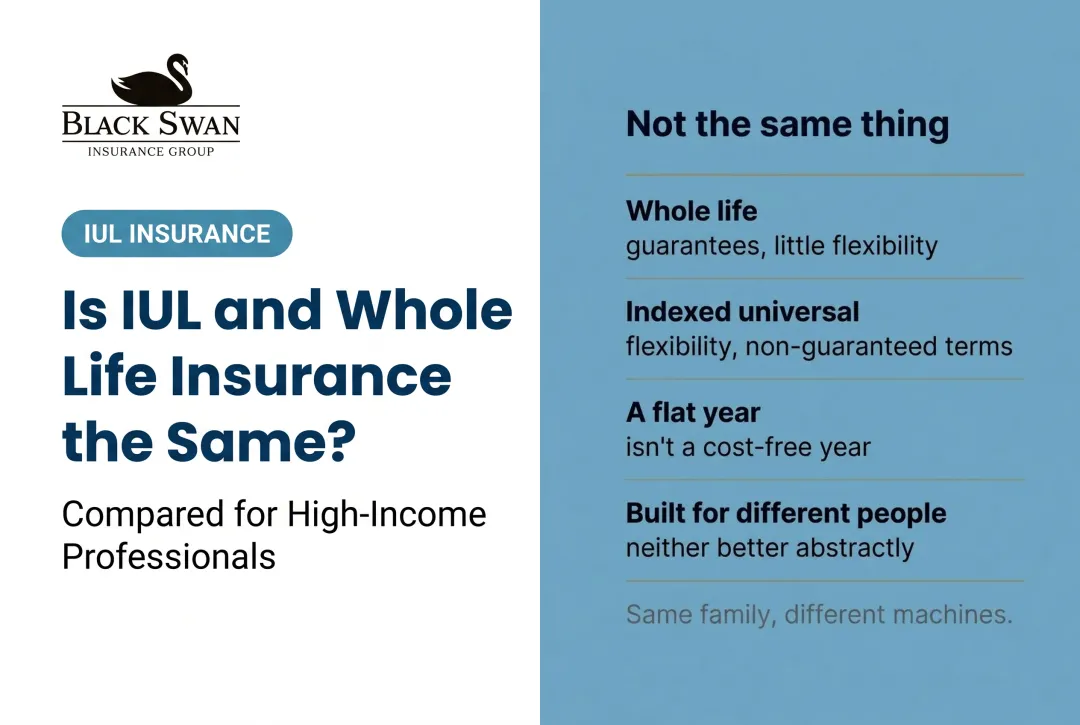
- Universal life and indexed universal life are not interchangeable terms, though they get used that way
How an IUL Works
Permanent life insurance built around two connected pieces: a death benefit paid to beneficiaries, and a cash-value account growing partly on an index's performance. The NAIC describes IUL as carrying both fixed and variable features, with interest tied to an external index rather than a single guaranteed rate.
Not every premium dollar reaches cash value. Before anything is credited, the insurer deducts cost of insurance, administrative and per-policy fees, rider charges where optional benefits are added, and premium loads. Whatever remains contributes to cash value, where index crediting takes over.
The Crediting Formula
You are not buying shares of the S&P 500. The insurer tracks the index's movement over a set period and applies a formula built from four terms:
- Participation rate — the percentage of index gain used in your credit; 80% of a 10% gain credits 8%
- Cap — the maximum credited rate for the period, however high the index climbed
- Spread — a flat deduction subtracted from the index gain before crediting
- Floor — the minimum credited rate, commonly 0%
A 0% floor means a bad index year will not reduce cash value through the crediting formula. It does not mean cash value cannot decline. Policy charges keep coming whether the index performs or not, and that distinction rarely gets enough attention in a sales conversation.
Zero is your hero in a down year — but the floor applies to the credit, not to the charges.
Reaching the Cash Value
Withdrawals or policy loans. Loans are real debt: they accrue interest, and left unpaid they shrink cash value and the death benefit over time. Surrendering in the early years triggers charges specified in the contract.
Flexible premiums and adjustable death-benefit options place real responsibility on the owner. Underfunding, leaning on optimistic illustrated returns, or stopping premiums too early can leave the policy without enough cash value to cover its own charges — and that is a lapse.

What Erie Actually Offers
Based on Erie's published life insurance portfolio, three categories:
- Term life — 5, 10, 15, 20 and 30-year plans
- Whole life — ERIE Whole Life Protector and ERIE Whole Life Accumulator
- ERIExpress Life, a simplified-issue option
Indexed universal life does not appear. Neither does conventional universal life. The published products are underwritten through Erie Family Life and are not available in New York. Whole life issue ages run from 15 days after birth through age 85 depending on the plan.
That gap matters because universal life and indexed universal life are not interchangeable. Conventional universal life credits interest at a fixed or declared rate the insurer sets. An IUL credits interest through an index-linked formula with caps, participation rates and floors. Erie's current materials show neither as an active offering, and there is no publicly confirmed Erie IUL product name, state list or issue-age schedule to evaluate.
What Erie Does Well
- Erie Family Life holds an A (Excellent) Financial Strength Rating from AM Best, with a stable outlook
- Licensed in the District of Columbia and 11 states, including Ohio, Pennsylvania, Virginia and Indiana
- Indiana's 2023 life insurance complaint index ranked Erie Family Life at 5.37, based on 2 complaints against $16.3 million in premium
Erie's focus is broad-based personal insurance — auto, home and general life coverage — rather than specialised cash-value or index-crediting design. That model serves many households well. If your actual need is affordable income replacement, Erie's term products may be exactly right, and no further reading is required.

What the Critics Get Right
Anyone who suspects "does carrier X sell IUL" content exists to redirect you toward a commission is not wrong to be suspicious.
Critics are right that a page answering a factual question about one carrier, then pivoting to a different product, is a well-worn sales pattern. They are right that IUL gets recommended to people whose genuine requirement was cheap term coverage. And they are right that popularity is not evidence — LIMRA reported 2025 IUL new premium hit a record $4.5 billion, up 17%, and that tells you the product is being sold well, not that it fits you.
So here is the honest position: if you came here wanting term insurance from a company you already trust, Erie sells it and the conversation ends. The IUL discussion only becomes relevant if you have a permanent protection need Erie's lineup does not address.
Who an IUL Actually Fits
Stronger Fit
- A genuine need for permanent rather than temporary death-benefit protection
- Household income of $150K+ with stable surplus cash flow after expenses, debt and savings
- Fully funded emergency reserves
- Willingness to fund and monitor the policy over decades
- Insurability supporting reasonable underwriting classes
- A need for tax-diversified savings after maxing lower-cost accounts such as a 401(k) or Roth IRA
Late-start high earners — professionals hitting peak earnings in their late 40s or early 50s — face a shorter runway. Less time for cash value to build, less room to absorb a weak crediting year, a tighter window before income is needed. Age, health and sustainable premium levels carry more weight than they would at 30, and a responsible evaluation stress-tests conservative crediting before anyone commits.
Weaker Fit
Not everyone should buy an IUL, from any carrier. The right question is whether permanent coverage fits at all, not who writes it.
- Limited monthly cash flow beyond necessities
- Unresolved high-interest debt
- No emergency fund in place
- A primarily short-term or temporary protection need
- No real intention or ability to monitor the policy
- A strong preference for guaranteed, predictable costs over index-linked potential
If affordable income replacement is the actual goal, term insurance — sometimes available up to $10 million depending on carrier — solves it more directly and at far lower cost. If guarantees matter more than growth potential, whole life or guaranteed universal life deserve a look first.

The Ultimate IUL Blueprint
If a permanent need genuinely exists and you are comparing designs across carriers, the Blueprint covers what to demand from each: funding levels, the MEC line, loan timing and the guaranteed column.
Benefits, Costs and Risks
What it offers: permanent coverage that does not expire; flexibility to adjust premiums and death benefit as circumstances change; cash-value accumulation potential tied to index performance without direct market exposure; and access to accumulated cash value through loans or withdrawals, with potential tax-advantaged treatment when the policy is properly structured, funded and managed.
The cost lines that move the needle, in both the illustration and the contract: cost of insurance charges rising with age; premium loads and administrative fees; rider charges; surrender charges in the early years; loan interest if you plan to borrow; and the cap, participation rate and spread limits on crediting.
Read Both Columns
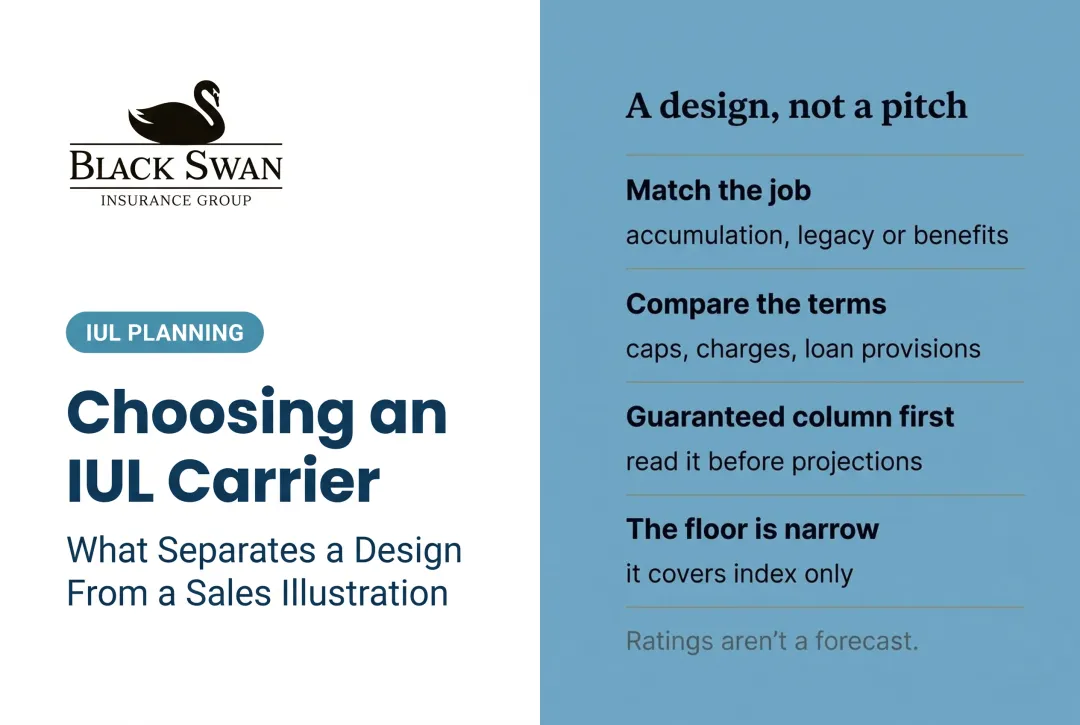
Every proper illustration shows guaranteed values — the worst-case contractual minimum — and non-guaranteed current-assumption values built on today's caps and charges, both of which can change.
Ask what happens if caps drop, charges rise, or you skip several premium payments. If the guaranteed column looks unacceptable, that is information worth having before you apply, not after.

Lapse and Tax
Unpaid charges, aggressive loans or underfunding erode cash value until it no longer covers the policy's own costs, and then the policy lapses. A lapse with an outstanding loan can create taxable income, since a surrender exceeding cost basis is generally treated as taxable gain.
Rules around modified endowment contracts and policy loans are technical and change. Confirm current treatment with a tax professional before assuming any distribution is tax-free.
Against Investing Separately
This is not a replacement for a diversified brokerage account and should not be marketed as one. A brokerage account gives full liquidity, transparent costs and uncapped participation, with no death benefit and no protection component. An IUL gives permanent protection with capped, charge-reduced crediting. They answer different questions, and comparing them on return alone will always favour the brokerage account.

Do not buy the highlight reel. Watch the game film. The guaranteed column is the game film.
Risks to Understand Before You Apply Anywhere
- Charges continue in a 0% crediting year, so cash value can fall with the floor intact
- Cost of insurance rises with age and is deducted regardless of index performance
- Caps, participation rates and spreads are non-guaranteed and can be reduced after issue
- Underfunding is the leading cause of lapse, and premium flexibility makes drifting easy
- Surrender charges apply in the early years
- Loans are real debt and a lapse with a loan outstanding and gain in the contract creates taxable income with no cash received
- Crossing the seven-pay limit makes the contract a MEC and changes distribution taxation permanently
- Product availability varies by carrier and state, and lineups change
- Illustrated values are projections, and only the guaranteed column commits the insurer
Find Out Where You Actually Stand
This starts with the Tax-Free Wealth Blueprint Fit Review. If you earn $150K+ and are trying to work out whether you need an IUL at all — or whether term coverage from a carrier you already use would do the job — we run the protection need first, then compare designs across carriers on guaranteed columns and matched assumptions. If it does not fit, we will tell you that too, and "buy the term policy" is a common conclusion.
Frequently Asked Questions
Does Erie Insurance sell indexed universal life?
Erie's published life insurance portfolio lists term, whole life and ERIExpress. Indexed universal life does not appear, and neither does conventional universal life. There is no publicly confirmed Erie IUL product to evaluate.
Is Erie a good life insurer?
Erie Family Life holds an AM Best A (Excellent) rating with a stable outlook and a low complaint index in Indiana's 2023 data. For term and whole life coverage it is a legitimate choice; it is simply not where index-linked cash value comes from.
What is the difference between UL and IUL?
Conventional universal life credits interest at a fixed or declared rate the insurer sets. An IUL credits interest through an index-linked formula bounded by caps, participation rates and floors. The terms get used interchangeably and should not be.
Does the 0% floor protect my cash value?
No. It prevents a negative index credit. Cost of insurance, administrative fees and loan interest continue regardless, so cash value can still fall in a flat year.
Should I just buy term insurance from Erie instead?
Quite possibly. If the need is affordable income replacement over a defined period, term is the right product and Erie sells it. Permanent coverage earns its place only when the protection need genuinely outlasts a term.
What should I compare across carriers?
Guaranteed and non-guaranteed columns, cost of insurance, premium loads, surrender schedules, loan provisions, caps and participation rates — and the carrier's financial strength and complaint history.
Sources
- Erie Insurance — life insurance products
- NAIC — Life Insurance
- LIMRA — 2025 individual life insurance new premium record
- NAIC — Life Insurance Illustrations
- I.R.C. § 7702A and Rev. Proc. 2008-39 (modified endowment contracts and the seven-pay test)
Disclosure: This article is educational and is not personal tax, legal or investment advice. Indexed universal life is life insurance first. Carrier product lineups, ratings and state availability change; confirm current details directly with the carrier. Actual results depend on policy design, carrier, crediting options, caps, participation rates, expenses, funding and ongoing management. Policy loans and withdrawals may reduce cash value and death benefit and can create tax consequences if the policy lapses or becomes a modified endowment contract. This strategy is not appropriate for everyone. Illustrated values are not guarantees; actual results depend on policy terms, crediting, costs and funding. Consult your own tax, legal and financial professionals for advice specific to your situation.
And remember, it's not what you earn, it's what you keep… enjoy the ride.