By Robert Balgac, Founder, Black Swan Insurance Group | October 5, 2026
South Carolina gives you between 10 and 31 days after policy delivery to read the contract and cancel for a full refund. That window is the single most valuable protection in this transaction, and almost nobody uses it for what it is actually for.
Indexed universal life combines permanent protection with a cash-value account credited on an external market index. Be clear from the start: an IUL is a life insurance contract, not a guaranteed investment, and its long-term value depends far more on how it is funded and managed than on what the index does.
If you earn $150K+ and have already maxed a 401(k), hit the Roth income limits, and been shown a policy as the natural next step, the questions are usually the same. Can I afford the premium in a bad year? How does the crediting actually work? What charges eat the cash value? Will this still be here when I need it?
The short answer: An IUL credits interest on an index formula rather than through index ownership. Caps, participation rates, floors, spreads and cost-of-insurance charges all shape performance. Premiums vary widely by age, health, coverage amount and funding strategy, and no universal South Carolina figure exists. Always compare guaranteed values against illustrated projections, and evaluate this alongside term insurance and your existing retirement accounts rather than in isolation. Then use the free-look period to read the contract.
Key Takeaways
- Interest is credited on an index formula, not through direct index ownership or market investing
- Caps, participation rates, floors, spreads and cost-of-insurance charges shape actual performance
- Premiums vary widely by age, health, coverage amount and funding strategy
- Always compare guaranteed values against illustrated, non-guaranteed projections
- South Carolina free-look runs at least 10 days, 20 on a replacement, and 31 for direct-response sales
How the Policy Works
Permanent universal life insurance that can stay in force for life while adequately funded. Two moving parts: a death benefit, and a cash-value account that can grow over time.
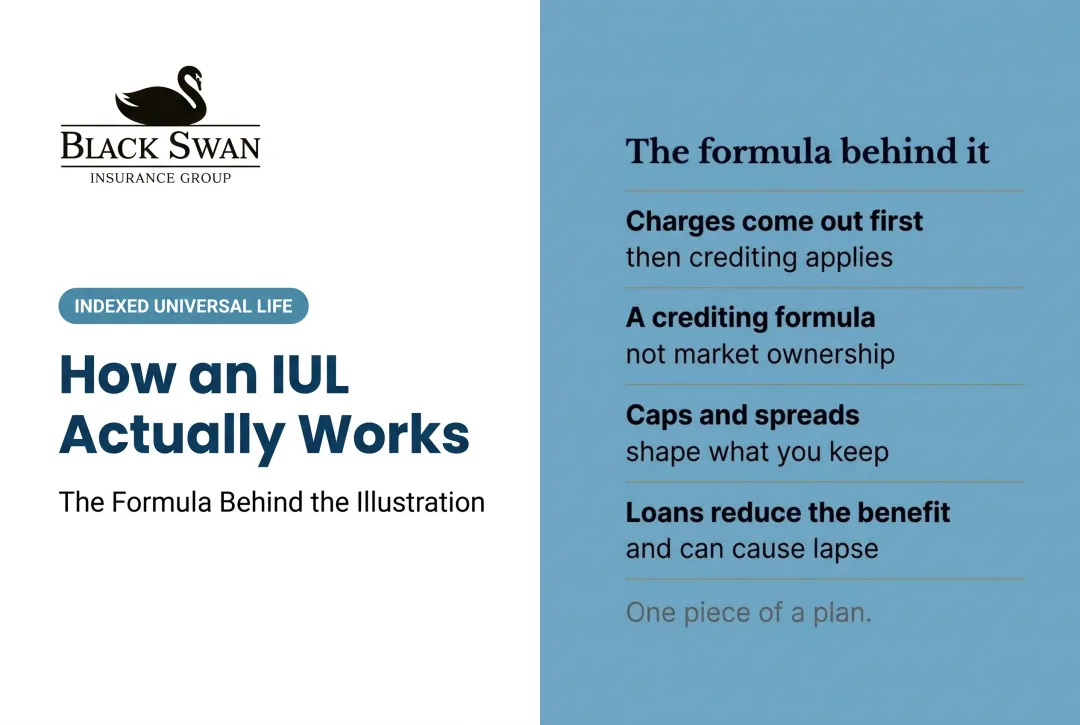
Premiums split several ways. Part covers the cost of insurance, part covers administrative fees and any riders, and the remainder builds cash value. The split depends on your contract — there is no fixed formula across insurers.
Crediting, Worked Through
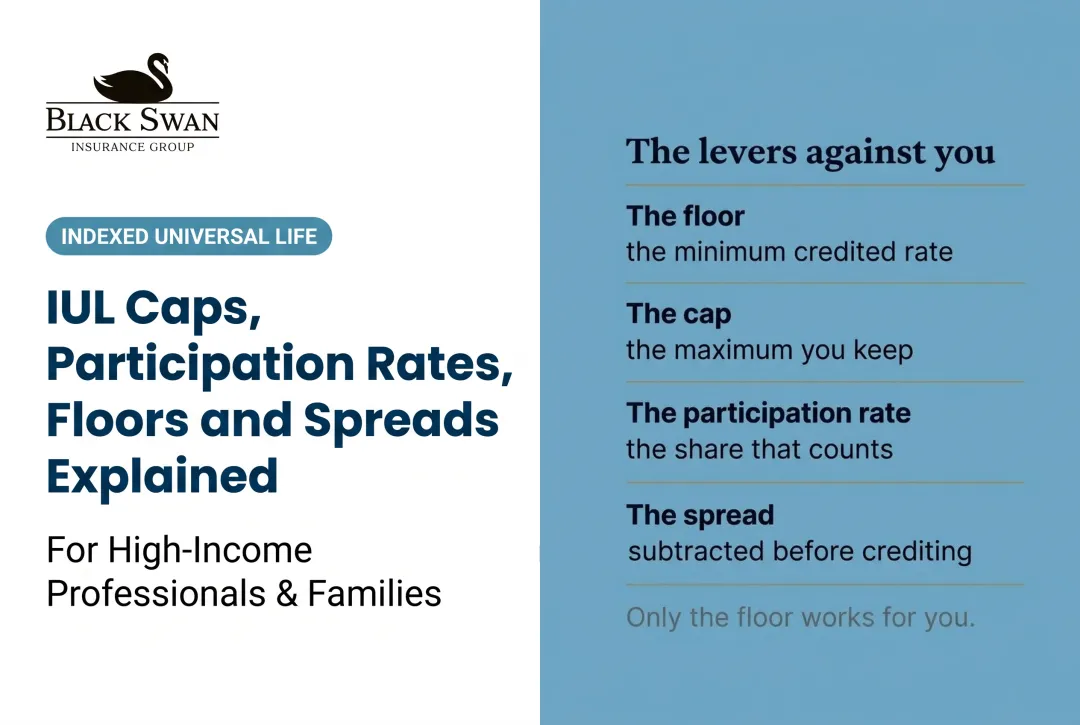
A policy tracking the S&P 500 with a 9% cap and a 0% floor: if the index gains 12%, the policy credits 9% because the cap limits the upside. If the index drops 15%, the floor prevents a negative credit, so you are unlikely to lose cash value from index performance alone that year.
The floor applies only to indexed interest, not to your whole balance. Cost of insurance and administrative fees come out regardless. A 0% floor is not a 0% guarantee on total account value.

- Cap rate — the maximum credited interest in a period
- Participation rate — the percentage of index gains applied toward your credit
- Spread — a percentage subtracted from index gains before crediting
- Floor — the minimum indexed credit, often 0%
Guaranteed Versus Non-Guaranteed
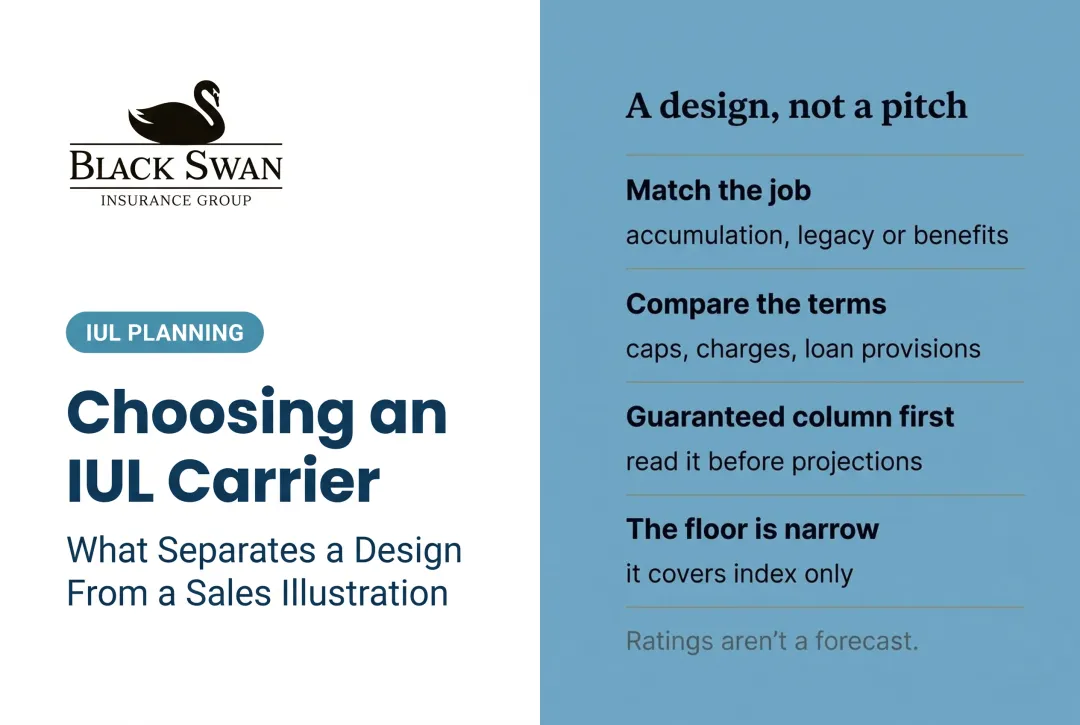
Every illustration shows two sets of numbers. Guaranteed values reflect the contract's minimum interest rate and maximum charges. Non-guaranteed values assume today's caps, participation rates and charges continue unchanged.
NAIC guidance on life insurance illustrations is clear that non-guaranteed elements can change and should not be treated as promises.
Premium and death-benefit flexibility sits alongside those figures. You can often adjust what you pay within limits. Skipping or reducing premiums raises lapse risk when the remaining cash value cannot cover ongoing charges.
Zero is your hero in a down year — but the floor applies to the credit, not to the charges.
What It Costs
There is no universal monthly price for an IUL in South Carolina. Every policy is individually underwritten and modelled on your age, health, coverage amount and design. Anyone quoting a flat number without underwriting is skipping a step.
What drives the premium: age and sex; health history and current conditions; tobacco use; occupation and hobbies, some of which are rated higher; coverage amount and death-benefit option; riders; policy design and intended premium duration; and the planned cash-value funding level.
Four Premium Terms That Get Confused
- Minimum premium — the smallest payment keeping the policy from lapsing in a period
- Planned premium — what you intend to pay on an ongoing basis
- Target premium — often tied to commission structures and guideline limits, not necessarily your ideal funding level
- Overfunding — paying above planned premium to accelerate cash-value growth, within IRS limits
Confirm these definitions against your carrier's illustration, because terminology varies between insurers.
The charges affecting long-term affordability: cost of insurance, premium loads, administrative fees, rider charges, surrender charges and loan interest.
A lower starting premium is not automatically cheaper. If the policy is underfunded, charges rise as illustrated, or extra premiums are needed later to keep it in force, the cheap option costs more.
LIMRA reported that IUL premium reached $3.8 billion in new annualised premium in 2024, up 4% year over year with policy count growing 10% and IUL representing 24% of the U.S. life insurance market. That tells you the product is popular. It tells you nothing about your premium.

Request multiple illustrations modelled for your South Carolina application. Compare guaranteed values, current and alternate crediting scenarios, cumulative premiums, cash surrender value, death benefit and any projected lapse year — side by side, never from a single quote.
What the Critics Get Right
The scepticism this product attracts is largely accurate, and meeting it directly is the only honest approach.
Critics are right that the target premium is tied to commission structures, which is a conflict that should be disclosed rather than discovered. They are right that a lower starting premium is frequently the most expensive choice over thirty years. And they are right that "popularity" data gets used as a substitute for suitability, when growing sales tell you only that distribution is working.
Where the criticism runs out is the coverage need. If your protection requirement genuinely outlasts a term, term insurance eventually stops being available on acceptable terms and something permanent has to carry it. The criticism is then a checklist for choosing well, not a reason to skip the conversation.
Who It Fits
Stronger Fit
- A genuine, ongoing need for permanent life insurance protection
- Household income of $150K+ with stable surplus cash flow beyond emergency savings and retirement contributions
- A long time horizon, typically 15 years or more
- Adequate emergency reserves already in place
- The ability to keep funding through changing financial conditions
What it offers: permanent protection; cash-value accumulation potential tied to an index crediting strategy; premium flexibility within policy guidelines; potential tax-advantaged access to cash value when the policy is properly structured, funded and managed; and death benefits that may pass income-tax-free when policy rules are followed.
Weaker Fit
Not everyone should buy an IUL. The free-look window exists precisely because a meaningful number of these purchases should be undone.
- The cheapest possible temporary coverage is the goal — term insurance wins that outright
- Highly liquid short-term savings are needed
- Cash flow is unstable or unpredictable
- You expect guaranteed, market-like returns
- Nobody intends to monitor the contract
The Ultimate IUL Blueprint
If a permanent need genuinely exists, the Blueprint covers the funding decisions that determine whether it survives: funding levels, the MEC line, index-strategy selection and loan timing.
Loans, Taxes and Lapse
Illustrated performance is non-guaranteed. The pressure points: caps and participation rates can change; cost of insurance rises with age; early-year surrender charges reduce exit flexibility; and underfunding combined with loan interest raises lapse risk without active monitoring.
Policy loans and withdrawals reduce cash value and can reduce the death benefit. Loan interest accrues, and an outstanding loan at lapse or surrender with gain in the contract can create taxable income with no cash received to pay it.

Favourable tax treatment on loans and withdrawals applies only while the policy stays in force and is not a modified endowment contract. Coordinate with a qualified tax professional before assuming any outcome.
Your South Carolina Protections
Suitability hinges on goals, health, cash flow and horizon rather than on which state you live in. A few South Carolina steps still matter before you sign.
Verify the Agent and Insurer
Confirm both the producer and the insurance company are licensed to sell life insurance in South Carolina through the South Carolina Department of Insurance licence search. It takes a few minutes and protects you from someone not authorised to transact business here.
Know Your Free-Look Rights
Under South Carolina Code Section 38-63-220, free-look periods are generally:
- At least 10 days after delivery
- At least 20 days when the policy involves a replacement
- At least 31 days for policies sold through direct-response insurers
Use that window to read the contract, not the illustration. If the guaranteed column is unacceptable, you can still walk away with every dollar back.
Before Committing
Review the insurer's financial-strength ratings from an independent agency; the complaint history through SCDOI's consumer resources; the current cap and participation-rate history for the index accounts you are considering; and the insurer's stated process for changing those crediting terms.

Do not buy the highlight reel. Watch the game film. South Carolina gives you up to 31 days to do exactly that.
Risks to Understand Before You Apply
- Charges continue in a 0% crediting year, so cash value can fall with the floor intact
- Cost of insurance rises with age and is deducted regardless of index performance
- Caps and participation rates are non-guaranteed and can be changed after issue
- The target premium reflects commission structures, not necessarily your right funding level
- A lower starting premium often costs more across the life of the contract
- Surrender charges limit exit flexibility in the early years
- Loans reduce cash value and death benefit, and a lapse with a loan outstanding and gain in the contract creates taxable income
- Crossing the seven-pay limit makes the contract a MEC and changes distribution taxation permanently
- Illustrated values are projections, and only the guaranteed column commits the insurer
Find Out Where You Actually Stand
This starts with the Tax-Free Wealth Blueprint Fit Review. If you earn $150K+ in South Carolina, we read the guaranteed column against the illustration, identify which premium level you were quoted, model reduced funding and an unrepaid loan, and price term plus your existing accounts on identical terms. If it does not fit, we will tell you that too — and the free-look window exists precisely so that conclusion is still actionable after delivery.
Frequently Asked Questions
How much does an IUL cost in South Carolina?
There is no state figure. Every policy is individually underwritten on age, health, coverage amount and design. Ask for multiple illustrations with their assumptions labelled.
How long is the free-look period here?
Generally at least 10 days after delivery, 20 days on a replacement, and 31 days for direct-response sales. Use it to read the contract.
Does the 0% floor protect my cash value?
No. It applies to indexed interest only. Cost of insurance and administrative charges come out regardless, so total account value can fall in a flat year.
What is the target premium?
A carrier benchmark often tied to commission structures and guideline limits. It is not necessarily your ideal funding level, and confusing the two is a common and expensive error.
How do I verify a carrier or agent?
Through the South Carolina Department of Insurance licence search, plus independent financial-strength ratings and the complaint history via SCDOI's consumer resources.
Should I buy term insurance instead?
If the protection need has an end date, yes. Term is cheaper and simpler, and it deserves pricing before anyone designs a permanent policy for you.
Sources
- South Carolina Code § 38-63-220 — free-look provisions
- South Carolina Department of Insurance — licence search
- NAIC — Life Insurance Illustrations
- LIMRA 2024 life insurance premium data, via InsuranceNewsNet
- I.R.C. § 7702A and Rev. Proc. 2008-39 (modified endowment contracts and the seven-pay test)
Disclosure: This article is educational and is not personal tax, legal or investment advice. Indexed universal life is life insurance first. State rules, carrier product availability and licensing requirements change; confirm current details before applying. Actual results depend on policy design, carrier, crediting options, caps, participation rates, expenses, funding and ongoing management. Policy loans and withdrawals may reduce cash value and death benefit and can create tax consequences if the policy lapses or becomes a modified endowment contract. This strategy is not appropriate for everyone. Illustrated values are not guarantees; actual results depend on policy terms, crediting, costs and funding. Consult your own tax, legal and financial professionals for advice specific to your situation.
And remember, it's not what you earn, it's what you keep… enjoy the ride.