By Robert Balgac, Founder, Black Swan Insurance Group | October 5, 2026
Two policies with identical cash value can produce completely different outcomes from the same loan, because the loan type changes what happens to the money you borrowed against. Most owners are never asked to choose. The choice is made at issue, buried in the application, and surfaces fifteen years later when the balance is doing something unexpected.
If you earn $150K+ and a policy loan is part of why you funded the contract, this is the mechanic to understand before the money moves.
The short answer: A fixed loan charges a stated rate and typically moves the borrowed amount into a declared-rate account, so the spread between what you are charged and what you are credited is small and predictable. An indexed or participating loan charges a rate while leaving the borrowed amount in the indexed account, so it can be credited more than the loan costs — or far less. The second option adds leverage and, in a flat decade, works against you.
Key Takeaways
- Fixed loans are predictable; indexed loans add a spread bet on top of a debt
- With an indexed loan, a zero-credit year still carries the full loan charge, so the balance grows against a static account
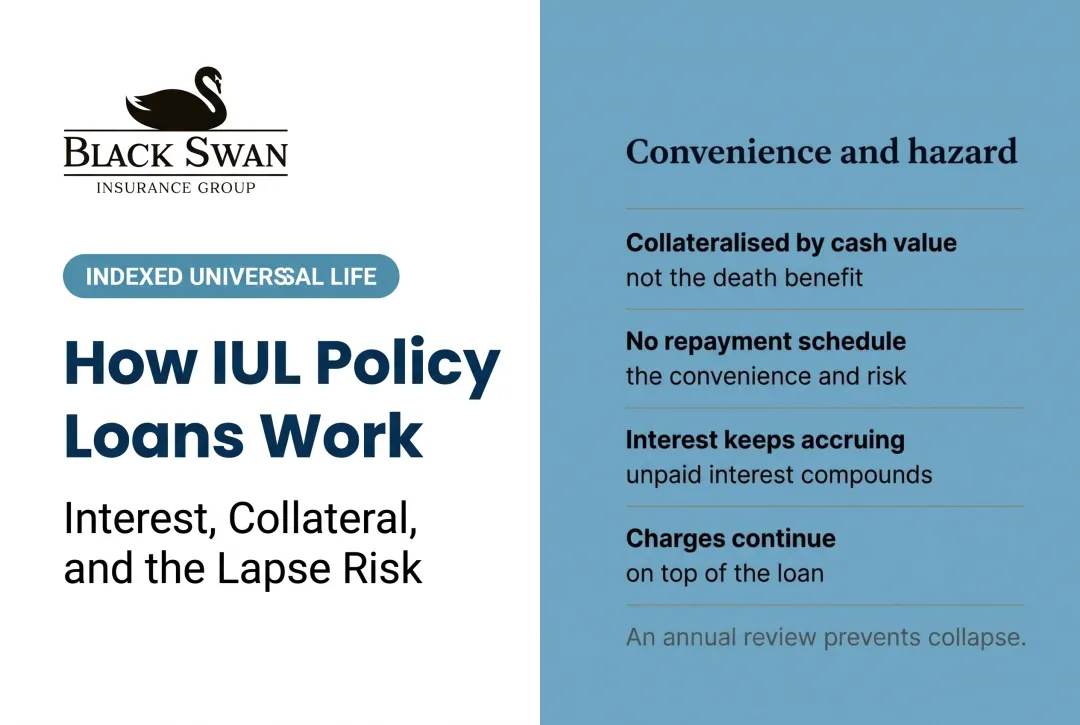
- Loan interest accrues whether or not you pay it, and insurance charges continue on top
- The loan rate itself may be adjustable within contract limits — check whether yours is fixed for life
- Model both loan types under a flat decade before deciding; that is when the difference becomes obvious
How the Two Loan Types Differ
An IUL is permanent life insurance first, and a policy loan is real borrowing secured by cash value. Any potential tax-advantaged access depends on the policy being properly structured, funded and managed.
Fixed Loans
The carrier charges a stated rate. The amount you borrowed is usually transferred to a fixed or declared-rate account inside the policy, where it earns a lower, stated rate. Your net cost is the difference. Some carriers offer a wash loan in later policy years, where the charged rate and the credited rate are equal or nearly so.
The advantage is predictability. You know your cost. The disadvantage is that the borrowed amount no longer participates in index crediting.
Indexed or Participating Loans
The carrier charges a rate, often higher than the fixed option, and leaves the borrowed amount in the indexed account where it continues to be credited under the normal formula.
In a strong index year, the credit can exceed the loan charge and the arrangement gains. In a flat or down year, you are credited zero and charged the full loan rate. The balance grows while the account does not.

The loan is not the problem. The unmanaged loan is the problem — and an indexed loan is the version that punishes inattention hardest.
The Arithmetic That Matters
Consider the same borrowed amount under both structures across a decade containing three zero-credit years. The fixed loan produces a known, modest drag. The indexed loan produces a gain in the good years and a compounding shortfall in the flat ones, and because the shortfall applies to a balance that keeps growing, the order of those years matters.
This is sequence risk applied to debt rather than to withdrawals, and it is why an illustration showing a steady credited rate every year is particularly misleading for a participating loan.
What Determines Your Actual Cost
- The charged rate, and whether it is fixed for the life of the contract or adjustable within limits
- The credited rate on the borrowed portion, which differs entirely between the two structures
- Whether interest is paid or capitalised, because unpaid interest compounds into the balance
- Ongoing policy charges, which continue regardless and are not part of the loan calculation
- Funding after the loan, since a policy still receiving premium carries a balance far more comfortably
What the Critics Get Right
Critics are right that participating loans are sold on their best case and rarely stress-tested, and that the phrase "borrow at 5%, earn 8%" describes an outcome rather than a mechanism. They are right that an owner who never receives an annual review will not notice the balance outrunning the account until the carrier sends a lapse warning.
Where the criticism overreaches is in treating all policy loans as traps. A fixed loan against a well-funded policy, taken deliberately with a repayment intention, is an ordinary liquidity decision.

Compare It Against the Alternatives
- A HELOC — usually cheaper, secured against the property, with a formal repayment schedule
- A 401(k) loan — fixed repayment terms, and the balance may come due if you leave the employer
- A securities-based line of credit — competitive rates, margin call risk
- Cash reserves — the cheapest option, and the reason an emergency fund comes first
- Term insurance plus a brokerage account — cheaper protection and liquidity without any loan mechanics at all
Reading Your Contract's Loan Provisions
The loan section of a policy is usually two or three pages and almost never discussed at the point of sale. These are the clauses that matter.
The stated rate and whether it is fixed or adjustable. Some contracts fix the loan rate for life. Others allow adjustment within a stated maximum. A policy priced on a 5% loan rate behaves differently at the contractual maximum, and that maximum is the number to plan around.
How interest is charged — in advance or in arrears. Interest charged in advance is deducted at the start of the policy year on the projected balance, which costs more than it first appears.
What happens to the borrowed amount. Confirm in writing whether it moves to a declared-rate account (fixed loan) or remains in the indexed account (participating loan). This single detail changes the arithmetic more than the headline rate does.
The termination trigger. Most contracts terminate when policy debt exceeds accumulated value less surrender charges. Find the exact formula in your contract; it varies, and it determines how much room you actually have.
Repayment mechanics. Whether partial repayments are applied to interest or principal first, and whether there is any restriction on repaying.
Panic is not a strategy. But neither is blind trust. Read the loan provisions before you need them.
The Ultimate IUL Blueprint
A plain-English walkthrough of loan types, rate mechanics, and what to ask before you borrow against a policy.
Who Each Loan Type May Fit
Stronger Fit
- Fixed loan — anyone who wants a known cost, or who is taking income in retirement and cannot absorb variability
- Indexed loan — a well-funded policy, a long horizon, an owner who reviews annually and can repay if the spread turns against them
- $150K+ stable income with the capacity to service interest rather than capitalise it
- A defined purpose and a written repayment intention
- Comfort with a reduced death benefit while the balance is outstanding
Weaker Fit
Not everyone should buy an IUL, and nobody should choose a participating loan on the strength of a smooth illustration. If a flat decade would break the arrangement, it is the wrong structure.
- Thin cash value, or an existing large balance
- No repayment intention and no annual review habit
- Income that could interrupt premium payments
- A cheaper secured option already available
Risks to Understand Before You Borrow
- Interest accrues whether or not you pay it, and unpaid interest compounds into the balance.
- Insurance charges continue regardless of the loan and are deducted on top.
- An indexed loan can be charged more than the account is credited, and in a flat year that gap is the full loan rate.
- The charged rate may be adjustable within contract limits on some products.
- Lapse risk rises when debt plus accruing interest outpaces available value and funding.
- A lapse or surrender with gain and an outstanding loan can create taxable income with no cash received to pay it. MEC contracts are taxed last-in-first-out with a possible 10% additional federal tax before 59½.
Find Out Where You Actually Stand
Start with the Tax-Free Wealth Blueprint Fit Review. If you earn $150K+ and are choosing between loan types or already carrying a balance, we model both structures across a decade with zero-credit years included and show what each does to the death benefit and lapse risk. If IUL does not fit, we will tell you that too.
Frequently Asked Questions
What interest rate do IUL policy loans charge?
It varies by carrier, product and loan type, and some rates are adjustable within contract limits. Ask for your contract's stated rate and whether it can change.
Is a fixed or indexed policy loan better?
Fixed is predictable. Indexed can outperform in strong index years and underperform badly in flat ones. Which is better depends on funding, horizon and your tolerance for variability.
Do I pay interest if I never repay the loan?
Yes. Interest accrues regardless and is typically added to the balance, which then accrues further interest.
Can the loan rate change after I buy?
On some products, within the limits written into the contract. Confirm whether yours is fixed for life or adjustable.
What is a wash loan?
An arrangement where the rate charged and the rate credited on the borrowed amount are equal or nearly equal, often available only in later policy years.
What happens if the loan grows too large?
If debt plus interest exceeds available value, the policy can terminate. If there is gain in the contract, that can produce a taxable event with no cash attached.
Sources
- NAIC — Life Insurance — policy loan definitions and cash value
- National Life Group — loan mechanics and processing
- NAIC, Life Insurance Illustrations Model Regulation (Model #582) — non-guaranteed element disclosure
- I.R.C. § 7702A — Modified Endowment Contract and the seven-pay test
- I.R.C. § 72 — additional tax on early distributions
Disclosure: The information on this page is educational in nature and does not constitute personalized financial, tax, or legal advice. Actual results depend on policy design, carrier, crediting options, caps, participation rates, expenses, funding, loans, and ongoing management. Policy loans and withdrawals reduce cash value and the death benefit, and can create tax consequences if the policy lapses or becomes a modified endowment contract. Consult a licensed insurance professional and, where appropriate, a tax or financial advisor before making any insurance or financial decision. Indexed universal life is life insurance first. Illustrated values are not guarantees; actual results depend on policy terms, crediting, costs and funding. This strategy is not appropriate for everyone.
And remember, it's not what you earn, it's what you keep… enjoy the ride.